Conjugate Acid-Base Pairs and the Ka-Kb Relationship
Almost every Class 11 ionic equilibrium question hides one idea: an acid and the base left behind after it gives away H+ are a pair, and their strengths are linked by a single equation. If you understand conjugate pairs, you can find the Kb of an anion from the Ka of its acid, decide which side of an equilibrium is favoured, and calculate the pH of a salt solution. This page explains the pair idea, the Ka × Kb = Kw relation, and four worked examples with every step shown.

What is a conjugate acid-base pair?
In the Brønsted-Lowry picture, an acid is a proton (H+) donor and a base is a proton acceptor. When an acid donates H+, what remains can take the proton back, so it is a base. The two species differ by exactly one H+. Such a pair is called a conjugate acid-base pair.
HA + H2O ⇄ A− + H3O+ Ka = [H3O+][A−] ÷ [HA]
A− + H2O ⇄ HA + OH− Kb = [HA][OH−] ÷ [A−]
Ka × Kb = Kw pKa + pKb = pKw
Here Ka is the acid dissociation constant of the acid HA, and Kb is the base constant of its conjugate base A−. Kw is the ionic product of water. At 25 °C, Kw = 1.0 × 10⁻¹⁴ and pKw = 14. Kw changes with temperature, so the value 14 holds only near 25 °C. The relation is true only when Ka and Kb belong to the same pair.
Common pairs to remember
| Acid | Conjugate base | Remark |
|---|---|---|
| HCl | Cl− | Strong acid, so the conjugate base is extremely weak |
| CH3COOH | CH3COO− | Weak acid, weak base |
| H2O | OH− | Water acts as an acid here |
| H3O+ | H2O | Water acts as a base here |
| NH4+ | NH3 | Weak acid, weak base |
| H2CO3 | HCO3− | HCO3− is also an acid; its own conjugate base is CO32− |
Notice that water appears on both sides of the table. A species that can act as an acid or as a base is called amphiprotic. The rule to apply is simple: to get the conjugate base, remove one H+; to get the conjugate acid, add one H+. The charge changes by one unit each time.
The strength rule
The stronger the acid, the weaker its conjugate base, and the other way round. This follows directly from Ka × Kb = Kw: if Ka is large, Kb must be small because their product is fixed. A strong acid such as HCl gives Cl−, which has no useful tendency to take a proton back from water, so a chloride solution is neutral. A weak acid gives a conjugate base that is weak but real, and it does make the solution slightly basic.
Worked example 1: naming the pairs
Question. In the reaction NH3 + H2O ⇄ NH4+ + OH−, identify the two conjugate pairs.
Step 1. NH3 gains H+ to become NH4+. So NH3 is the base and NH4+ is its conjugate acid.
Step 2. H2O loses H+ to become OH−. So H2O is the acid and OH− is its conjugate base.
Check. Each pair differs by one H+: NH4+/NH3 and H2O/OH−. The H and the charge balance on both sides.
Worked example 2: Ka of the ammonium ion
Question. The Kb of ammonia is 1.8 × 10⁻⁵ at 25 °C. Find Ka and pKa of NH4+.
Formula. Ka = Kw ÷ Kb.
Calculation. Ka = 1.0 × 10⁻¹⁴ ÷ 1.8 × 10−5 = 5.56 × 10⁻¹⁰.
pKa = −log(5.56 × 10⁻¹⁰) = 9.26.
Cross-check. pKb of ammonia = −log(1.8 × 10⁻⁵) = 4.74. Then pKa + pKb = 9.26 + 4.74 = 14.00, as it should be.
Worked example 3: pH of sodium acetate solution
Question. Ka of acetic acid is 1.8 × 10⁻⁵. Find the pH of 0.10 M sodium acetate at 25 °C.
Step 1: find Kb of the acetate ion. Kb = 1.0 × 10⁻¹⁴ ÷ 1.8 × 10−5 = 5.56 × 10⁻¹⁰.
Step 2: write the equilibrium. CH3COO− + H2O ⇄ CH3COOH + OH−. Let [OH−] = x. Then x2 ÷ (0.10 − x) = 5.56 × 10⁻¹⁰.
Step 3: approximate. x is very small compared with 0.10, so x2 = 5.56 × 10−10 × 0.10 = 5.56 × 10⁻¹¹. Hence x = 7.45 × 10⁻⁶ M.
Step 4: convert. pOH = −log(7.45 × 10⁻⁶) = 5.13. pH = 14 − 5.13 = 8.87.
Check. Solving the quadratic exactly gives x = 7.453 × 10⁻⁶ and the same pH of 8.87, so the approximation is safe. The answer is above 7, which agrees with a salt of a weak acid and a strong base.
Worked example 4: which direction is favoured?
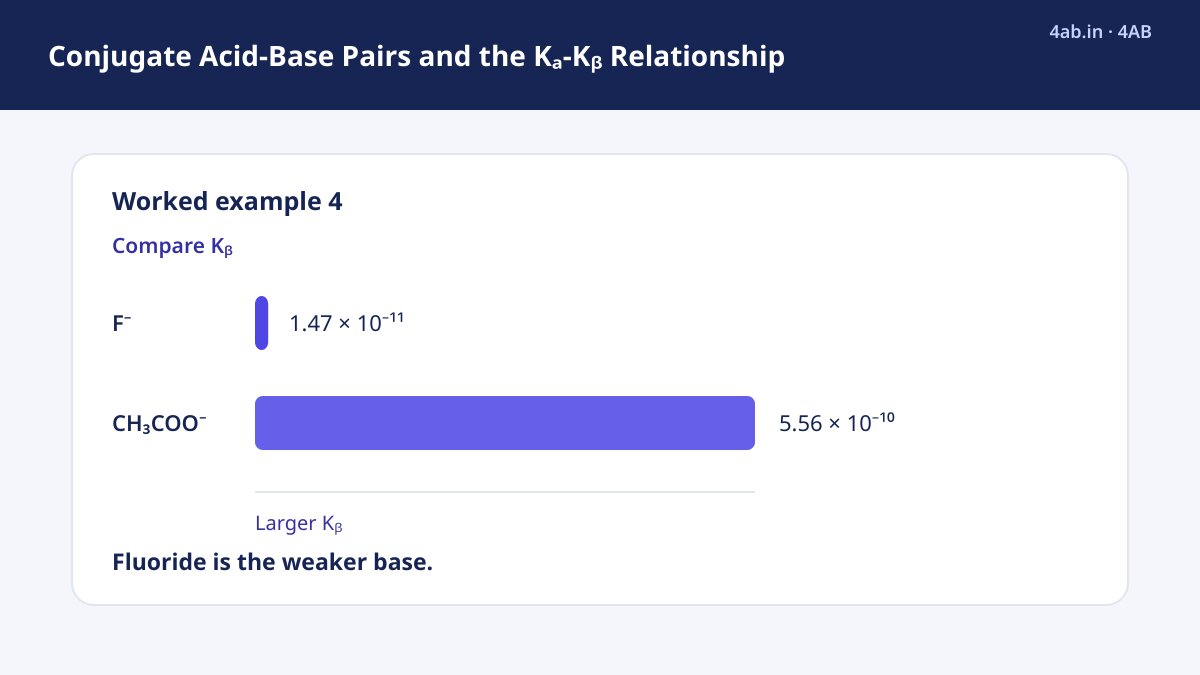
Question. Hydrofluoric acid has Ka = 6.8 × 10⁻⁴. Is F− a stronger or weaker base than CH3COO−?
Calculation. Kb(F−) = 1.0 × 10⁻¹⁴ ÷ 6.8 × 10−4 = 1.47 × 10⁻¹¹. For acetate, Kb = 5.56 × 10⁻¹⁰.
Conclusion. 1.47 × 10⁻¹¹ is smaller than 5.56 × 10⁻¹⁰, so fluoride is the weaker base. This agrees with the rule: HF is the stronger acid (larger Ka), so its conjugate base is weaker. In any acid-base reaction, the equilibrium lies on the side of the weaker acid and weaker base.
Common mistakes
- Adding or removing the wrong particle. A conjugate pair differs by one H+ only. The conjugate base of H2SO4 is HSO4−, not SO42−.
- Using Ka × Kb = Kw for unrelated species. The two constants must belong to the same pair, such as NH4+ and NH3.
- Forgetting that the charge changes. Removing H+ lowers the charge by one. Check that the charges balance on both sides.
- Calling the conjugate base of a strong acid a base. Cl−, Br− and NO3− do not change the pH of water.
- Using pKw = 14 at every temperature. It is a 25 °C value. If the question gives another temperature or another Kw, use that.
Where this is used in school exams
| Question type | What you use |
|---|---|
| Identify conjugate pairs in a reaction | Add or remove one H+ |
| Compare strengths of bases | Stronger acid → weaker conjugate base |
| Kb of an anion or Ka of a cation | Ka × Kb = Kw |
| pH of a salt of a weak acid or base | Hydrolysis of the conjugate species |
Textbooks and boards differ in the number of significant figures they expect and in the Ka values they print, so use the constants given in your own book or paper.
Use the pH tool to check the pH values from the salt-hydrolysis example.
Open the pH / pOH Calculator →Previous-year CSIR-NET questions and timed quizzes to check what you just read.
More Exam guides articles