Degree of Dissociation from Vapour Density: PCl5 and N2O4
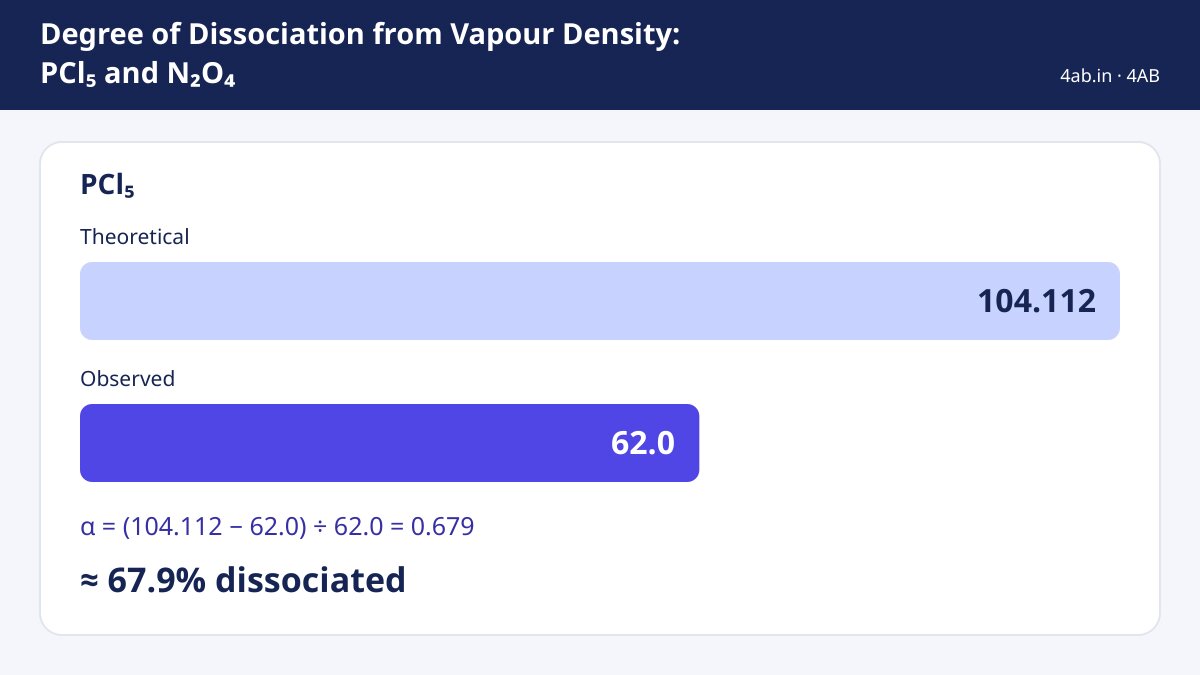
Some gases split into smaller molecules when they are heated. Phosphorus pentachloride breaks into PCl3 and Cl2. Dinitrogen tetroxide breaks into two NO2 molecules. Because one molecule becomes two, the number of moles of gas goes up, and so the gas becomes less dense. If we measure the density of the gas mixture, we can find out how much of the gas has dissociated. This is a favourite Class 11 equilibrium numerical, and the whole method fits on five lines.

The key idea
Vapour density is the density of a gas compared with hydrogen under the same conditions. It equals half of the molar mass: vapour density = M ÷ 2. When a gas dissociates, the total mass stays the same but the number of moles increases. So the average molar mass of the mixture falls, and the vapour density falls with it.
α = (D − d) ÷ [(n − 1) × d]
D = theoretical vapour density (before any dissociation) = M ÷ 2
d = observed vapour density of the equilibrium mixture
n = number of moles of products formed from 1 mole of reactant
For both reactions in this article n = 2, so the formula becomes simply α = (D − d) ÷ d.
Where the formula comes from
Start with 1 mol of PCl5. If a fraction α dissociates, then at equilibrium:
| PCl5 | PCl3 | Cl2 | Total moles | |
|---|---|---|---|---|
| Start | 1 | 0 | 0 | 1 |
| Equilibrium | 1 − α | α | α | 1 + α |
The mass of gas is unchanged, so the volume (or the number of moles) rises in the ratio (1 + α) : 1. Density is mass divided by volume, so density falls in the ratio 1 : (1 + α). Hence d = D ÷ (1 + α), and rearranging gives α = (D − d) ÷ d. The same argument works for the molar mass: Mobserved = M ÷ (1 + α).
Worked examples
Example 1: PCl5 from observed vapour density. At a certain temperature the vapour density of an equilibrium mixture of PCl5, PCl3 and Cl2 is found to be 62.0. Find the degree of dissociation.
Molar mass of PCl5 = 30.974 + 5 × 35.45 = 30.974 + 177.25 = 208.224 g mol−1.
Theoretical vapour density D = 208.224 ÷ 2 = 104.112.
α = (D − d) ÷ d = (104.112 − 62.0) ÷ 62.0 = 42.112 ÷ 62.0 = 0.679, i.e. about 67.9 % dissociated.
Check by the molar-mass route: Mobs = 2 × 62.0 = 124.0 g mol−1. Using Mobs = M ÷ (1 + α): 208.224 ÷ 1.679 = 124.0. It matches.
Example 2: N2O4 ⇌ 2NO2. The observed vapour density of a N2O4 sample at a higher temperature is 38.3. Find α.
Molar mass of N2O4 = 2 × 14.007 + 4 × 15.999 = 28.014 + 63.996 = 92.010 g mol−1.
D = 92.010 ÷ 2 = 46.005.
α = (46.005 − 38.3) ÷ 38.3 = 7.705 ÷ 38.3 = 0.201, about 20.1 %.
Check: total moles = 1 + α = 1.201. Mobs = 92.010 ÷ 1.201 = 76.6, so d = 38.3. Correct.
Example 3: the reverse question. PCl5 is 40 % dissociated (α = 0.40). What vapour density would you measure?
d = D ÷ (1 + α) = 104.112 ÷ 1.40 = 74.4.
Check: the mean molar mass is 2 × 74.4 = 148.7, and 208.224 ÷ 1.40 = 148.7. Both routes agree.
Example 4: from α to Kp. Use α = 0.679 from Example 1, with total pressure P = 1 atm.
Mole fractions at equilibrium: PCl5 = (1 − α) ÷ (1 + α), PCl3 = Cl2 = α ÷ (1 + α). So
Kp = α2 P ÷ (1 − α2).
α2 = 0.679232 = 0.4614 (carry the unrounded α here). So Kp = 0.4614 × 1 ÷ (1 − 0.4614) = 0.4614 ÷ 0.5386 = 0.857 (no unit shown here because P is taken as 1 atm; strictly the unit is atm).
Now raise the pressure to 2 atm at the same temperature. Kp is unchanged, so α2 = Kp ÷ (Kp + P) = 0.857 ÷ 2.857 = 0.2999, so α = 0.548. Dissociation falls when pressure rises, exactly as Le Chatelier’s principle predicts, because the reaction produces more moles of gas.
For N2O4 ⇌ 2NO2 the expression changes to Kp = 4α2P ÷ (1 − α2). With α = 0.201 and P = 1 atm this gives 4 × 0.0404 ÷ 0.9596 = 0.168 (about 0.17). Always rebuild the expression from the mole-fraction table; do not copy it from another reaction.
What if more than two moles form?
The general formula has (n − 1) in the denominator. If 1 mole splits into 3 moles (for example some ammonium-salt type decompositions in textbook problems), n = 3 and α = (D − d) ÷ 2d. The total moles at equilibrium are 1 + (n − 1)α. Write the table first and the formula follows.
Common mistakes
- Using the observed vapour density as D. D is always the theoretical value, calculated from the formula of the undissociated gas.
- Forgetting that vapour density is M ÷ 2, and writing D = 208.224 instead of 104.112.
- Putting (n − 1) wrongly. For PCl5 and N2O4, n = 2, so (n − 1) = 1.
- Giving α as a percentage and then using it as 67.9 instead of 0.679 inside Kp.
- Using the total moles as 1 − α. The total is 1 + α for these reactions.
- Expecting α to be unchanged when the pressure changes. Kp stays fixed, α does not.
Where this appears in exams
| Topic | How it is used |
|---|---|
| Class 11 equilibrium | Degree of dissociation, Kp and Kc from α, effect of pressure |
| Class 11 mole concept | Vapour density, molar mass and mean molar mass of a mixture |
| Competitive entrance exams | The same numerical with a changed reaction; check the current official syllabus for the expected depth |
Keep the reaction table in every answer. It earns method marks even if a calculation slip changes the final number.
Do the divisions step by step and keep the reaction table beside you. A calculator helps with the arithmetic, but the setup is yours.
Open the Chemistry Calculator Suite →Turn this concept into marks: solve previous-year CSIR-NET questions and take a timed quiz.
More Concepts articles