Electrochemical Series: Will a Redox Reaction Occur?
One of the most useful skills in electrochemistry is to look at a table of standard electrode potentials and say, in ten seconds, whether a reaction will happen. Will zinc displace copper from copper sulphate? Will copper dissolve in dilute hydrochloric acid? Will Fe3+ oxidise iodide? This page shows the method, with four worked examples.

Standard electrode potentials and the electrochemical series
A standard reduction potential, E°, measures how strongly a species gains electrons, compared with the standard hydrogen electrode (SHE), which is fixed at 0.00 V. Standard conditions are 1 M concentration, 1 bar pressure and 298 K. When half-reactions are arranged in order of E°, the list is called the electrochemical series. Values below are the commonly used textbook values; a few books differ in the second decimal place, so use the table printed in your own textbook.
| Half-reaction (reduction) | E° (V) |
|---|---|
| Mg2+ + 2e− → Mg | −2.36 |
| Zn2+ + 2e− → Zn | −0.76 |
| Fe2+ + 2e− → Fe | −0.44 |
| 2H+ + 2e− → H2 | 0.00 |
| Cu2+ + 2e− → Cu | +0.34 |
| I2 + 2e− → 2I− | +0.54 |
| Fe3+ + e− → Fe2+ | +0.77 |
| Ag+ + e− → Ag | +0.80 |
| Cl2 + 2e− → 2Cl− | +1.36 |
How to read it: the species on the left of a half-reaction with a more positive E° is a stronger oxidising agent (it gains electrons easily). The metal on the right with a more negative E° is a stronger reducing agent (it gives up electrons easily). So Mg is a very strong reducing agent and Cl2 is a strong oxidising agent.
E°cell = E°(cathode) − E°(anode)
Reaction is spontaneous (as written) if E°cell > 0
ΔG° = −nFE°cell (F = 96485 C/mol)
The method in four steps
- Split the proposed reaction into two half-reactions: one reduction (the species gaining electrons, the cathode) and one oxidation (the species losing electrons, the anode).
- Look up E° for both as reduction potentials. Do not change the sign of the oxidation half-reaction at this stage.
- Compute E°cell = E°(cathode) − E°(anode). Do not multiply E° by the number of electrons; E° is an intensive quantity.
- If E°cell is positive, the reaction goes as written under standard conditions. If negative, the reverse reaction is the spontaneous one.
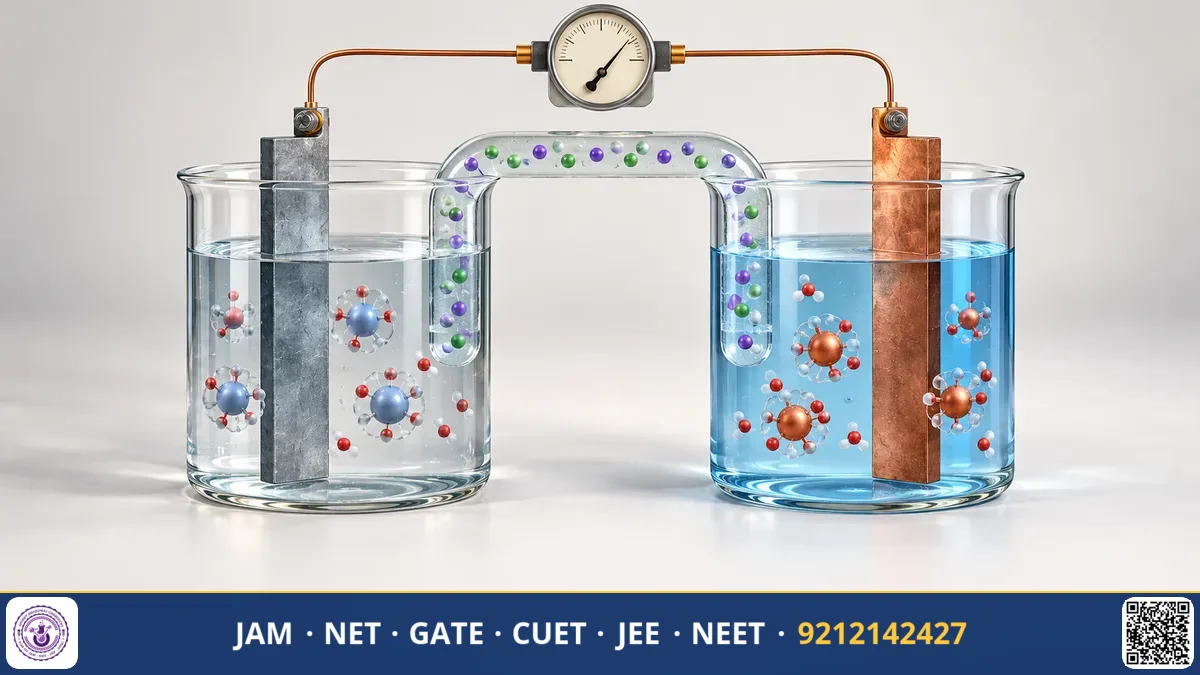
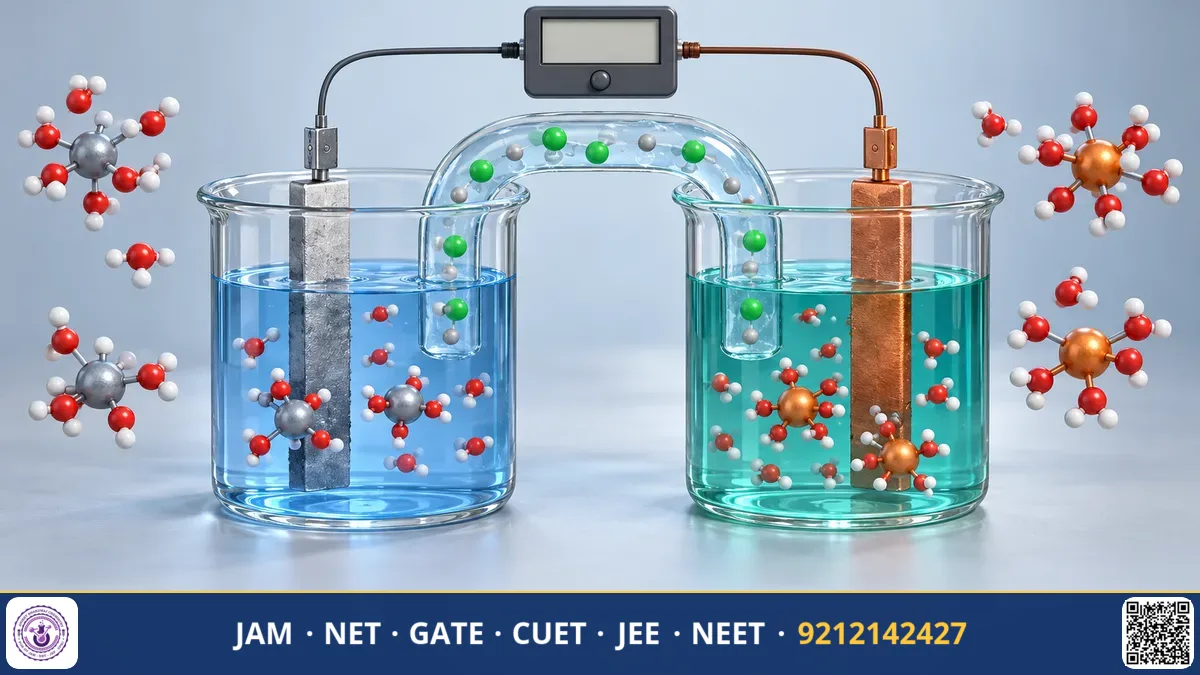
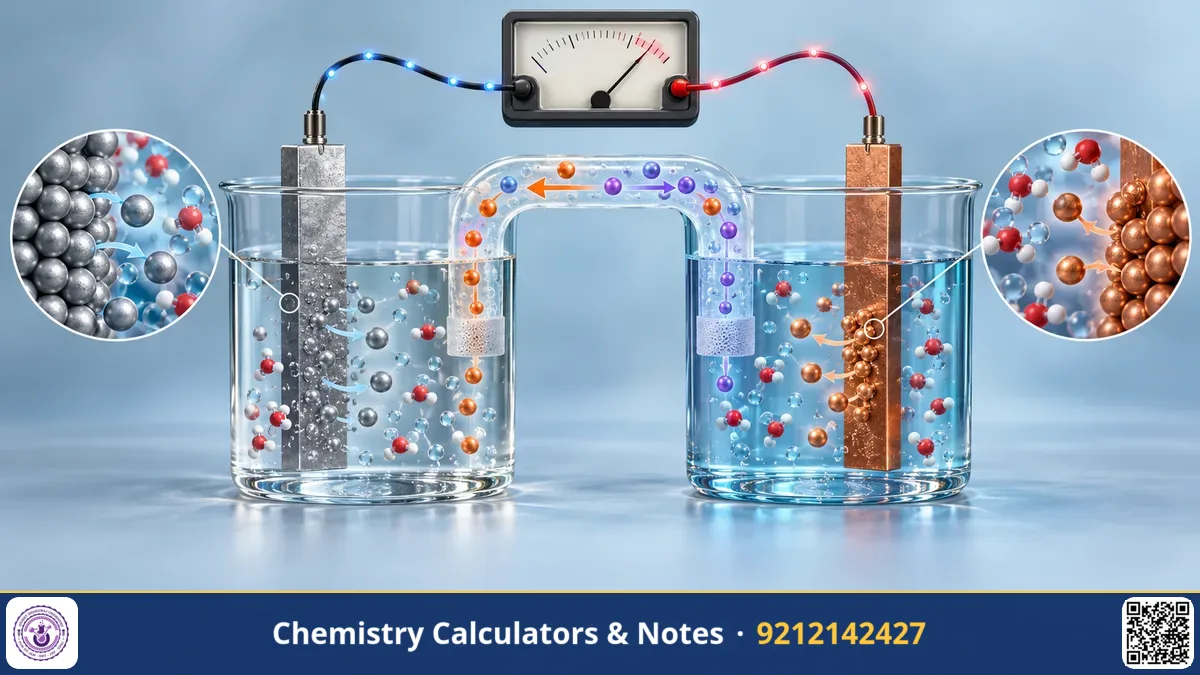
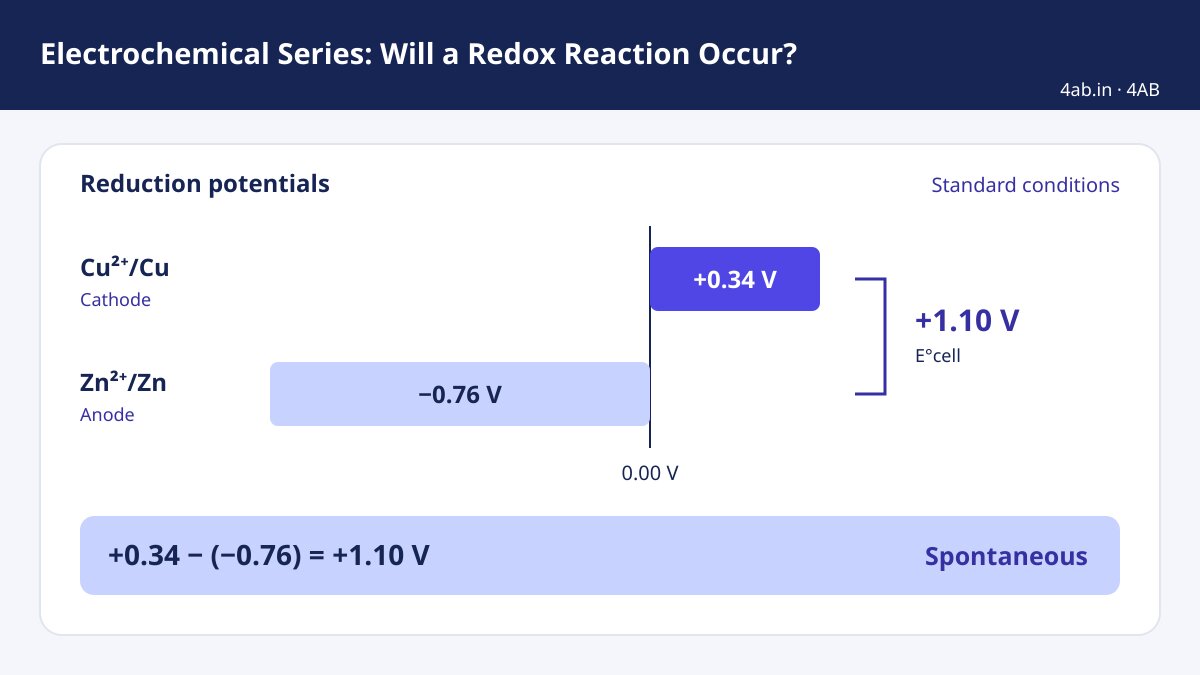
Example 1: zinc in copper sulphate. Does Zn + Cu2+ → Zn2+ + Cu occur? Find E°cell and ΔG°.
Cathode (reduction): Cu2+/Cu, E° = +0.34 V. Anode (oxidation): Zn/Zn2+, E° = −0.76 V.
E°cell = 0.34 − (−0.76) = +1.10 V, so it is spontaneous.
n = 2 electrons. ΔG° = −2 × 96485 × 1.10 = −212267 J = −212 kJ/mol.
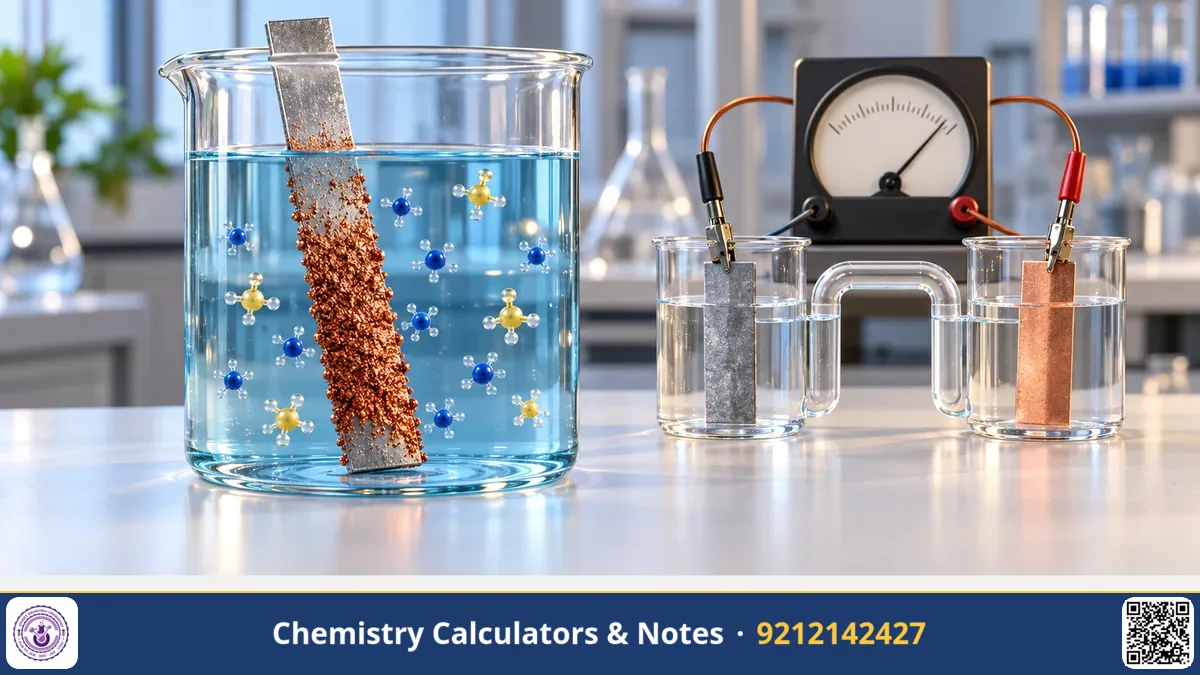
This is why a zinc rod gets coated with red-brown copper when dipped in copper sulphate solution.
Example 2: which way does the displacement go? (a) Will copper displace silver from silver nitrate? (b) Will copper displace zinc from zinc sulphate?
(a) Cu + 2Ag+ → Cu2+ + 2Ag. Cathode Ag+/Ag = +0.80 V, anode Cu/Cu2+ = +0.34 V. E°cell = 0.80 − 0.34 = +0.46 V, spontaneous. ΔG° = −2 × 96485 × 0.46 = −88766 J, about −88.8 kJ per mole of reaction as written. (Each Ag+ needs one electron, but the equation as written transfers 2, so n = 2.)
(b) Cu + Zn2+ → Cu2+ + Zn. Cathode Zn2+/Zn = −0.76 V, anode Cu/Cu2+ = +0.34 V. E°cell = −0.76 − 0.34 = −1.10 V, not spontaneous. The reverse (Example 1) is.
Example 3: metals and dilute acid; and an oxidation of iodide. (a) Does Cu dissolve in dilute HCl, releasing hydrogen? (b) Does Fe3+ oxidise I− to I2?
(a) Cu + 2H+ → Cu2+ + H2. Cathode H+/H2 = 0.00 V, anode Cu = +0.34 V. E°cell = 0.00 − 0.34 = −0.34 V: no reaction. Copper lies above hydrogen in the series and does not release H2 from dilute acids. By the same method, Zn gives 0.00 − (−0.76) = +0.76 V, so zinc does react.
(b) 2Fe3+ + 2I− → 2Fe2+ + I2. Cathode Fe3+/Fe2+ = +0.77 V, anode I2/I− = +0.54 V. E°cell = 0.77 − 0.54 = +0.23 V: yes, it is spontaneous.
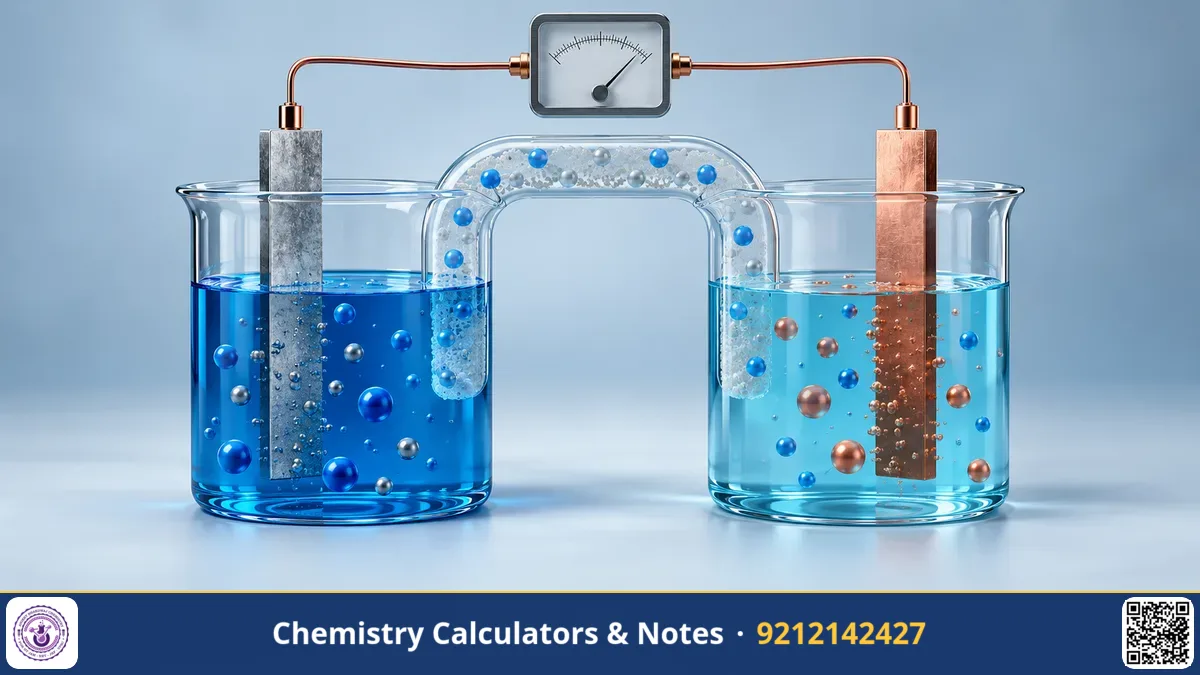
Example 4: when concentrations are not 1 M. A cell Zn | Zn2+ (0.10 M) || Cu2+ (0.010 M) | Cu has E°cell = 1.10 V. Find Ecell at 298 K.
Nernst equation: E = E° − (0.0592/n) log Q, where Q = [Zn2+]/[Cu2+] = 0.10/0.010 = 10 and n = 2.
E = 1.10 − (0.0592/2) × log 10 = 1.10 − 0.0296 × 1 = 1.07 V (1.0704).
The cell is still spontaneous. Standard values are a guide; for a reaction with a small E°cell, concentrations can change the verdict.
Common mistakes
- Flipping the sign of E° for the cathode too, or taking E°cell = E°(anode) − E°(cathode). Always cathode minus anode, using reduction potentials.
- Multiplying E° by the number of electrons when balancing. E° stays the same; only ΔG° depends on n.
- Calling a positive E°cell a guarantee of fast reaction. E° shows direction, not speed; some spontaneous reactions are extremely slow.
- Using E° for a reaction that is not at standard conditions. Use the Nernst equation (Example 4).
- Mixing up “more negative E°” with “stronger oxidising agent”. A more negative E° means a stronger reducing agent.
Quick reference
| Question | Rule |
|---|---|
| Will metal M displace metal N from its salt? | Yes if E°(Mn+/M) is more negative than E°(Nn+/N) |
| Will metal M release H2 from dilute acid? | Yes if E°(Mn+/M) is below 0.00 V |
| Is a redox reaction spontaneous? | E°cell = E°cathode − E°anode > 0 |
| Free energy change | ΔG° = −nFE°cell |
| Non-standard conditions | E = E° − (0.0592/n) log Q at 298 K |
In board and entrance-style questions, always write the two half-reactions and label cathode and anode before you subtract. For the exact table of E° values used in your syllabus, check the textbook or official data sheet provided with your exam.
Test a cell under non-standard concentrations: enter E°, n and the concentrations and compare the Nernst result with your working.
Open the Nernst Equation Calculator →Reaction mechanisms stick only with practice: attempt previous-year CSIR-NET questions and a timed quiz.
More Organic articles