Entropy and Gibbs Energy of Mixing of Ideal Gases
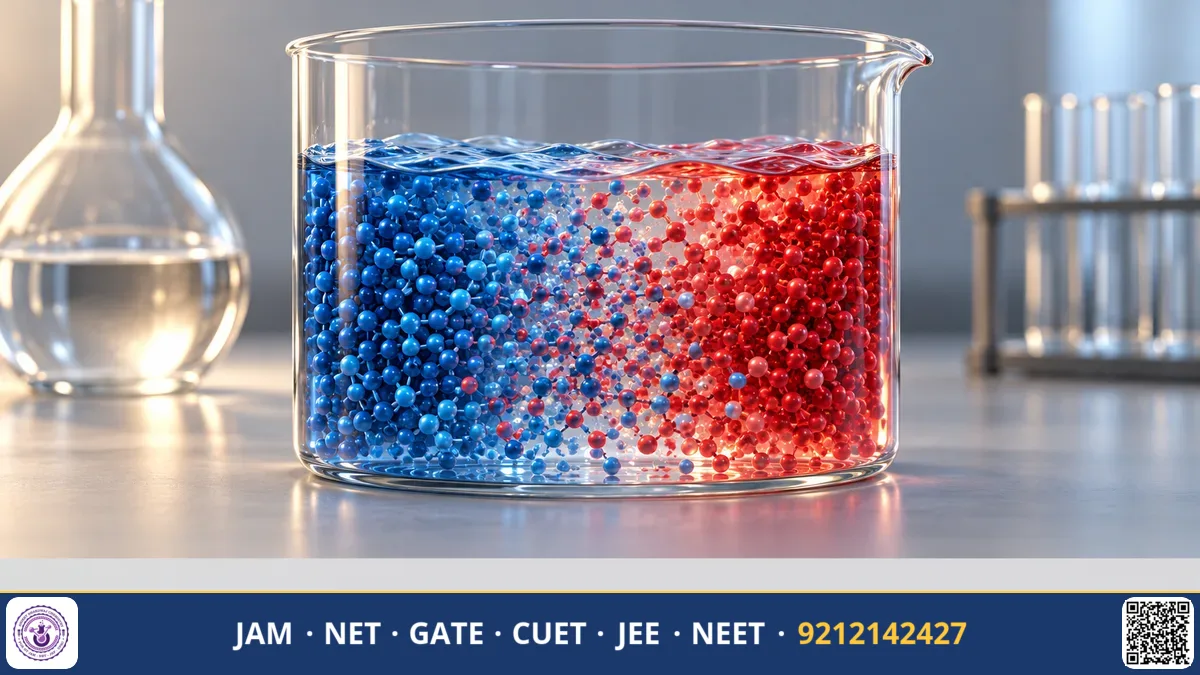
When two different ideal gases are allowed to mix, the process is spontaneous even though no energy is exchanged and no bond is formed. The only driving force is entropy: the molecules of each gas now have more room to spread. Mixing is the simplest example of a process driven purely by entropy, and it leads directly to the expression for the chemical potential of a component in an ideal solution. Questions on this appear in thermodynamics for IIT-JAM, GATE, CSIR-NET and CUET-PG.
The formulas
ΔmixG = n R T Σ xi ln xi = − T ΔmixS
ΔmixH = 0 and ΔmixV = 0 (ideal gases)
xi is the mole fraction of component i, always between 0 and 1, so ln xi is negative, ΔmixS is positive and ΔmixG is negative. The sum runs over every gas. R = 8.314 J K−1 mol−1. These equations hold for gases at the same T and P before mixing, and also for ideal solutions.
The formula follows from treating each gas as expanding independently from its own volume Vi to the total volume V. For an ideal gas at constant T, ΔSi = ni R ln (V / Vi). When the initial pressures are equal, Vi / V = xi, so ΔSi = −ni R ln xi. Adding over all gases gives the formula above.
Why ΔH = 0 for ideal gases
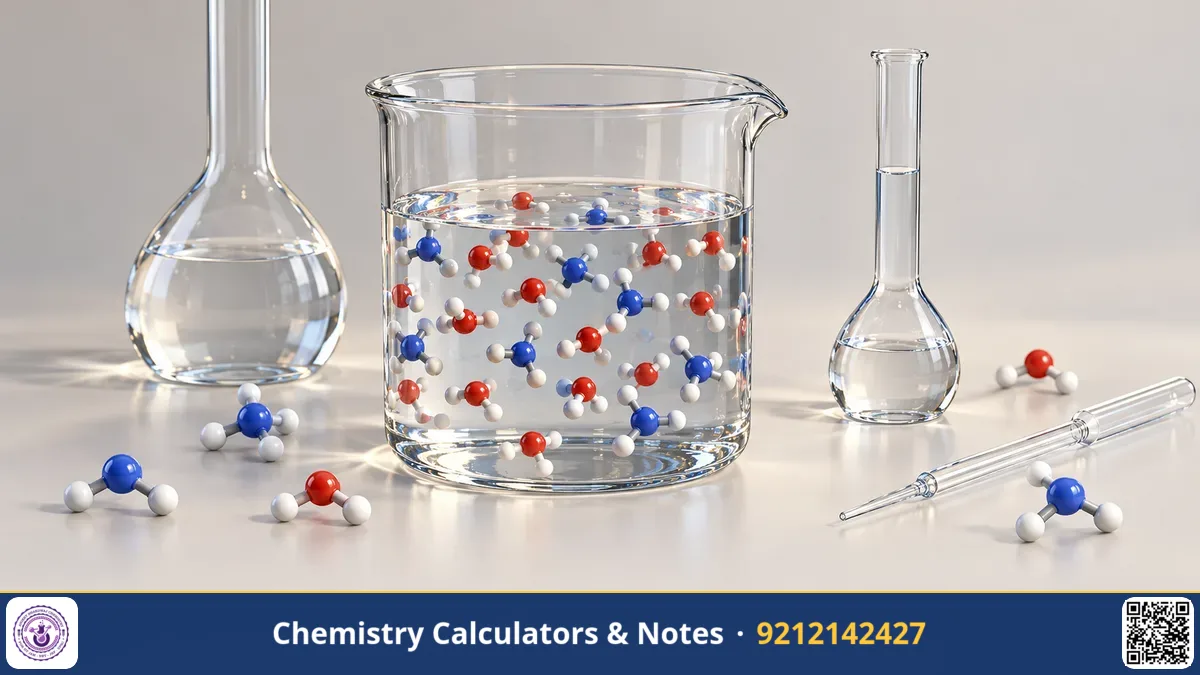
An ideal gas has no intermolecular forces. A molecule of A is not attracted to or repelled by a molecule of B, so no heat is absorbed or released on mixing. Therefore ΔmixG = −T ΔmixS and the whole decrease in Gibbs energy comes from the entropy term. For real gases and non-ideal solutions, ΔmixH is not zero.
Worked example 1: nitrogen and hydrogen
1.0 mol of N2 and 3.0 mol of H2 mix at 298 K, both initially at the same pressure. Find ΔmixS and ΔmixG.
n = 4.0 mol; x(N2) = 0.25, x(H2) = 0.75.
Σ x ln x = 0.25 ln 0.25 + 0.75 ln 0.75 = 0.25(−1.3863) + 0.75(−0.2877) = −0.3466 − 0.2158 = −0.5623.
ΔmixS = −4.0 × 8.314 × (−0.5623) = +18.7 J/K.
ΔmixG = −T ΔmixS = −298 × 18.70 = −5573 J = −5.57 kJ.
Worked example 2: equal amounts
1.0 mol of A and 1.0 mol of B mix at 298 K. Find ΔmixS and ΔmixG.
x = 0.5 for each. Σ x ln x = 2 × 0.5 × ln 0.5 = −0.6931. n = 2.0 mol.
ΔmixS = 2.0 × 8.314 × 0.6931 = 11.53 J/K, which can also be written as 2R ln 2.
ΔmixG = −298 × 11.53 = −3435 J = −3.43 kJ.
For a given total n, the entropy of mixing is largest at x = 0.5 and falls to zero as one component becomes the only one present.
Worked example 3: two vessels with a cross-check
0.20 mol of gas A in a 2.0 L vessel and 0.30 mol of gas B in a 3.0 L vessel are at the same temperature and pressure. The tap between them is opened. Find ΔS.
Route 1 (volumes): the final volume is 5.0 L. ΔS = 0.20 R ln (5.0/2.0) + 0.30 R ln (5.0/3.0) = 0.20 × 8.314 × 0.9163 + 0.30 × 8.314 × 0.5108 = 1.524 + 1.274 = 2.80 J/K.
Route 2 (mole fractions): n = 0.50 mol; x(A) = 0.40, x(B) = 0.60. Σ x ln x = 0.4 ln 0.4 + 0.6 ln 0.6 = −0.3665 − 0.3065 = −0.6730. ΔS = 0.50 × 8.314 × 0.6730 = 2.80 J/K.
The two routes agree. The same pressure is required, otherwise Vi / V would not equal xi.
Worked example 4: per mole of mixture
Show that for any ideal binary mixture, the entropy of mixing per mole is largest at x = 0.5 and find its value.
Per mole, ΔmixS / n = −R [x ln x + (1 − x) ln (1 − x)]. The function is symmetric about x = 0.5. At x = 0.5, the bracket is 0.5 ln 0.5 + 0.5 ln 0.5 = −0.6931, so ΔmixS / n = 8.314 × 0.6931 = 5.76 J K−1 mol−1 (that is, R ln 2).
At x = 0.1 the bracket is 0.1 ln 0.1 + 0.9 ln 0.9 = −0.2303 − 0.0948 = −0.3251, giving 2.70 J K−1 mol−1, less than half the maximum.
Links to other topics
- Chemical potential: for a component in an ideal mixture, μi = μi° + RT ln xi. The mixing equation is simply the sum ni (μi − μi°).
- Raoult’s law: a solution that obeys Raoult’s law over the full range is ideal and has the same ΔmixS and ΔmixG expressions.
- Identical gases: mixing two samples of the same gas gives no entropy change, because nothing distinguishable has been mixed. The formula is for different species.
Common mistakes
- Using mole fractions above 1 or entering percentages instead of fractions.
- Forgetting the minus sign in −nR Σ x ln x and reporting a negative entropy of mixing.
- Using T in °C in −T ΔS.
- Using n for one component instead of the total n.
- Applying the formula to real solutions where ΔmixH is not zero.
- Thinking that mixing needs energy. It is spontaneous because ΔG is negative, with no energy input at all.
Exam relevance
| Question type | Quick approach |
|---|---|
| ΔS or ΔG of mixing for given moles | Find xi, use −nR Σ x ln x |
| Maximum entropy of mixing | Equal mole fractions, R ln 2 per mole for two components |
| Two vessels joined by a tap | Use V / Vi per gas, or convert to xi |
| Why mixing is spontaneous | ΔH = 0, ΔS > 0, so ΔG < 0 |
For the syllabus and pattern in a given year, always check the current official notification of the exam.
The Gibbs free energy calculator helps you check the ΔG = −TΔS step.
Open the Gibbs Free Energy Calculator →Turn this concept into marks: solve previous-year CSIR-NET questions and take a timed quiz.
More Thermodynamics articles