Equipartition Theorem and the Heat Capacity of Gases
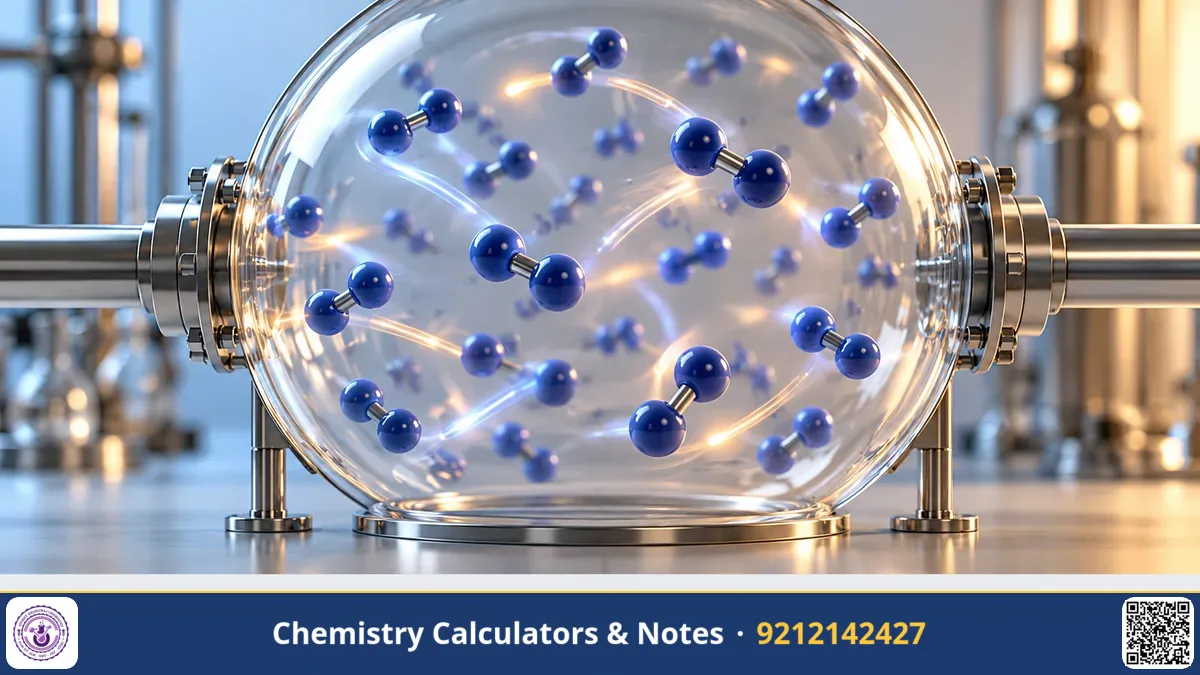
Why is the molar heat capacity of helium 12.47 J/(mol·K) while that of nitrogen is about 20.8 J/(mol·K) at room temperature? The equipartition theorem answers this by counting how many ways a molecule can store energy. The idea appears in physical chemistry for IIT-JAM, GATE, CSIR-NET and CUET-PG, usually as a short numerical on CV, CP or the ratio γ. Check the current official syllabus for the depth required.

The formula
Um = (f/2)RT ⇒ CV,m = (f/2)R
CP,m = CV,m + R = ((f + 2)/2)R γ = CP/CV = (f + 2)/f
f is the number of quadratic terms in the energy of one molecule, often called the degrees of freedom. Translation gives 3 terms (one for each direction). Rotation of a linear molecule gives 2 terms, and rotation of a non-linear molecule gives 3. Each vibrational mode gives 2 terms, one for kinetic and one for potential energy. A molecule of N atoms has 3N total modes. So the vibrational modes number 3N − 5 for a linear molecule and 3N − 6 for a non-linear one.
The theorem, in simple words
In a system in thermal equilibrium at temperature T, classical statistical mechanics says that every term in the energy that is quadratic in a coordinate or momentum holds, on average, ½kT. A translation term is (½)mvx2. A rotation term is (½)Iω2. A vibration has two terms, (½)mv2 and (½)kx2. This is a classical result. It works only when the energy gaps between quantum levels are small compared with kT.
Quantum freezing: why the counting changes with temperature
Rotational energy levels of small molecules are close together, so at room temperature the rotations are fully active. Vibrational levels are far apart, so for light diatomic molecules like N2 and O2 the vibrations are mostly “frozen” at room temperature, and the molecule behaves as if only translation and rotation count. At much higher temperatures vibrations switch on and CV rises. This is why a table of f values must always carry a condition. The statement “f = 5 for diatomics” means translation + rotation only, with vibration frozen.
Worked example 1: monatomic gas
Question. Find CV, CP and γ for helium.
Step 1. A single atom has only translation: f = 3.
Step 2. CV = (3/2)R = 1.5 × 8.3145 = 12.47 J/(mol·K).
Step 3. CP = CV + R = 2.5 × 8.3145 = 20.79 J/(mol·K).
Step 4. γ = 20.79 ÷ 12.47 = 1.667 (that is, 5/3).
Worked example 2: a diatomic gas at room temperature
Question. Estimate CV, CP and γ for N2 with vibration frozen. How much heat is needed to warm 2.00 mol from 300 K to 350 K at constant volume, and at constant pressure?
Step 1. f = 3 (translation) + 2 (rotation) = 5.
Step 2. CV = (5/2)R = 20.79 J/(mol·K). CP = (7/2)R = 29.10 J/(mol·K). γ = 7/5 = 1.40.
Step 3. Constant volume: q = nCVΔT = 2.00 × 20.79 × 50 = 2079 J = 2.08 kJ.
Step 4. Constant pressure: q = nCPΔT = 2.00 × 29.10 × 50 = 2910 J = 2.91 kJ.
The extra 831 J at constant pressure is the work of expansion, nRΔT = 2.00 × 8.3145 × 50 = 831 J. This agrees with the difference.
Worked example 3: non-linear polyatomic without vibration
Question. Estimate γ for methane at a temperature where vibrations are frozen.
Step 1. Methane is non-linear, so f = 3 + 3 = 6.
Step 2. CV = 3R = 24.94 J/(mol·K), CP = 4R = 33.26 J/(mol·K).
Step 3. γ = 4/3 = 1.333.
The result shows the trend: more degrees of freedom means a larger CV and a smaller γ, which moves toward 1.
Worked example 4: high-temperature limit for CO2
Question. In the classical high-temperature limit, with every mode fully active, find CV and γ for CO2.
Step 1. CO2 is linear with N = 3. Translation = 3, rotation = 2, vibrational modes = 3N − 5 = 4.
Step 2. Each vibrational mode has 2 terms, so vibration adds 8. Total f = 3 + 2 + 8 = 13.
Step 3. CV = (13/2)R = 6.5 × 8.3145 = 54.04 J/(mol·K). CP = 7.5R = 62.36 J/(mol·K).
Step 4. γ = 15/13 = 1.154.
This is a limit, not the measured room-temperature value. At room temperature the vibrations of CO2 are only partly active, so the real CV is well below this figure. Always read the question to see which case it asks for.
Common mistakes
- Counting only one term for vibration. Each vibrational mode carries kinetic and potential energy, so it counts as 2 in the classical limit.
- Using 3N − 6 for a linear molecule. A linear molecule has 3N − 5 vibrational modes, because it has only two rotations.
- Forgetting the condition. “CV = 5R/2 for a diatomic” holds only when vibration is frozen.
- Applying CP = CV + R to a non-ideal gas or a solid. The relation is for ideal gases.
- Mixing J/(mol·K) with J/(g·K). The equipartition values are per mole.
Exam relevance
| Gas type | f (vibration frozen) | CV | γ |
|---|---|---|---|
| Monatomic | 3 | (3/2)R | 5/3 = 1.667 |
| Linear (e.g. N2, CO2) | 5 | (5/2)R | 7/5 = 1.40 |
| Non-linear (e.g. CH4) | 6 | 3R | 4/3 = 1.333 |
Questions often ask you to compare these with an experimental value and explain the difference through quantum freezing of vibration. Use the molar heat-capacity relation article for the general CP − CV = R derivation.
This topic is a hand calculation with R, and no tool in the suite is built for it. The Scientific Calculator is enough for the arithmetic.
Open the Chemistry Calculator Suite →