Volume Strength of Hydrogen Peroxide: Conversion to Molarity and % w/v
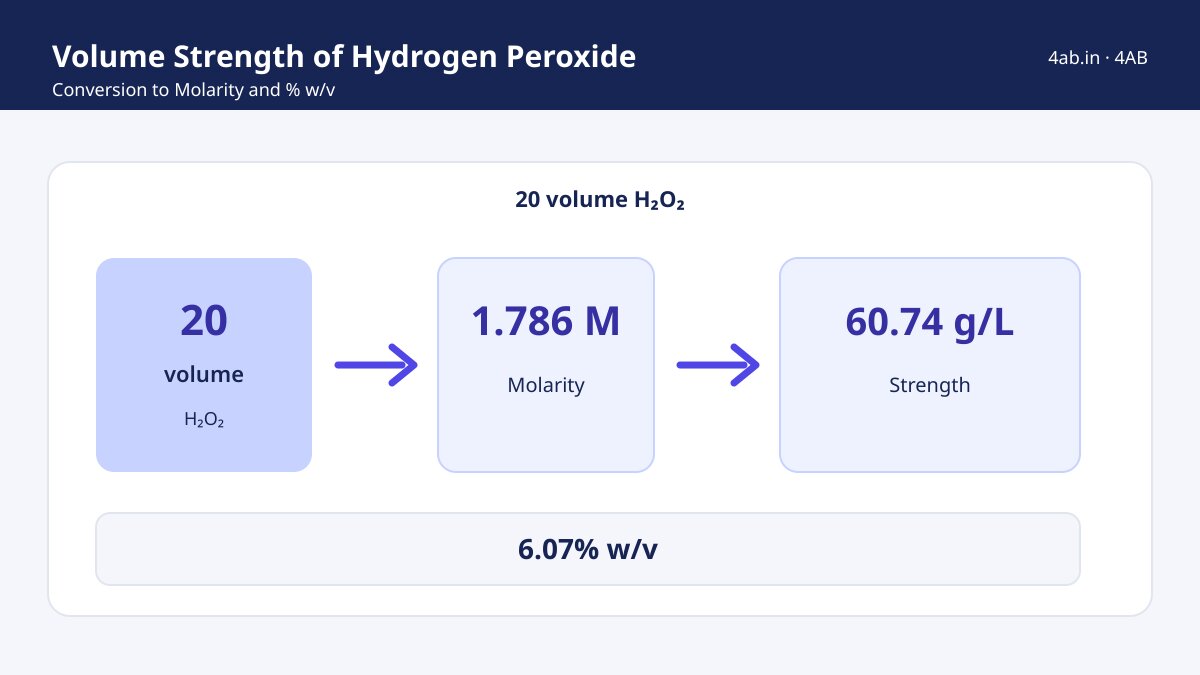
Bottles of hydrogen peroxide in the lab or at the chemist are often labelled “20 volume” or “10 volume”. This is not a percentage and not a molarity. It is called the volume strength, and Class 11 and Class 12 papers ask you to convert it into molarity, grams per litre or per cent w/v. The conversion needs only one balanced equation and the molar volume of a gas.

What “volume strength” means
Hydrogen peroxide decomposes on heating or with a catalyst such as MnO2:
2 mol (68 g) of H2O2 gives 1 mol of O2 = 22.4 L at STP
A solution of “V volume” strength is one where 1 L of the solution releases V litres of O2 at STP when all the H2O2 decomposes. So “20 volume H2O2” means 1 L of the solution gives 20 L of oxygen (or 1 mL gives 20 mL).
The conversion formulas
Strength in g/L = M × 34 (molar mass of H2O2 = 34.01 g/mol)
Per cent w/v = (g/L) ÷ 10
Why 11.2? From the equation, 1 mol of H2O2 gives half a mole of O2, which is 22.4 ÷ 2 = 11.2 L at STP. So each mole of H2O2 in a litre supplies 11.2 L of gas, and the volume strength is 11.2 times the molarity. Always derive the number 11.2 from the equation in the exam; do not just recall it.
Which molar volume? The constant 22.4 L/mol applies at STP defined as 0°C and 1 atm. Some newer books use STP = 0°C and 1 bar, where the molar volume is 22.7 L/mol, and then the factor becomes 22.7 ÷ 2 = 11.35. Use the one your textbook or question states. This article uses 22.4, so the factor is 11.2.
Worked example 1: 20 volume H2O2 to molarity and per cent
Question. Find the molarity, strength in g/L and per cent w/v of 20 volume H2O2.
Step 1. Molarity = 20 ÷ 11.2 = 1.786 M.
Step 2. Strength = 1.786 × 34.01 = 60.74 g/L.
Step 3. Per cent w/v = 60.74 ÷ 10 = 6.07 g per 100 mL.
Check by direct route: 20 L of O2 is 20 ÷ 22.4 = 0.8929 mol. Two moles of H2O2 are needed for each mole of O2, so H2O2 = 2 × 0.8929 = 1.786 mol per litre. Same answer.
Answer. 1.79 M, about 60.7 g/L, about 6.07% w/v.
Worked example 2: from per cent w/v to volume strength
Question. A solution of H2O2 is 3.4% w/v. What is its volume strength?
Step 1. 3.4% w/v means 3.4 g in 100 mL, so 34 g in 1000 mL.
Step 2. Moles per litre = 34 ÷ 34.01 = 0.9997, about 1.00 M.
Step 3. Volume strength = 11.2 × 1.00 = 11.2 volume.
Answer. About 11.2 volume. Notice that 3.4% w/v is almost exactly 1 M, which is why this is a popular textbook choice.
Worked example 3: oxygen from a given sample
Question. How much oxygen at STP is released when 50 mL of 30 volume H2O2 decomposes completely?
Step 1. 30 volume means 1 mL of solution gives 30 mL of O2.
Step 2. 50 mL × 30 = 1500 mL = 1.5 L of O2.
Check: Molarity = 30 ÷ 11.2 = 2.679 M. Moles of H2O2 in 50 mL = 2.679 × 0.050 = 0.1339 mol. Moles of O2 = 0.1339 ÷ 2 = 0.06696 mol. Volume = 0.06696 × 22.4 = 1.500 L. Correct.
Worked example 4: diluting 30 volume to 10 volume
Question. How much 30 volume H2O2 is needed to prepare 250 mL of 10 volume solution?
Step 1. Volume strength is proportional to concentration, so the dilution rule can be used directly: V1S1 = V2S2.
Step 2. V1 × 30 = 250 × 10, so V1 = 2500 ÷ 30 = 83.3 mL.
Step 3. Take 83.3 mL of the 30 volume solution and add water to make 250 mL.
Check in molarity: 30 volume = 2.679 M; 2.679 × 83.33 = 223.2 mmol. The 10 volume solution is 0.8929 M; 0.8929 × 250 = 223.2 mmol. The moles match.
Common mistakes
- Using 22.4 instead of 11.2. The equation makes 1 mol of O2 from 2 mol of H2O2. Dividing by 22.4 gives half the correct molarity.
- Treating “20 volume” as 20%. 20 volume is about 6% w/v, not 20%.
- Using the molar mass of water or of O2. The molar mass for the g/L step is that of H2O2, 34 g/mol.
- Forgetting the STP condition. Volume strength is defined at STP. Gas collected at room temperature needs a gas-law correction first.
- Mixing 22.4 and 22.7 within one question.
Exam relevance
| Given | Find | Method |
|---|---|---|
| Volume strength V | Molarity | M = V ÷ 11.2 |
| Volume strength V | g/L and % w/v | M × 34, then ÷ 10 |
| % w/v | Volume strength | g/L ÷ 34 gives M, then × 11.2 |
| Volume of solution | O2 released | Volume × V |
| Dilution | Volume to take | V1S1 = V2S2 |
This idea also appears in redox titrations of H2O2 with KMnO4, where you must first know the molarity. Check which molar volume your syllabus uses before you start.
Convert a volume strength to molarity, then use the Molarity & Concentration tool to check your working.
Open the Molarity & Concentration Calculator →