Ionic Product of Water (Kw): Why Neutral pH Is Not Always 7
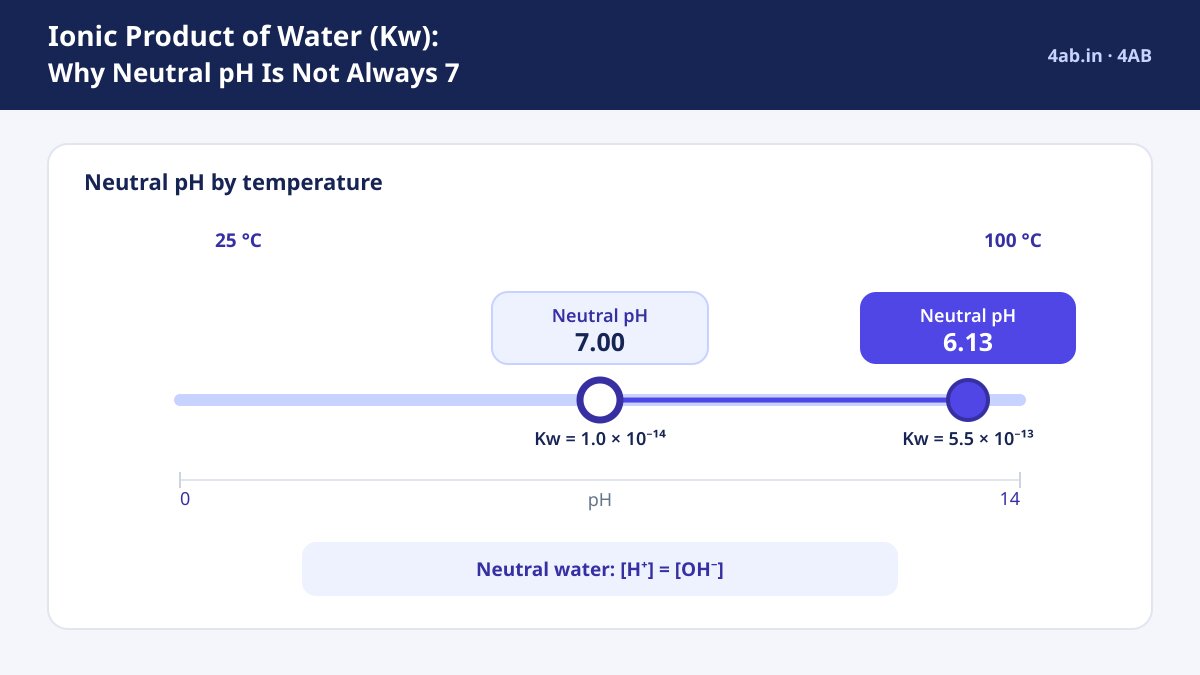
Most students learn one fact about water: “pH of pure water is 7.” Then a board paper asks for the pH of pure water at 100 °C and the answer is not 7. This is a favourite trap because the question looks too easy. The idea behind it is the ionic product of water, Kw, and the fact that its value depends on temperature.

What Kw is
Water ionises very slightly: H2O ⇌ H+ + OH−. (In full, H+ is H3O+, but the short form is fine for school problems.) The product of the two ion concentrations in any aqueous solution is a constant at a given temperature.
pKw = −log Kw = pH + pOH
Neutral water: [H+] = [OH−] = √Kw, so neutral pH = ½ pKw
[H+] and [OH−] are in mol L−1. Kw has no unit in most school books. At 25 °C, Kw = 1.0 × 10⁻¹⁴, so pKw = 14 and neutral pH = 7. That is where the well-known “pH + pOH = 14” comes from. It is a result for 25 °C, not a law for all temperatures.
Why does Kw change? The ionisation of water absorbs heat (it is endothermic). By Le Chatelier’s principle, raising the temperature pushes the equilibrium to the right, so more H+ and OH− form and Kw increases. As Kw rises, pKw falls.
| Temperature | Kw used in the examples | pKw | Neutral pH |
|---|---|---|---|
| 25 °C | 1.0 × 10⁻¹⁴ | 14.00 | 7.00 |
| 100 °C | 5.5 × 10⁻¹³ | 12.26 | 6.13 |
The 100 °C value is a rounded textbook figure, and books differ slightly (some use 1.0 × 10⁻¹² for easy arithmetic). Always use the Kw your question gives. If it gives none, assume 25 °C.
Worked example 1: pH of pure water at 100 °C
Question. Kw = 5.5 × 10⁻¹³ at 100 °C. Find the pH of pure water and say whether it is acidic.
In pure water [H+] = [OH−] = √(5.5 × 10⁻¹³) = 7.42 × 10⁻⁷ M.
pH = −log(7.42 × 10⁻⁷) = 6.13.
Answer. pH = 6.13. The water is still neutral, because [H+] = [OH−]. Neutral does not mean pH = 7; it means equal concentrations of H+ and OH−.
Worked example 2: is pH 6.5 acidic or basic at 100 °C?
Use Kw = 5.5 × 10⁻¹³, so pKw = 12.26 and neutral pH = 6.13.
A solution with pH 6.5 has [H+] = 10−6.5 = 3.16 × 10⁻⁷ M.
pOH = 12.26 − 6.50 = 5.76, so [OH−] = 10−5.76 = 1.74 × 10⁻⁶ M.
Here [OH−] is larger than [H+], so the solution is basic at 100 °C, although most students would call pH 6.5 “acidic” because it is below 7. The rule is: compare the pH with neutral pH at that temperature, not with 7.
Worked example 3: 0.010 M NaOH at 100 °C
NaOH is a strong base, so [OH−] = 0.010 M and pOH = 2.00.
Wrong way: pH = 14 − 2 = 12.
Right way at 100 °C: [H+] = Kw ÷ [OH−] = 5.5 × 10⁻¹³ ÷ 0.010 = 5.5 × 10⁻¹¹ M. pH = −log(5.5 × 10⁻¹¹) = 10.26.
Check: pH = pKw − pOH = 12.26 − 2.00 = 10.26. Both routes agree.
Worked example 4: finding Kw from a pH
Question. At a certain temperature pure water has pH 6.5. Find Kw and pKw.
Neutral: [H+] = [OH−] = 10−6.5 = 3.16 × 10⁻⁷ M.
Kw = (3.16 × 10⁻⁷)2 = 1.0 × 10⁻¹³. So pKw = 13.00 (also 2 × 6.5 = 13).
Since Kw is larger than 1.0 × 10⁻¹⁴, this temperature is above 25 °C, which matches the idea that Kw grows on heating.
Worked example 5: a strong acid at 100 °C
Question. Find pH and [OH−] of 0.010 M HCl at 100 °C (Kw = 5.5 × 10⁻¹³).
HCl is a strong acid, so [H+] = 0.010 M and pH = 2.00. The acid concentration is so much larger than the 7.4 × 10⁻⁷ M from water that water’s own ions can be ignored.
[OH−] = Kw ÷ [H+] = 5.5 × 10⁻¹³ ÷ 0.010 = 5.5 × 10⁻¹¹ M, so pOH = 10.26.
Check: pH + pOH = 2.00 + 10.26 = 12.26 = pKw. For a strong acid, the pH itself does not depend on temperature in this simple model; only the pOH and the neutral point change.
A simple way to think about it
Imagine a seesaw. In neutral water the two ions are balanced: [H+] = [OH−]. Adding acid raises [H+] and pushes [OH−] down so that the product stays at Kw. Heating water makes the whole seesaw heavier on both sides, so the product Kw becomes larger, but the balance point is still neutral. The pH scale from 0 to 14 is therefore a 25 °C picture. At 100 °C the scale effectively runs from 0 to about 12.26, with neutral at about 6.13.
This is also why a pH meter used for hot solutions is calibrated or temperature-compensated: the same [H+] gives the same pH, but the meaning of “neutral” moves with temperature.
Common mistakes
- Writing pH + pOH = 14 at every temperature. The sum is pKw, which is 14 only at 25 °C.
- Calling pure hot water acidic because its pH is below 7. It is neutral if [H+] = [OH−].
- Thinking a pH below 7 always means an acid. Compare with ½ pKw for that temperature.
- Taking Kw as 10−7. That is [H+] of pure water at 25 °C, not Kw.
- Forgetting the square root when finding [H+] of pure water from Kw.
Exam relevance
| Question type | What to do |
|---|---|
| pH of pure water at a given temperature | [H+] = √Kw, then −log |
| Is the solution acidic, basic or neutral? | Compare [H+] with [OH−], or pH with ½ pKw |
| pH of a strong base at a non-standard temperature | pH = pKw − pOH |
| Assertion–reason on pH of water on heating | Kw rises, pH falls, water stays neutral |
| No temperature given | Assume 25 °C and Kw = 1.0 × 10⁻¹⁴ |
Read the question carefully: if it states a temperature, it expects you to use the Kw given for that temperature.
After working out pOH or [H+] by hand, enter the value in the pH tool to check the last step.
Open the pH / pOH Calculator →Turn this concept into marks: solve previous-year CSIR-NET questions and take a timed quiz.
More Equilibrium articles