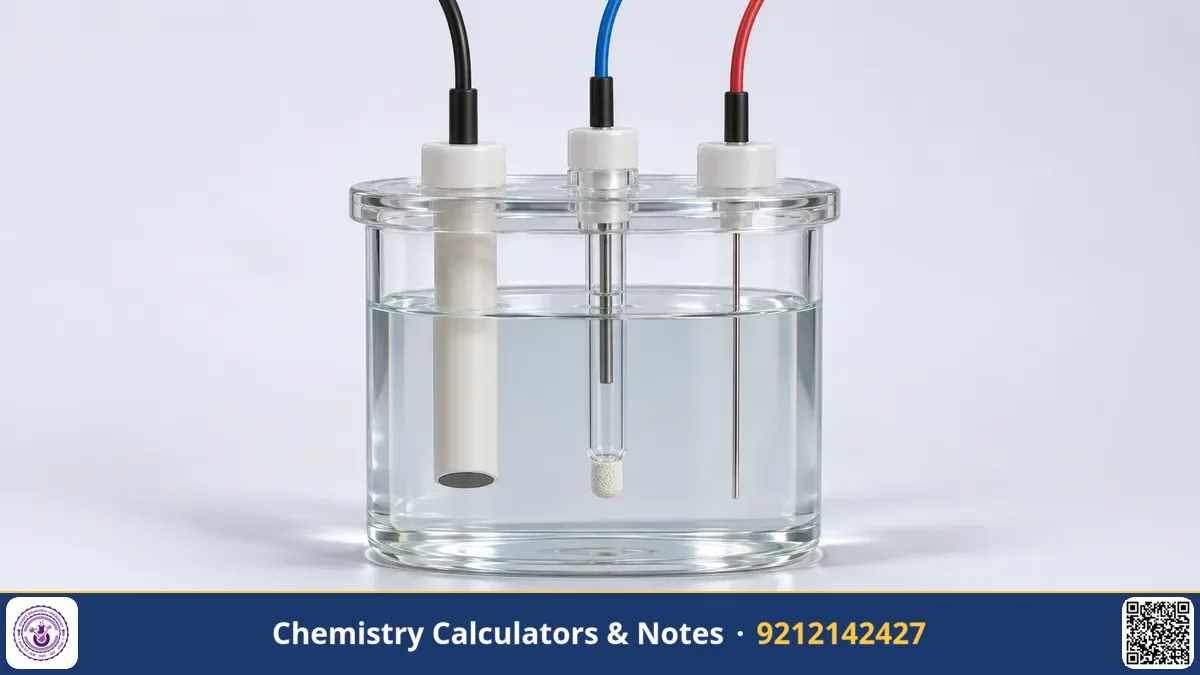
Levich Equation: Diffusion Current at RDE
Hydrodynamic voltammetry plays an indispensable role in contemporary electrochemistry, providing rigorous access to kinetic rates, diffusion coefficients, and electron transfer stoichiometries. Among steady-state hydrodynamic methods, the rotating disk electrode (RDE) is the primary technique studied in competitive examinations including CSIR NET, GATE Chemistry, and advanced university entrance tests. Unlike stationary voltammetry where the diffusion boundary layer grows continuously with time, a rotating disk creates a well-defined, time-independent convective-diffusion regime. The Levich equation provides the analytical mathematical description for the mass-transport-controlled limiting current observed at such an electrode.
Hydrodynamics and Boundary Layer at a Rotating Disk
When a planar conducting disk embedded in an insulating sheath rotates about its normal central axis at angular velocity ω, it acts as a fluid mechanical pump. Fluid adjacent to the electrode face is driven radially outwards along the disk surface by centrifugal acceleration. To conserve mass, fresh solution from the bulk is drawn axially upward toward the center of the electrode face, continuously replenishing the electroactive species.
Because fluid velocity parallel to the surface drops to zero at the solid-liquid interface (no-slip condition), a stagnant hydrodynamic boundary layer forms near the disk. Inside this hydrodynamic zone, a narrower mass-transfer or diffusion boundary layer develops. Benjamin Levich solved the coupled Navier-Stokes fluid equations and convective diffusion equations, proving that the steady-state diffusion layer thickness δ is completely uniform across the entire active disk area:
δ = 1.61 · D^(1/3) · ν^(1/6) · ω^(-1/2)
Because δ is uniform across the surface, current density is distributed evenly across the electrode face, yielding clean, reproducible, time-independent steady-state voltammograms.
Standard Form of the Levich Equation:
I_L = 0.620 · n · F · A · D^(2/3) · ω^(1/2) · ν^(-1/6) · C
Alternative Angular Frequency Form (using rotational speed f in Hz or rev/s):
Since ω = 2πf, the prefactor becomes 0.620 × (2π)^(1/2) ≈ 1.554:
I_L = 1.554 · n · F · A · D^(2/3) · f^(1/2) · ν^(-1/6) · C
Variables, Standard Units, and Physical Dimensions:
• I_L = Levich limiting current, in amperes (A).
• n = Number of electrons transferred per molecule/ion in the electrode reaction (dimensionless integer).
• F = Faraday constant (96485 C/mol).
• A = Geometric surface area of the active disk electrode, in cm² or m².
• D = Diffusion coefficient of the electroactive reactant, in cm²/s or m²/s.
• ω = Angular rotation speed of the electrode, in radians per second (rad/s), where ω = 2π · (rpm / 60).
• ν = Kinematic viscosity of the liquid electrolyte solution, in cm²/s or m²/s (where ν = dynamic viscosity η divided by liquid density ρ; for pure dilute aqueous media at 25 °C, ν ≈ 0.010 cm²/s = 1.0 × 10⁻⁶ m²/s).
• C = Bulk concentration of the electroactive analyte, in mol/cm³ or mol/m³ (remember: 1.0 mM = 1.0 × 10⁻³ mol/L = 1.0 × 10⁻⁶ mol/cm³ = 1.0 mol/m³).
The Diagnostic Levich Plot (I_L versus ω^(1/2))
In analytical voltammetry, a central diagnostic test is constructing a plot of the steady-state limiting current I_L on the vertical axis against the square root of angular velocity ω^(1/2) on the horizontal axis. For an ideal mass-transfer-limited electrochemical reaction free from kinetic inhibition or sluggish adsorption steps, this plot yields a straight line that passes directly through the origin (intercept = 0).
If the reaction experiences sluggish heterogeneous electron transfer kinetics, the current does not reach the full mass-transfer limit at intermediate overpotentials. In that scenario, one applies the Koutecký-Levich equation: 1/I = 1/I_k + 1/I_L = 1/I_k + 1/(B · ω^(1/2)), where I_k represents the activation-controlled kinetic current and B is the Levich slope. Plotting 1/I versus ω^(-1/2) produces a linear response whose non-zero vertical intercept allows direct extraction of the standard heterogeneous rate constant.
Exam details
- Source: practice problem written for this article (not a past-paper question)
- Relevant exams: CSIR NET Chemical Sciences, GATE Chemistry, CUET-PG
- Topic: Electroanalytical Chemistry and Hydrodynamic Voltammetry
- Difficulty: Advanced postgraduate
Question: A glassy carbon rotating disk electrode with a surface area of 0.196 cm² is immersed in an aqueous solution containing 2.00 mM potassium ferricyanide, K₃[Fe(CN)₆], and 0.10 M KCl supporting electrolyte at 25 °C. The single-electron reduction Fe(CN)₆³⁻ + e⁻ → Fe(CN)₆⁴⁻ occurs at the electrode. Given D = 7.60 × 10⁻⁶ cm²/s, ν = 0.0100 cm²/s, and F = 96485 C/mol, calculate the limiting diffusion current in milliamperes when the electrode rotates at 1600 rpm.
Solution:
Step 1: Convert the rotation rate from revolutions per minute (rpm) to angular velocity ω in radians per second (rad/s):
ω = 2π × (rpm / 60) = 2π × (1600 / 60) = 2π × 26.6667 = 167.5516 rad/s
Take the square root of angular velocity:
ω^(1/2) = (167.5516)^(1/2) ≈ 12.9442 rad^(1/2)/s^(1/2)
Step 2: Convert analyte concentration into consistent CGS units (mol/cm³):
C = 2.00 mM = 2.00 × 10⁻³ mol/L = 2.00 × 10⁻⁶ mol/cm³
Step 3: Calculate the individual power factors for diffusion coefficient D and kinematic viscosity ν:
D = 7.60 × 10⁻⁶ cm²/s
D^(2/3) = (7.60 × 10⁻⁶)^(2/3) = (7.60)^(2/3) × (10⁻⁶)^(2/3) = 3.8653 × 10⁻⁴ cm^(4/3)/s^(2/3)
ν = 0.0100 cm²/s = 1.00 × 10⁻² cm²/s
ν^(-1/6) = (1.00 × 10⁻²)^(-1/6) = (10²)^(1/6) = 10^(2/6) = 10^(1/3) ≈ 2.15443 s^(1/6)/cm^(1/3)
Step 4: Combine all terms in the Levich equation:
I_L = 0.620 · n · F · A · D^(2/3) · ν^(-1/6) · C · ω^(1/2)
Substitute the evaluated parameters (with n = 1 and A = 0.196 cm²):
I_L = 0.620 × 1 × 96485 × 0.196 × (3.8653 × 10⁻⁴) × 2.15443 × (2.00 × 10⁻⁶) × 12.9442
Step 5: Multiply the prefactors sequentially:
0.620 × 96485 = 59820.7 C/mol
59820.7 × 0.196 = 11724.86 C·cm²/mol
11724.86 × (3.8653 × 10⁻⁴) = 4.5320 cm^(10/3)/(mol·s^(2/3))
4.5320 × 2.15443 = 9.7639
9.7639 × (2.00 × 10⁻⁶) = 1.95277 × 10⁻⁵
I_L = 1.95277 × 10⁻⁵ × 12.9442 = 2.5277 × 10⁻⁴ A
Step 6: Convert current from amperes to milliamperes (mA):
I_L = 2.5277 × 10⁻⁴ A × 1000 mA/A = 0.2528 mA ≈ 0.253 mA
Step 7: Verification via SI units (m-kg-s):
A = 0.196 × 10⁻⁴ m², C = 2.00 mol/m³, D = 7.60 × 10⁻¹⁰ m²/s, ν = 1.00 × 10⁻⁶ m²/s
D^(2/3) = (7.60 × 10⁻¹⁰)^(2/3) = 8.327 × 10⁻⁷ m^(4/3)/s^(2/3)
ν^(-1/6) = (1.00 × 10⁻⁶)^(-1/6) = 10.0 s^(1/6)/m^(1/3)
I_L = 0.620 × 1 × 96485 × (1.96 × 10⁻⁵) × (8.327 × 10⁻⁷) × 10.0 × 2.00 × 12.9442 = 2.528 × 10⁻⁴ A = 0.253 mA. Identical result obtained.
Answer: 0.253 mA
Question: In a study of an irreversible one-electron reduction at a platinum rotating disk electrode, the limiting current was measured as 0.360 mA at an angular rotation velocity of 100 rad/s. Assuming purely mass-transport-controlled behavior, what will be the limiting current when the electrode rotation rate is increased to 400 rad/s?
Solution:
Step 1: Identify the relationship between limiting current I_L and rotation speed ω:
According to the Levich equation, I_L is directly proportional to ω^(1/2) when all other physical parameters (n, F, A, D, ν, C) remain constant:
I_L = k · ω^(1/2)
Step 2: Set up a proportional ratio between state 1 and state 2:
I_L,2 / I_L,1 = (ω_2 / ω_1)^(1/2)
Step 3: Substitute the known rotation speeds:
ω_1 = 100 rad/s
ω_2 = 400 rad/s
ω_2 / ω_1 = 400 / 100 = 4.00
Step 4: Compute the square root of the velocity ratio:
(ω_2 / ω_1)^(1/2) = (4.00)^(1/2) = 2.00
Step 5: Calculate the new limiting current I_L,2:
I_L,2 = I_L,1 × 2.00 = 0.360 mA × 2.00 = 0.720 mA
Step 6: Alternate verification by calculating the proportionality constant k:
k = I_L,1 / (ω_1)^(1/2) = 0.360 mA / (100)^(1/2) = 0.360 / 10 = 0.0360 mA·s^(1/2)/rad^(1/2)
I_L,2 = k · (ω_2)^(1/2) = 0.0360 × (400)^(1/2) = 0.0360 × 20 = 0.720 mA. Both approaches agree exactly.
Answer: 0.720 mA
Question: A rotating disk electrode with an area of 0.250 cm² produces a mass-transfer-limited current of 0.450 mA at 2500 rpm for the reduction of a 1.50 mM species involving 2 electrons. The solution kinematic viscosity is 0.00900 cm²/s. Determine the diffusion coefficient D of the electroactive species.
Solution:
Step 1: Convert all given quantities to consistent CGS units:
I_L = 0.450 mA = 4.50 × 10⁻⁴ A
n = 2
F = 96485 C/mol
A = 0.250 cm²
C = 1.50 mM = 1.50 × 10⁻⁶ mol/cm³
ν = 0.00900 cm²/s = 9.00 × 10⁻³ cm²/s
Step 2: Convert rotational speed 2500 rpm to angular velocity ω in rad/s:
ω = 2π × (2500 / 60) = 2π × 41.6667 = 261.799 rad/s
ω^(1/2) = (261.799)^(1/2) = 16.1802 rad^(1/2)/s^(1/2)
Step 3: Evaluate the kinematic viscosity factor:
ν^(-1/6) = (0.00900)^(-1/6) = (111.111)^(1/6) ≈ 2.1923 s^(1/6)/cm^(1/3)
Step 4: Rearrange the Levich equation to isolate the D^(2/3) term:
I_L = [0.620 · n · F · A · ν^(-1/6) · C · ω^(1/2)] · D^(2/3)
D^(2/3) = I_L / [0.620 · n · F · A · ν^(-1/6) · C · ω^(1/2)]
Step 5: Compute the denominator product:
Denominator = 0.620 × 2 × 96485 × 0.250 × 2.1923 × (1.50 × 10⁻⁶) × 16.1802
0.620 × 2 × 96485 = 119641.4
119641.4 × 0.250 = 29910.35
29910.35 × 2.1923 = 65572.5
65572.5 × (1.50 × 10⁻⁶) = 0.098359
0.098359 × 16.1802 = 1.59147 A·(s/cm²)^(2/3)
Step 6: Calculate D^(2/3):
D^(2/3) = (4.50 × 10⁻⁴) / 1.59147 = 2.82757 × 10⁻⁴ cm^(4/3)/s^(2/3)
Step 7: Solve for D by raising both sides to the power 3/2 = 1.5:
D = (2.82757 × 10⁻⁴)^(1.5) = (2.82757)^(1.5) × (10⁻⁴)^(1.5)
Since (2.82757)^(1.5) = 4.7544 and (10⁻⁴)^(1.5) = 10⁻⁶:
D = 4.7544 × 10⁻⁶ cm²/s ≈ 4.75 × 10⁻⁶ cm²/s
Step 8: Double-check by back-substitution:
I_L = 1.59147 × (4.7544 × 10⁻⁶)^(2/3) = 1.59147 × (2.8276 × 10⁻⁴) = 4.500 × 10⁻⁴ A = 0.450 mA. The calculation is fully verified.
Answer: 4.75 × 10⁻⁶ cm²/s
Common Student Mistakes
1. Substituting Rotational Frequency Directly as Angular Velocity: Students frequently substitute rotation speed directly in revolutions per minute (rpm) or Hertz (rev/s) instead of radians per second (rad/s). Remember that ω = 2π(rpm / 60). Omitting the factor 2π/60 leads to an error factor of roughly 0.32 or 3.14 in the square root.
2. Concentration Unit Confusion (mM to mol/cm³ vs mol/m³): In CGS calculations, 1 mM must be converted to 10⁻⁶ mol/cm³ (not 10⁻³ mol/cm³). Mixing mol/L with centimeters directly causes a thousand-fold calculation error.
3. Misunderstanding the Kinematic Viscosity Exponent: The exponent of kinematic viscosity ν is -1/6 (or 1/6 in the denominator). Students sometimes mistakenly use -1/2 or -1/3 by confusing it with the diffusion coefficient exponent (which is +2/3).
4. Overlooking the Koutecký-Levich Intercept: Assuming that the Levich equation holds when heterogeneous electron transfer is slow. If a plot of I_L versus ω^(1/2) bends downward at higher rotation speeds, kinetic limitations are present, requiring a Koutecký-Levich analysis.
| Target Examination | Question Format and Assessment Scope | Key Focus Concepts |
|---|---|---|
| CSIR NET Chemical Sciences | Four-mark problems in Part C and two-mark concepts in Part B | Extraction of diffusion coefficient D, boundary layer thickness δ, Koutecký-Levich kinetic intercepts |
| GATE Chemistry | Numerical Answer Type (NAT) and multiple-choice electrochemistry questions | Direct calculation of I_L, scaling of limiting current with rotation frequency (I_L ∝ ω^(1/2)) |
| IIT-JAM Chemistry | Analytical chemistry and physical electrochemistry questions | Comparison of hydrodynamic voltammetry with stationary diffusion methods, basic proportionality rules |
| CUET-PG Chemistry | Single-correct objective questions | Functional dependencies of boundary layer thickness on rotation speed, qualitative Levich trends |
Turn this concept into marks: solve previous-year CSIR-NET questions and take a timed quiz.
More Electrochemistry articles