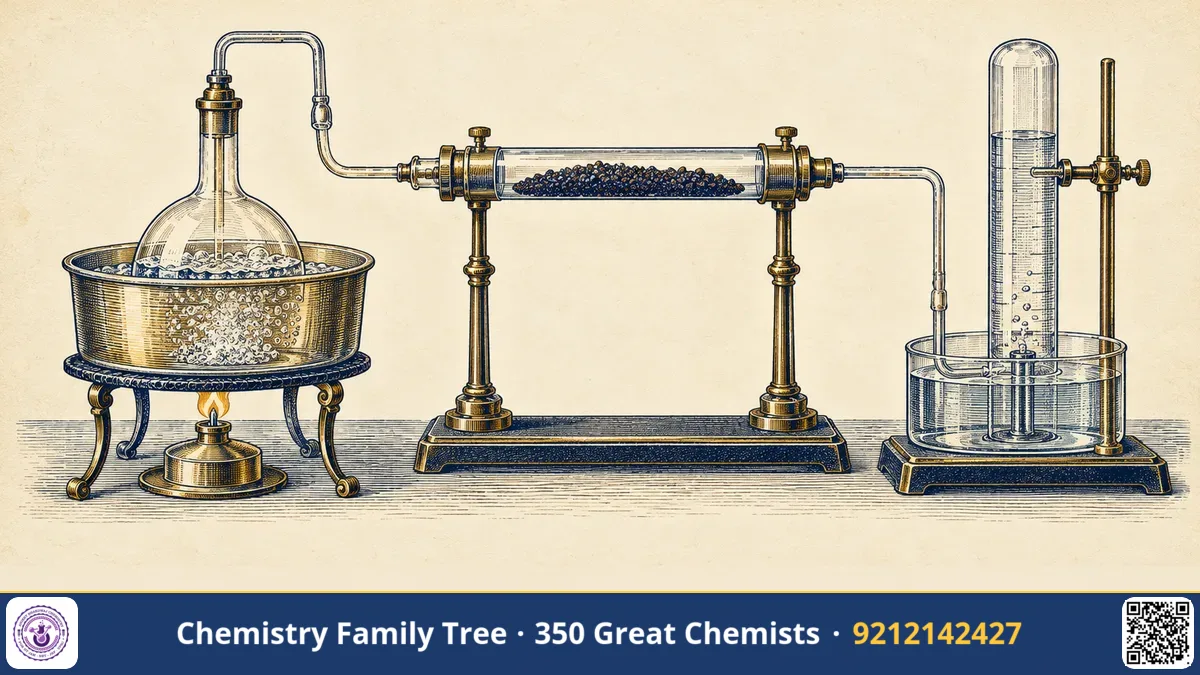
Liebig's Method: Carbon and Hydrogen Calculations
Quantitative elemental analysis is a cornerstone of organic chemistry, establishing empirical and molecular formulas of unknown substances. Among classical analytical techniques, Liebig's combustion method is the foundational procedure for determining percentages of carbon and hydrogen. In school board exams, NEET, and JEE, numerical problems on Liebig's method frequently appear as direct calculations or as the initial step in finding empirical formulas.
Principle of Liebig's Combustion Method
In Liebig's method, a known mass of a dry organic compound is heated strongly in a combustion tube packed with pure cupric oxide (CuO) in a stream of dry oxygen. The copper(II) oxide oxidizes carbon to carbon dioxide and hydrogen to water vapour:
C + 2 CuO → CO2 + 2 Cu
2 H + CuO → H2O + Cu
If the compound contains nitrogen, nitrogen oxides are reduced back to nitrogen gas by passing over a heated copper gauze placed near the exit of the combustion tube.
Absorption Apparatus and Mass Changes
The gaseous combustion products pass through two sequentially connected absorption tubes:
1. Anhydrous Calcium Chloride U-Tube: The gases first pass through a weighed U-tube containing anhydrous calcium chloride (CaCl2), which absorbs water vapour. The increase in mass of this tube gives the mass of water (H2O) produced.
2. Caustic Potash Bulb (KOH Bulb): The dry gases next enter bulbs containing concentrated aqueous potassium hydroxide (KOH), which absorbs carbon dioxide:
2 KOH + CO2 → K2CO3 + H2O
The gain in mass of the potash bulb gives the mass of carbon dioxide (CO2) produced. A guard tube containing anhydrous CaCl2 prevents atmospheric moisture from entering.
Key Formulas for Percentage Calculations
Formulas for Carbon and Hydrogen Percentages:
Let m = mass of organic compound taken (g).
Let m_CO2 = mass of carbon dioxide formed (gain in KOH bulb, g).
Let m_H2O = mass of water formed (gain in CaCl2 tube, g).
- Percentage of Carbon:
IUPAC values (C = 12.011, CO2 = 44.01): % C = (12.011 / 44.01) × (m_CO2 / m) × 100
Textbook integer values (C = 12, CO2 = 44): % C = (12 / 44) × (m_CO2 / m) × 100 - Percentage of Hydrogen:
IUPAC values (2 H = 2.016, H2O = 18.015): % H = (2.016 / 18.015) × (m_H2O / m) × 100
Textbook integer values (2 H = 2, H2O = 18): % H = (2 / 18) × (m_H2O / m) × 100 - Percentage of Oxygen (by difference): % O = 100% − (% C + % H)
Exam details
- Source: practice problem written for this article (not a past-paper question)
- Relevant exams: JEE Main, NEET, CBSE Class 11, ISC Class 11, CUET-UG
- Topic: Quantitative Organic Analysis — Estimation of Carbon and Hydrogen
- Difficulty: Intermediate (School Level)
Worked Examples with Complete Arithmetic Steps
Question: In an elemental estimation by Liebig's method, 0.2460 g of an organic compound containing carbon, hydrogen, and oxygen produced 0.5280 g of carbon dioxide and 0.2160 g of water on complete combustion. Calculate the percentage composition of carbon, hydrogen, and oxygen in the compound.
Step-by-step Solution:
Step 1: Identify given quantities.
Mass of compound (m) = 0.2460 g; m_CO2 = 0.5280 g; m_H2O = 0.2160 g.
Step 2: Calculate percentage of carbon.
Mass of carbon = (12.011 / 44.01) × 0.5280 g = 0.14410 g.
Percentage of carbon = (0.14410 g / 0.2460 g) × 100 = 58.58%.
(Using integer values 12/44: (12 / 44) × 0.5280 g = 0.1440 g; % C = 58.54%.)
Step 3: Calculate percentage of hydrogen.
Mass of hydrogen = (2.016 / 18.015) × 0.2160 g = 0.02417 g.
Percentage of hydrogen = (0.02417 g / 0.2460 g) × 100 = 9.83%.
(Using integer values 2/18: (2 / 18) × 0.2160 g = 0.0240 g; % H = 9.76%.)
Step 4: Calculate percentage of oxygen.
% O = 100.00% − (58.58% + 9.83%) = 31.59%.
(Using integer values: % O = 100.00% − 68.30% = 31.70%.)
Double-check by second route:
Moles of C = 0.5280 / 44.01 = 0.01200 mol → Mass of C = 0.01200 × 12.011 = 0.1441 g.
Moles of H = 2 × (0.2160 / 18.015) = 0.02398 mol → Mass of H = 0.02417 g.
Mass of O = 0.2460 − (0.1441 + 0.02417) = 0.07773 g.
% C = 58.58%, % H = 9.83%, % O = 31.59%. Both routes yield identical results.
Answer: C = 58.58%, H = 9.83%, O = 31.59%
Question: Combustion of 0.3000 g of an organic liquid in a Liebig apparatus gave 0.4400 g of carbon dioxide and 0.1800 g of water. Find the percentages of carbon and hydrogen. If the compound contains only C, H, and O, determine its empirical formula.
Step-by-step Solution:
Step 1: Calculate percentages of carbon and hydrogen.
Mass of compound (m) = 0.3000 g.
% C = (12.011 / 44.01) × (0.4400 g / 0.3000 g) × 100 = 40.03%.
(Using integer values 12/44: % C = 40.00%.)
% H = (2.016 / 18.015) × (0.1800 g / 0.3000 g) × 100 = 6.71%.
(Using integer values 2/18: % H = 6.67%.)
Step 2: Calculate percentage of oxygen.
% O = 100.00% − (40.03% + 6.71%) = 53.26%.
(Using integer values: % O = 53.33%.)
Step 3: Determine empirical formula.
Moles of C = 40.03 / 12.011 = 3.333 mol.
Moles of H = 6.71 / 1.008 = 6.657 mol.
Moles of O = 53.26 / 15.999 = 3.329 mol.
Dividing by 3.329 gives C : H : O = 1 : 2 : 1.
Empirical formula = CH2O.
Double-check by second route:
Mass of C = 0.1201 g; Mass of H = 0.0201 g; Mass of O = 0.1598 g.
Mole ratio: C = 0.0100 mol, H = 0.0200 mol, O = 0.0100 mol.
Ratio C : H : O = 1 : 2 : 1, confirming empirical formula CH2O.
Answer: C = 40.03%, H = 6.71%, O = 53.26%, Empirical formula = CH2O
Common Mistakes in Liebig's Method Calculations
- Reversing absorption tube order: Gases must pass through CaCl2 first, then KOH. If passed through KOH first, water will evaporate from the KOH solution, ruining both measurements.
- Using 1/18 instead of 2/18 for hydrogen: Each water molecule contains two hydrogen atoms. Using 1/18 halves the calculated hydrogen percentage.
- Ignoring the guard tube: Without a guard tube at the KOH bulb exit, atmospheric moisture and CO2 enter the tube, artificially raising the carbon percentage.
- Treating oxygen as directly weighed: Oxygen is never absorbed in Liebig's apparatus; its percentage is always obtained by difference from 100%.
Exam Relevance and Question Patterns
| Examination | Question Format | Key Skills Evaluated |
|---|---|---|
| JEE Main | Numerical value questions and single-choice MCQs | Calculating elemental percentages, converting mass increases into empirical formulas, and vapor density integration |
| NEET | Direct calculation MCQs and conceptual assertion-reason | Functions of CuO, CaCl2, and KOH bulbs, basic stoichiometric formulas, and rapid percentage evaluation |
| CBSE & State Boards | Short-answer and structured numerical problems | Apparatus diagrams, balanced chemical reactions, complete formula derivations, and step-by-step arithmetic |
| CUET-UG | Objective questions on organic practical techniques | Purpose of copper gauze for nitrogen, absorption sequences, and empirical formula derivations |
Previous-year CSIR-NET questions and timed quizzes to check what you just read.
More Concepts articles