The discovery, explained · Chemist no. 244 of 350
Dumas Methods: How a French Chemist Weighed Vapours and Counted Nitrogen
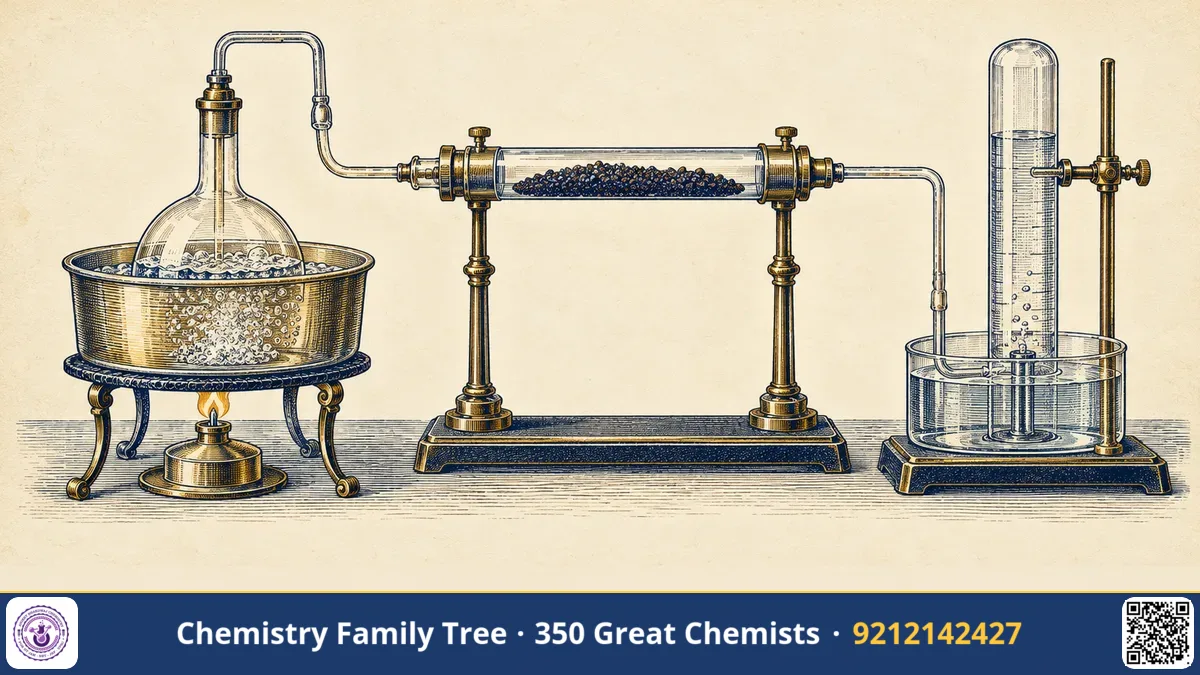
If you have studied molar mass from vapour density or estimated nitrogen in an organic compound, you have used the ideas of Jean-Baptiste Dumas (1800-1884). The French chemist gave two classic methods that appear in school textbooks and in JAM, NET and GATE papers: the Dumas method for determining the vapour density (and therefore the molecular mass) of a volatile liquid, and the Dumas method for estimating nitrogen in an organic compound. He also showed that chlorine can replace hydrogen in organic compounds, which opened a new chapter in organic chemistry. In this post we look at the problems he solved, the steps of his experiments, the science behind them and where they are used today.
The Scientific Problem Before the Discovery
In the 1820s chemists were still unsure about atomic weights and molecular formulas. Avogadro's hypothesis (1811) said that equal volumes of gases at the same temperature and pressure contain equal numbers of molecules, but it was widely ignored. Without a method for fixing the molecular mass, the same compound could be written with many different formulas, and organic chemistry was confusing.
Two practical problems stood out. First, how to find the density of the vapour of a substance that is liquid at room temperature, such as ether, acetone or turpentine. Second, how to find nitrogen in an organic compound, since a method based on weighing was clumsy and often gave poor results. Dumas solved both.
The Discovery / Experiment
1. The vapour density method (1826)
- A clean glass bulb with a narrow drawn-out neck is weighed when full of air, with temperature and pressure noted.
- A little of the volatile liquid is put in the bulb, which is then heated in a bath, for example boiling water or oil, at a temperature above the boiling point of the liquid.
- The liquid boils, and its vapour drives out all the air. When the last of the liquid has vaporised, the neck is sealed with a flame, and the temperature of the bath and the barometric pressure are recorded.
- The sealed bulb is cooled and weighed. The extra mass is the mass of vapour that filled the bulb.
- The volume of the bulb is found by filling it with water (or mercury) and weighing, and the density is calculated.
Vapour density (relative to H2) = mass of a volume of vapour / mass of same volume of H2
Molecular mass = 2 x vapour density
Dumas used the method to find the vapour densities of compounds and even of elements like sulfur, phosphorus and mercury, whose results showed that the molecule of an element in the vapour state may have more than one atom. This was an early clue that the formula of an element in vapour need not be the same as its atomic weight.
2. The nitrogen method (1830-1833)
Dumas heated the organic compound with an excess of copper(II) oxide in a combustion tube, in a stream of carbon dioxide. The carbon and hydrogen are oxidised to CO2 and H2O, and nitrogen is set free as N2 (with a little oxides of nitrogen). The gases pass over hot copper gauze, which reduces any nitrogen oxides to nitrogen. The gas is collected in a graduated tube over concentrated potassium hydroxide, which absorbs the CO2, so only nitrogen remains.
CxHyNz + CuO (excess, heat)  ->  CO2 + H2O + N2 + (some NOx)
2 NOx + 2x Cu  ->  N2 + 2x CuO
CO2 + 2 KOH  ->  K2CO3 + H2O
The volume of N2 is corrected to standard temperature and pressure, with the vapour pressure of water allowed for, and the percentage of nitrogen is found:
% N = (28 x V / 22400) x (100 / w) (V = volume of N2 in mL at STP, w = mass of compound in g)
3. Substitution of hydrogen by chlorine (1830s)
While studying the action of chlorine on organic compounds, Dumas found in 1834 that chlorine can take the place of hydrogen atom by atom. He also prepared chloroform and worked out its formula, and in 1839 he showed that acetic acid can be turned to trichloroacetic acid. He noted that the acid keeps the same basic character as acetic acid, though three hydrogens have been replaced by chlorine. This went against the then-popular electrochemical view of Berzelius, which said that electropositive hydrogen could not be replaced by electronegative chlorine without changing the compound's properties.
CH3COOH + 3 Cl2  ->  CCl3COOH + 3 HCl
(acetic acid)        (trichloroacetic acid)
The Chemistry Behind It
The Dumas bulb method depends on the gas laws and Avogadro's principle. The vapour is treated as an ideal gas, so PV = nRT gives the molar mass M = wRT / PV. Notice that the Dumas method needs the substance to be completely vaporised without decomposition. It is best for liquids with moderate boiling points, and the results are only as good as the ideal gas approximation allows.
For the nitrogen method, the idea is to convert all the nitrogen in the compound to molecular N2, which can be measured as a gas. This works with nitro, azo, amine and ring nitrogen alike. The comparison with the Kjeldahl method (1883) is a common exam question. Kjeldahl converts nitrogen to ammonium sulfate with hot concentrated H2SO4, then liberates NH3 with alkali, and titrates; it fails for nitro, azo and azoxy compounds and for nitrogen in rings, such as pyridine, unless special steps are used. The Dumas method works for all.
The substitution reactions show that a hydrogen atom bonded to carbon can be replaced in a radical-chain process under light or heat. Today we write the mechanism of free-radical halogenation:
Initiation:   Cl2  -> (light)  2 Cl.
Propagation:  R-H + Cl.  ->  R. + HCl
              R. + Cl2   ->  R-Cl + Cl.
Termination:  Cl. + Cl.  ->  Cl2 ;  R. + Cl.  -> R-Cl
Applications Today
- Food and agriculture: Automated Dumas combustion analysers are used to measure total nitrogen, and therefore crude protein, in grain, pulses, milk and fertiliser samples. In India they are used in food-testing and agricultural labs.
- Pharma: Elemental (CHN) analysis, a direct descendant of Dumas's combustion work, is used to confirm the formula of newly made drugs and materials.
- Molecular mass in teaching labs: The Victor Meyer and Dumas methods are standard school experiments on vapour density.
- Industrial chlorinated compounds: Substitution reactions are used to make solvents and intermediates such as chloromethanes.
Exam Corner
- Dumas method for nitrogen: compound heated with CuO in CO2 atmosphere; N2 collected over KOH solution; % N = (28 x V x 100) / (22400 x w).
- Kjeldahl method does not work for nitro, azo, diazo compounds and nitrogen in rings (pyridine) unless modified; Dumas works for all.
- Dumas vapour density: bulb sealed at the temperature of the bath; molecular mass = 2 x vapour density.
- Trichloroacetic acid from acetic acid and chlorine challenged the dualistic theory of Berzelius.
- The Victor Meyer method measures the volume of air displaced by a known mass of vapour; the Dumas method measures the mass of a known volume of vapour.
Common Misconceptions
- "The Dumas method is the same as Kjeldahl." No. Dumas is a dry combustion method that gives N2 gas, and Kjeldahl is a wet digestion method that gives NH3.
- "Water vapour pressure can be ignored in the nitrogen calculation." If the gas is collected over an aqueous solution, the aqueous tension must be subtracted from the total pressure.
- "Vapour density has units." It is a ratio of densities, so it has no unit.
Quick Revision Box
- Dumas: vapour density method (1826) and nitrogen method (about 1830).
- Dumas nitrogen: CuO, CO2 stream, hot Cu gauze, collection over KOH.
- % N = 28 x V x 100 / (22400 x w), V at STP in mL.
- Vapour density = M / 2.
- Substitution of H by Cl: acetic acid to trichloroacetic acid.
- Kjeldahl fails for nitro and azo compounds; Dumas does not.
FAQ
What does the Dumas method measure?
The name is used for two methods: one finds the vapour density and molecular mass of a volatile liquid, and the other finds the percentage of nitrogen in an organic compound.
Why is copper gauze used in the Dumas nitrogen method?
Hot copper reduces any oxides of nitrogen formed during combustion back to N2, so that all the nitrogen is measured as one gas.
Why is KOH used in the nitrometer?
Potassium hydroxide absorbs carbon dioxide, and the gas that remains is nitrogen alone, whose volume can be read.
How did Dumas challenge the theory of Berzelius?
By showing that chlorine can replace hydrogen in an organic compound while the main chemical character stays similar, he argued against the idea that only like-charged parts could replace each other.
Published by ABC Chemistry — IIT-JAM | CSIR-NET | GATE Chemistry Coaching. Visit abcchemistry.com
About the chemist
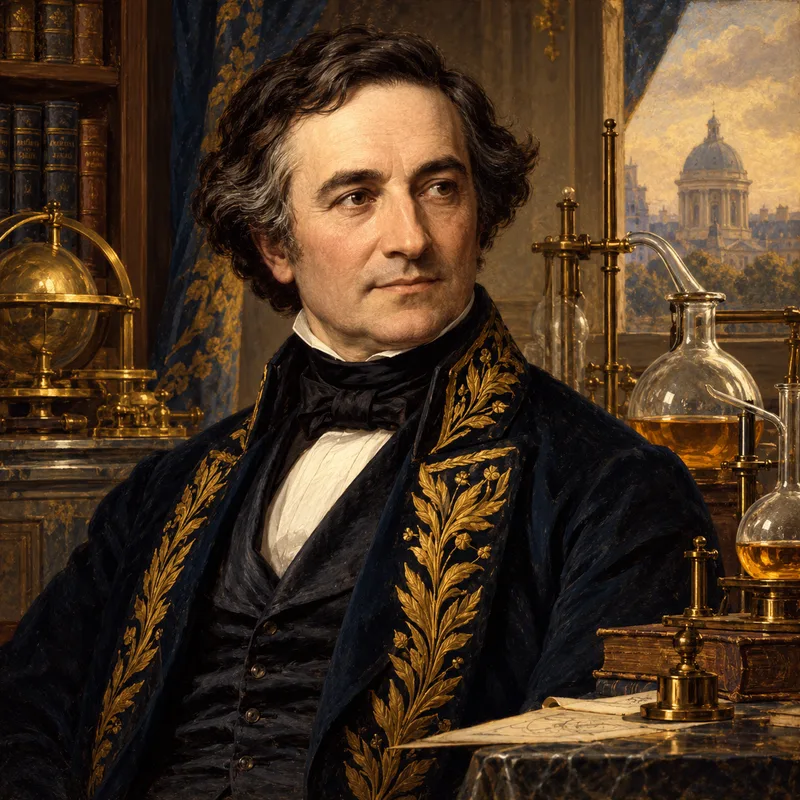
Jean-Baptiste Dumas
1800-1884 · France
Vapor density method; organic analysis