Maxwell Relations: Four Equations, How to Derive Them and How to Use Them
Entropy cannot be measured directly with a meter, but pressure, volume and temperature can. Maxwell relations are the bridge: they replace a hard-to-measure entropy derivative with an easy-to-measure P–V–T derivative. They appear regularly in physical chemistry problems for IIT-JAM, GATE and CSIR-NET, usually as “show that” or “find (∂U/∂V)T for this gas” questions.

Where they come from
Start with the four fundamental equations for a closed system doing only PV work (reversible changes):
dA = −S dT − P dV dG = −S dT + V dP
Each is an exact differential: if dz = M dx + N dy, then (∂M/∂y)x = (∂N/∂x)y. Applying this to each equation gives the four Maxwell relations.
| From | Maxwell relation |
|---|---|
| dU | (∂T/∂V)S = −(∂P/∂S)V |
| dH | (∂T/∂P)S = (∂V/∂S)P |
| dA | (∂S/∂V)T = (∂P/∂T)V |
| dG | (∂S/∂P)T = −(∂V/∂T)P |
The last two are used most often, because their right-hand sides contain only P, V and T, which are measurable. A memory aid: in each relation the variables on top and bottom swap sides, and a minus sign appears when a pressure and a temperature are on the same side of the “swap”.
Useful consequences
- Entropy change at constant T: (∂S/∂V)T = (∂P/∂T)V, so ΔS = ∫(∂P/∂T)V dV.
- Entropy change with pressure: (∂S/∂P)T = −(∂V/∂T)P = −αV, where α is the thermal expansion coefficient.
- Internal pressure: (∂U/∂V)T = T(∂P/∂T)V − P. This is the “thermodynamic equation of state”. It follows from dU = TdS − PdV by dividing by dV at constant T and using the Maxwell relation from dA.
Worked examples
Example 1: ideal gas internal pressure. Show that (∂U/∂V)T = 0 for an ideal gas.
P = nRT/V, so (∂P/∂T)V = nR/V.
(∂U/∂V)T = T(nR/V) − P = nRT/V − P = P − P = 0. ✓
This proves, from thermodynamics alone, that the internal energy of an ideal gas depends only on temperature.
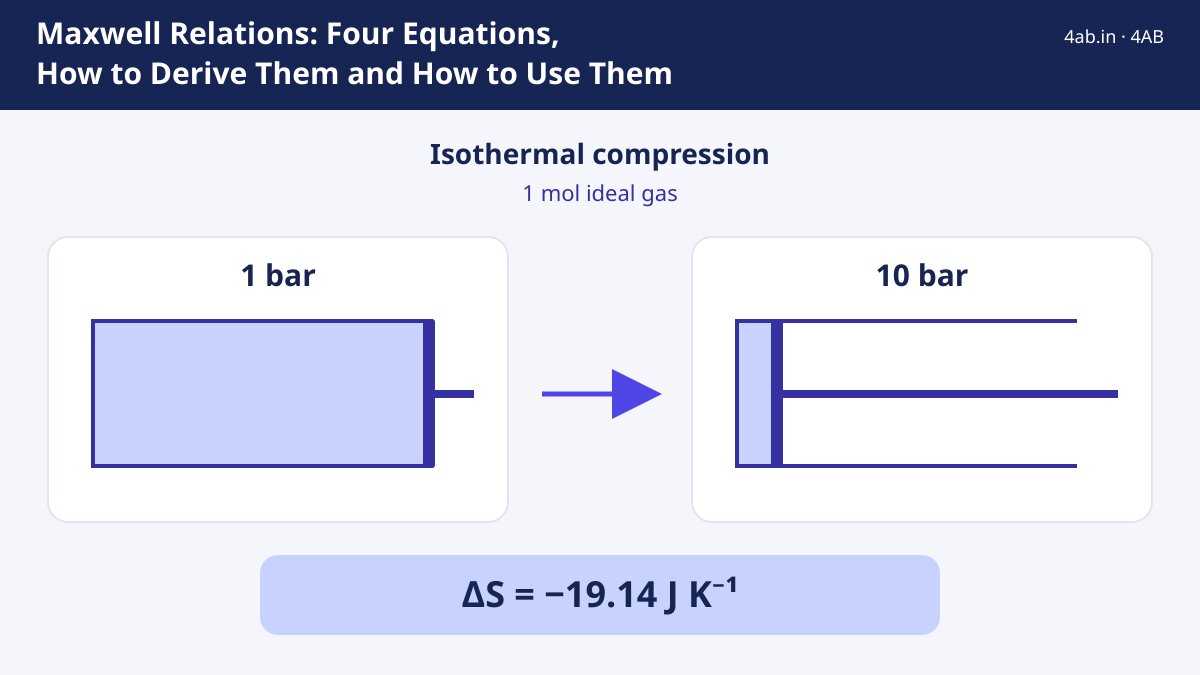
Example 2: entropy of isothermal compression of an ideal gas. Find ΔS for 1 mol of ideal gas compressed isothermally from 1 bar to 10 bar.
(∂S/∂P)T = −(∂V/∂T)P. With V = nRT/P, (∂V/∂T)P = nR/P.
So (∂S/∂P)T = −nR/P and ΔS = −nR ln(P2/P1) = −(1)(8.314) ln 10 = −8.314 × 2.3026 = −19.14 J K−1.
The sign is negative: compression reduces the volume available to the molecules, so entropy falls. This matches the familiar result ΔS = nR ln(V2/V1) with V2/V1 = 1/10.
Example 3: real gas (van der Waals) entropy change. For P = RT/(Vm − b) − a/Vm2, find ΔS for isothermal expansion of 1 mol from 1.00 L to 10.0 L with b = 0.0427 L mol−1.
(∂P/∂T)V = R/(Vm − b). The attraction term a/Vm2 does not depend on T, so it drops out.
ΔS = R ln[(V2 − b)/(V1 − b)] = 8.314 × ln(9.9573 / 0.9573) = 8.314 × ln(10.402) = 8.314 × 2.3420 = 19.47 J K−1.
For an ideal gas the same expansion gives 8.314 × ln 10 = 19.14 J K−1. The real gas value is a little larger, because the molecules’ own volume reduces the free volume at the start more, in relative terms.
Example 4: internal pressure of a van der Waals gas. Using (∂U/∂V)T = T(∂P/∂T)V − P:
T(∂P/∂T)V = RT/(Vm − b) and P = RT/(Vm − b) − a/Vm2.
So (∂U/∂V)T = a/Vm2. Numerically, with a = 3.64 L2 atm mol−2 and Vm = 1.00 L mol−1, the internal pressure is 3.64 atm = 3.64 × 101.325 = 368.8 kPa.
The result confirms that the “a” constant is a measure of the attractive forces: expansion costs energy because molecules must be pulled apart.
Common mistakes
- Dropping the minus sign in the dG relation. The correct form is (∂S/∂P)T = −(∂V/∂T)P.
- Using Maxwell relations as if S and T, or P and V, were independent variables in the wrong pair. Keep the “natural variables” of each potential in mind: U(S,V), H(S,P), A(T,V), G(T,P).
- Mixing units: with R = 8.314 J K−1 mol−1, convert litre-atmosphere to joules (1 L atm = 101.325 J) before combining.
- Saying ΔS = 0 for isothermal expansion of an ideal gas because ΔU = 0. Entropy is a different quantity.
- Forgetting that the relations apply to reversible changes in closed systems with only PV work.
Exam-relevance table
| Type of question | Which relation to reach for |
|---|---|
| Entropy change with volume at constant T | (∂S/∂V)T = (∂P/∂T)V |
| Entropy change with pressure at constant T | (∂S/∂P)T = −(∂V/∂T)P |
| Internal pressure of any gas | (∂U/∂V)T = T(∂P/∂T)V − P |
| “Show that” proofs | Write the exact differential, then equate the cross derivatives |
Check the current syllabus and past papers of your own exam for the depth expected.
Use the ideal-gas panel to check P, V, T and n values when you test a Maxwell-relation result numerically.
Open the Ideal Gas Law Calculator →Turn this concept into marks: solve previous-year CSIR-NET questions and take a timed quiz.
More Thermodynamics articles