Molarity of Ions in Solution: Finding [Na⁺], [Cl⁻] and [SO₄²⁻] from the Salt
A question says: “Find the concentration of chloride ions in 0.10 M CaCl2.” Many students write 0.10 M and lose the mark. The salt is 0.10 M, but the ions have different concentrations. This skill appears in solutions, ionic equilibrium, electrochemistry and titration chapters, so it is worth learning once and properly.

The main idea
A strong ionic salt dissolves completely (we assume 100% dissociation unless the question gives a degree of dissociation). One formula unit gives a fixed number of each ion. So the ion molarity is the salt molarity multiplied by the number of that ion in the formula.
- Salt molarity = moles of salt per litre of solution (mol L−1).
- Number of ions per formula unit = the subscript in the formula. For Al2(SO4)3: 2 Al3+ and 3 SO42−. A subscript outside a bracket multiplies everything inside it.
- Total ion concentration = sum of all ion molarities. This is the number you need for colligative properties and conductivity comparisons.
Quick reference table
| Salt (0.10 M) | Dissociation | Cation (M) | Anion (M) | Total ions (M) |
|---|---|---|---|---|
| NaCl | Na+ + Cl− | 0.10 | 0.10 | 0.20 |
| CaCl2 | Ca2+ + 2Cl− | 0.10 | 0.20 | 0.30 |
| Na2SO4 | 2Na+ + SO42− | 0.20 | 0.10 | 0.30 |
| AlCl3 | Al3+ + 3Cl− | 0.10 | 0.30 | 0.40 |
| Al2(SO4)3 | 2Al3+ + 3SO42− | 0.20 | 0.30 | 0.50 |
Notice the pattern in the last column: total ions = salt molarity × (number of ions per formula unit).
Worked examples
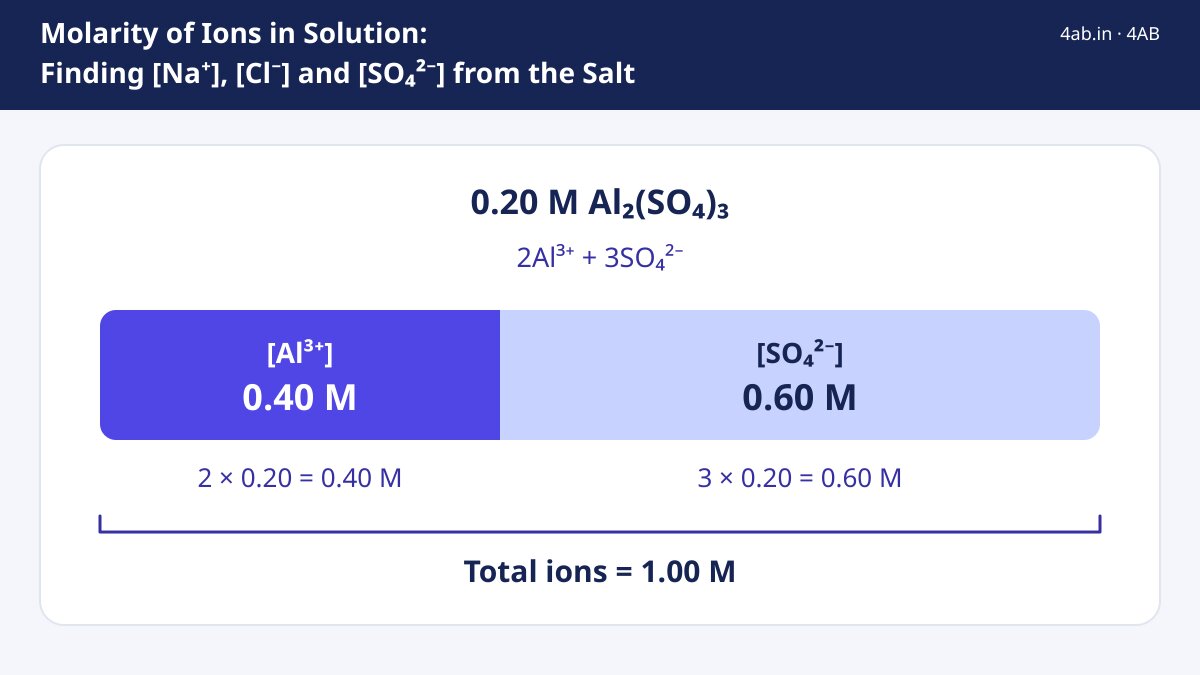
Example 1: 0.20 M aluminium sulphate, Al2(SO4)3.
Al2(SO4)3 → 2Al3+ + 3SO42−
[Al3+] = 2 × 0.20 = 0.40 M
[SO42−] = 3 × 0.20 = 0.60 M
Total ions = 0.40 + 0.60 = 1.00 M, which is 5 × 0.20. Charge check: positive charge = 3 × 0.40 = 1.20 M of charge; negative charge = 2 × 0.60 = 1.20 M of charge. They are equal, so the solution is neutral and the answer is consistent.
Example 2: mixing two salts. 100 mL of 0.10 M NaCl is mixed with 200 mL of 0.050 M CaCl2. Find [Cl−], [Na+] and [Ca2+] in the mixture. (Assume volumes add.)
Work in moles (or millimoles), because concentrations cannot be added directly when volumes differ.
NaCl: 0.10 mol L−1 × 100 mL = 10 mmol → 10 mmol Na+ and 10 mmol Cl−.
CaCl2: 0.050 × 200 = 10 mmol → 10 mmol Ca2+ and 2 × 10 = 20 mmol Cl−.
Total Cl− = 10 + 20 = 30 mmol. Total volume = 300 mL.
[Cl−] = 30 / 300 = 0.100 M
[Na+] = 10 / 300 = 0.0333 M, and [Ca2+] = 10 / 300 = 0.0333 M.
Charge check: positive = 0.0333 + 2(0.0333) = 0.100; negative = 0.100. ✓
Example 3: working backwards to a mass. You need 250 mL of a solution with [Na+] = 0.10 M, using Na2SO4. How many grams are needed?
Each formula unit gives 2 Na+, so [Na2SO4] = 0.10 / 2 = 0.050 M.
Moles = 0.050 mol L−1 × 0.250 L = 0.0125 mol.
Molar mass of Na2SO4 = 2(22.990) + 32.06 + 4(15.999) = 45.980 + 32.06 + 63.996 = 142.04 g mol−1.
Mass = 0.0125 × 142.04 = 1.78 g (1.7755 g before rounding).
Example 4: which solution has more chloride? Compare 0.30 M NaCl, 0.12 M CaCl2 and 0.080 M AlCl3.
[Cl−] in NaCl = 1 × 0.30 = 0.30 M. In CaCl2 = 2 × 0.12 = 0.24 M. In AlCl3 = 3 × 0.080 = 0.24 M.
So the order is NaCl (0.30 M) > CaCl2 = AlCl3 (0.24 M each). The most “concentrated” salt label (0.30 M) is not always the answer, and the lowest label (0.080 M) can still give a lot of chloride.
Common mistakes
- Writing [Cl−] = 0.10 M for 0.10 M CaCl2. Multiply by the subscript: 0.20 M.
- Forgetting that the subscript outside a bracket multiplies every atom inside. In Al2(SO4)3 there are 3 sulphate ions, not 1.
- Adding molarities of two solutions directly when mixing. Add moles, then divide by the total volume.
- Using ion molarity for the salt. Moles of salt = moles of ion ÷ number of that ion per formula unit.
- Applying 100% dissociation to a weak electrolyte such as acetic acid. The rule here is for strong electrolytes and fully soluble salts. For sparingly soluble salts, use the Ksp method instead.
Where this is used in exams
| Topic | How ion molarity is used |
|---|---|
| Ionic equilibrium and Ksp | Common-ion concentration decides whether a precipitate forms. |
| Colligative properties | Total ion concentration (or the van’t Hoff factor) changes the effect. |
| Electrochemistry | Ion concentrations go into the Nernst equation and conductivity. |
| Titrations and precipitation reactions | Moles of reacting ion, not of salt, decide the stoichiometry. |
Always follow the exact wording of your question and your syllabus about dissociation assumptions.
Type in the salt amount and volume to get the molarity, then multiply by the number of ions per formula unit.
Open the Molarity & Concentration Calculator →Turn this concept into marks: solve previous-year CSIR-NET questions and take a timed quiz.
More Solutions articles