Preparing a Standard Solution: How Many Grams to Weigh
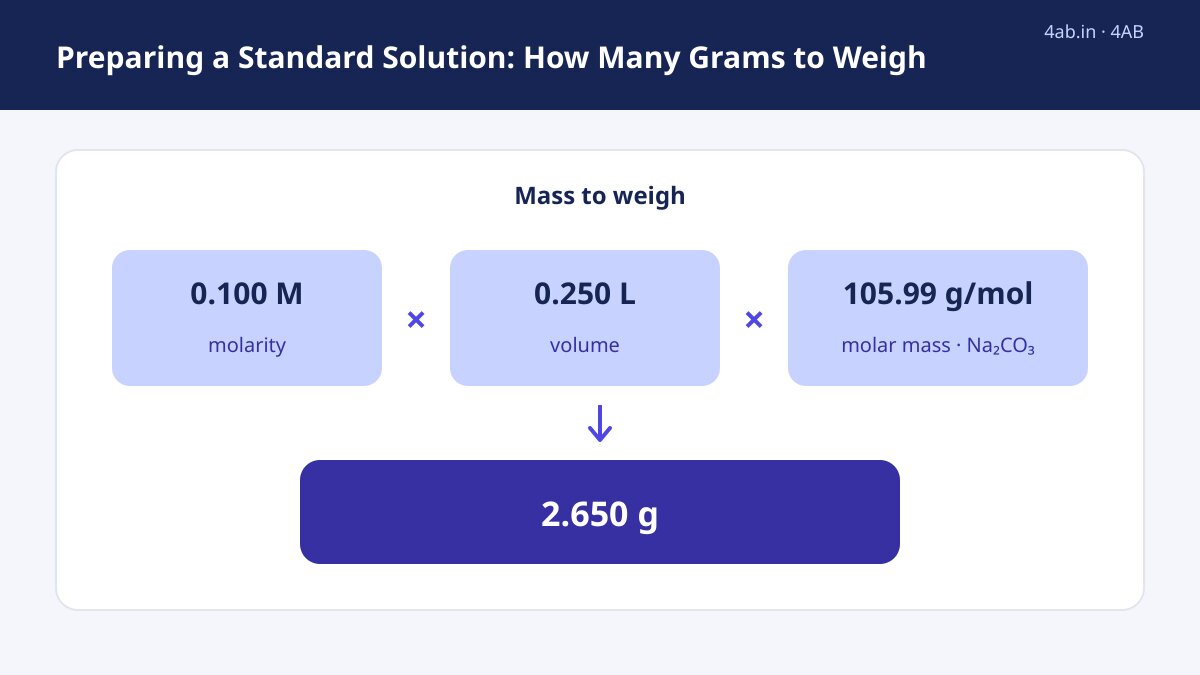
In a school practical or a titration question, you are told to “prepare 250 mL of 0.1 M sodium carbonate solution”. The first job is to decide how many grams to weigh. This is a simple calculation, but small slips such as using the wrong molar mass or forgetting the water of crystallisation lose marks. This article shows the method and explains why only some chemicals are used as standards.

The formula
If the sample is not 100% pure: divide by the purity fraction
Molarity is moles of solute in 1 L of solution. Volume must be in litres, so 250 mL = 0.250 L. Molar mass is of the exact solid you weigh, including any water of crystallisation. A standard solution is one whose concentration is known accurately because it was made from a weighed pure solid in a measured volume.
What makes a good primary standard
A primary standard is a substance you can weigh directly and trust. It should be pure, stable in air, not absorb moisture or CO2, and preferably have a large molar mass so that weighing errors are small in relative terms. Anhydrous sodium carbonate, oxalic acid dihydrate and potassium dichromate are common school-level examples. Sodium hydroxide is not a primary standard because it absorbs water and CO2 from the air, so its solution is first standardised against a primary standard such as oxalic acid.
Worked example 1: sodium carbonate
Question. How many grams of anhydrous Na2CO3 are needed for 250 mL of 0.100 M solution?
Step 1. Molar mass of Na2CO3 = 2(22.99) + 12.01 + 3(16.00) = 105.99 g/mol.
Step 2. Moles needed = 0.100 × 0.250 = 0.0250 mol.
Step 3. Mass = 0.0250 × 105.99 = 2.650 g.
Answer. Weigh 2.65 g, dissolve in a little water in a beaker, transfer to a 250 mL volumetric flask, rinse and add water up to the mark.
Worked example 2: oxalic acid with water of crystallisation
Question. Prepare 250 mL of 0.0500 M oxalic acid, H2C2O4·2H2O. How much should you weigh?
Step 1. Molar mass of the dihydrate = 2(1.008) + 2(12.011) + 4(15.999) + 2(18.015) = 126.07 g/mol. Water counts, because the crystals you weigh contain it.
Step 2. Moles = 0.0500 × 0.250 = 0.01250 mol.
Step 3. Mass = 0.01250 × 126.07 = 1.576 g.
Answer. About 1.58 g. If you had used the anhydrous molar mass (90.03), you would have weighed only 1.125 g and the solution would be 28.6% too dilute.
Because oxalic acid has two replaceable hydrogen atoms, 0.0500 M oxalic acid is also 0.100 N, which older books call N/10. Use the version asked in your question.
Worked example 3: correcting the actual weighing
Question. A student wanted 0.100 M Na2CO3 (250 mL) but the balance read 2.62 g after weighing. What is the actual molarity?
Step 1. Moles = 2.62 ÷ 105.99 = 0.02472 mol.
Step 2. Molarity = 0.02472 ÷ 0.250 = 0.0989 M.
Answer. 0.0989 M. In a standard-solution experiment you do not need to hit 2.650 g exactly. You record the real mass and calculate the real molarity from it. This is better than trying to adjust the mass to the target.
Worked example 4: impure sample
Question. The available sodium carbonate is only 98.0% pure. What mass gives 250 mL of 0.100 M solution?
Step 1. The pure mass needed is 2.650 g (from example 1).
Step 2. The sample contains 0.980 g of Na2CO3 in each 1.000 g, so weigh 2.650 ÷ 0.980 = 2.704 g.
Check: 2.704 × 0.980 = 2.650 g of pure compound. Correct.
In real laboratory work, an impure substance is usually not used as a primary standard at all. This example is for practice with the purity step.
Common mistakes
- Volume in mL. 250 mL must be changed to 0.250 L before multiplying.
- Wrong molar mass for hydrated salts. If the label says ·2H2O or ·10H2O, add the water.
- Dissolving in 250 mL of water. The solution volume must be 250 mL, so dissolve first in a small amount of water and then make up to the mark in the flask.
- Using NaOH as a primary standard. It absorbs moisture and CO2, so the weighed mass is not all NaOH.
- Not rinsing the beaker and funnel into the flask, which leaves solute behind.
Exam relevance
| Question | Key step |
|---|---|
| Mass for a given M and volume | M × V(L) × molar mass |
| Hydrated salt | Include water in the molar mass |
| Actual molarity from the weighing | (mass ÷ molar mass) ÷ volume in L |
| Normality asked | N = M × n-factor (oxalic acid: 2) |
| Why not NaOH | Not a primary standard |
After this step comes the titration itself, where your standard solution is used to find an unknown concentration.
Check your mass-to-molarity working with the Molarity & Concentration tool.
Open the Molarity & Concentration Calculator →