Radial and Angular Nodes of Hydrogen-Like Orbitals
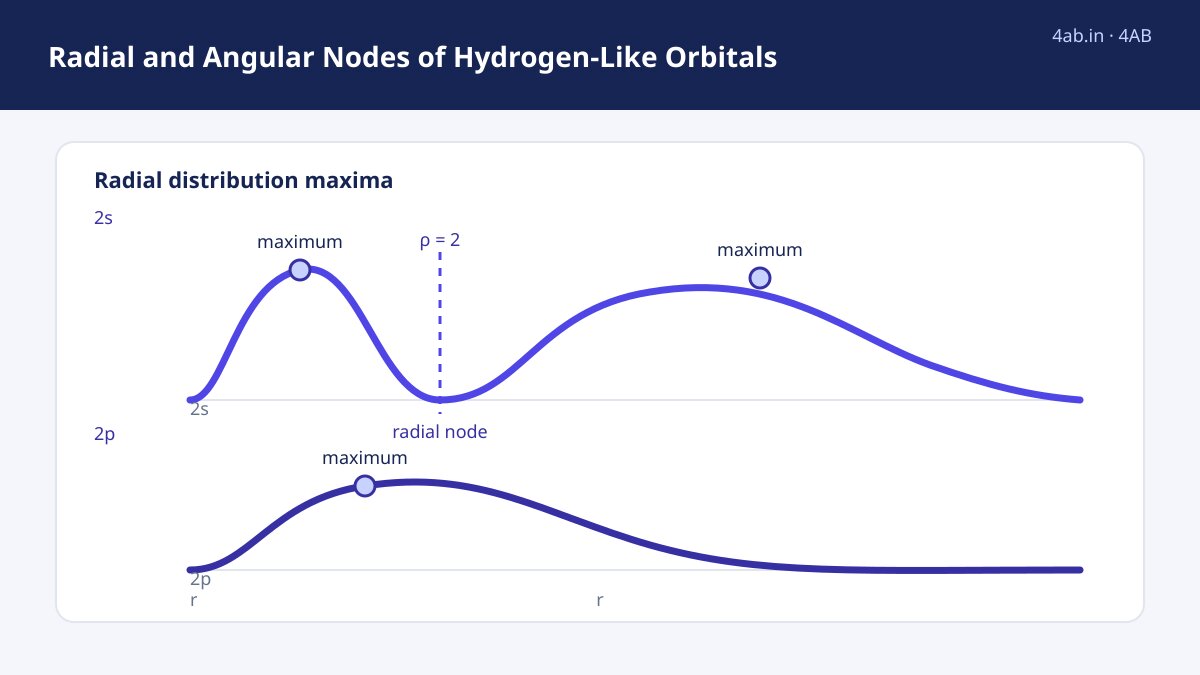
Nodes are the places where an electron is never found. They decide the shape of every orbital, and they explain why a 2s orbital has a second, smaller region around the nucleus while a 2p orbital has none. Questions on nodes appear in IIT-JAM, GATE, CSIR-NET and CUET-PG as direct counting problems, and sometimes as a request to find the actual distance of a radial node. This page gives the counting rules, derives the node positions for a few hydrogen-like orbitals, and works five examples with the arithmetic checked.

The counting rules
Angular nodes = l
Total nodes = n − 1
n is the principal quantum number and l is the azimuthal (angular momentum) quantum number: l = 0, 1, 2, 3 for s, p, d, f. A radial node is a spherical surface at a fixed distance r from the nucleus where the wavefunction ψ is zero. An angular node is a plane or cone passing through the nucleus. The wavefunction changes sign when you cross a node.
The total number of nodes depends only on n. Each step up in n adds exactly one node, and the l value decides how many of the nodes are angular and how many are radial.
Table of nodes
| Orbital | n | l | Radial nodes | Angular nodes | Total |
|---|---|---|---|---|---|
| 1s | 1 | 0 | 0 | 0 | 0 |
| 2s | 2 | 0 | 1 | 0 | 1 |
| 2p | 2 | 1 | 0 | 1 | 1 |
| 3s | 3 | 0 | 2 | 0 | 2 |
| 3p | 3 | 1 | 1 | 1 | 2 |
| 3d | 3 | 2 | 0 | 2 | 2 |
| 4f | 4 | 3 | 0 | 3 | 3 |
Notice the pattern along each row of n: the first orbital of a given l has no radial node. The lowest p orbital is 2p, the lowest d is 3d and the lowest f is 4f; each has zero radial nodes.
Where the radial nodes lie
For a one-electron atom with nuclear charge Z, write ρ = Zr ÷ a0, where a0 is the Bohr radius, 52.9177 pm. The radial parts of the wavefunctions are a polynomial in ρ multiplied by a decaying exponential. A radial node is a root of the polynomial. The standard polynomials are:
| Orbital | Polynomial in ρ | Roots (nodes) |
|---|---|---|
| 2s | 2 − ρ | ρ = 2 |
| 3s | 27 − 18ρ + 2ρ2 | ρ = 1.902 and 7.098 |
| 3p | ρ(6 − ρ) | ρ = 6 (the factor ρ only gives the zero at r = 0) |
The node positions in a hydrogen-like atom are therefore r = ρ a0 ÷ Z. A larger Z pulls the nodes in towards the nucleus. These forms follow from the hydrogen-like radial equation; the exponential factor never equals zero, so it does not create nodes.
Worked example 1: counting nodes
Question. Find the radial, angular and total nodes in a 4d orbital and in a 5f orbital.
4d. n = 4, l = 2. Radial = 4 − 2 − 1 = 1; angular = 2; total = 4 − 1 = 3. Check: 1 + 2 = 3.
5f. n = 5, l = 3. Radial = 5 − 3 − 1 = 1; angular = 3; total = 5 − 1 = 4. Check: 1 + 3 = 4.
Worked example 2: from nodes to the orbital
Question. An orbital has 2 radial nodes and 1 angular node. Name it.
l. Angular nodes = l, so l = 1 (a p orbital).
n. Radial nodes = n − l − 1 = 2, so n = 2 + 1 + 1 = 4.
Answer. It is a 4p orbital. Total nodes = 3 = n − 1, which confirms it.
Worked example 3: the 2s node in hydrogen
Question. Find the distance of the radial node of the 2s orbital of the hydrogen atom from the nucleus. Take a0 = 52.9177 pm.
Condition. 2 − ρ = 0, so ρ = 2. For hydrogen Z = 1, so r = 2a0.
Calculation. r = 2 × 52.9177 = 105.8 pm.
Worked example 4: the effect of nuclear charge
Question. Where is the 2s radial node in He+ (Z = 2) and in Li2+ (Z = 3)?
Rule. ρ = 2 for any hydrogen-like 2s orbital, and r = ρ a0 ÷ Z.
He+. r = 2 × 52.9177 ÷ 2 = 52.9 pm.
Li2+. r = 2 × 52.9177 ÷ 3 = 35.3 pm.
The node moves inward as Z increases, because the stronger attraction shrinks the whole orbital.
Worked example 5: the two nodes of 3s
Question. Find the radial nodes of the 3s orbital of hydrogen.
Polynomial. 2ρ2 − 18ρ + 27 = 0.
Quadratic formula. ρ = [18 ± √(182 − 4 × 2 × 27)] ÷ (2 × 2) = [18 ± √(324 − 216)] ÷ 4 = [18 ± √108] ÷ 4 = [18 ± 10.392] ÷ 4.
Roots. ρ1 = 7.608 ÷ 4 = 1.902; ρ2 = 28.392 ÷ 4 = 7.098.
Distances. r1 = 1.902 × 52.9177 = 100.6 pm; r2 = 7.098 × 52.9177 = 375.6 pm.
Check. Sum of roots = 18 ÷ 2 = 9 and 1.902 + 7.098 = 9.000. Product = 27 ÷ 2 = 13.5 and 1.902 × 7.098 = 13.50. The number of roots is 2, as n − l − 1 = 2 requires.
Nodes and the radial distribution curve
If you plot the radial distribution function 4πr2R2(r) against r, the curve touches zero at every radial node. It also touches zero at r = 0. A useful result is that this curve for a given orbital has (n − l) maxima. For example, 2s has two maxima, with the larger one outside the node, and 2p has one. The inner peak of 2s lies close to the nucleus, which is one reason a 2s electron is lowered in energy relative to 2p in many-electron atoms (penetration).
Common mistakes
- Counting the nucleus. The zero of ψ at r = 0 for p, d and f orbitals is not a radial node. Radial nodes are at finite distances.
- Using n − l instead of n − l − 1. n − l is the number of maxima in the radial distribution curve, one more than the number of nodes.
- Forgetting angular nodes. A 2p orbital has one node, the nodal plane, even though it has no radial node.
- Applying hydrogen-like roots to many-electron atoms. The positions r = ρ a0 ÷ Z are for one-electron species only; the counting rules still hold for all atoms.
- Mixing up total nodes and radial nodes. Total = n − 1 always.
Exam relevance
| Question type | Method |
|---|---|
| Count nodes of a named orbital | Use n − l − 1, l and n − 1 |
| Name the orbital from its nodes | l = angular nodes, then n = radial + l + 1 |
| Find the distance of a node | Solve the radial polynomial for ρ, then r = ρ a0 ÷ Z |
| Compare penetration | Use the number of maxima, n − l |
Check the current syllabus of your exam to see whether explicit radial functions are required or only the counting rules.
Revise the allowed values of n, l and m before you count nodes, using the quantum numbers tool.
Open the Quantum Numbers Calculator →Turn this concept into marks: solve previous-year CSIR-NET questions and take a timed quiz.
More Quantum & structure articles