Rotational Constant and Bond Length from a Microwave Spectrum
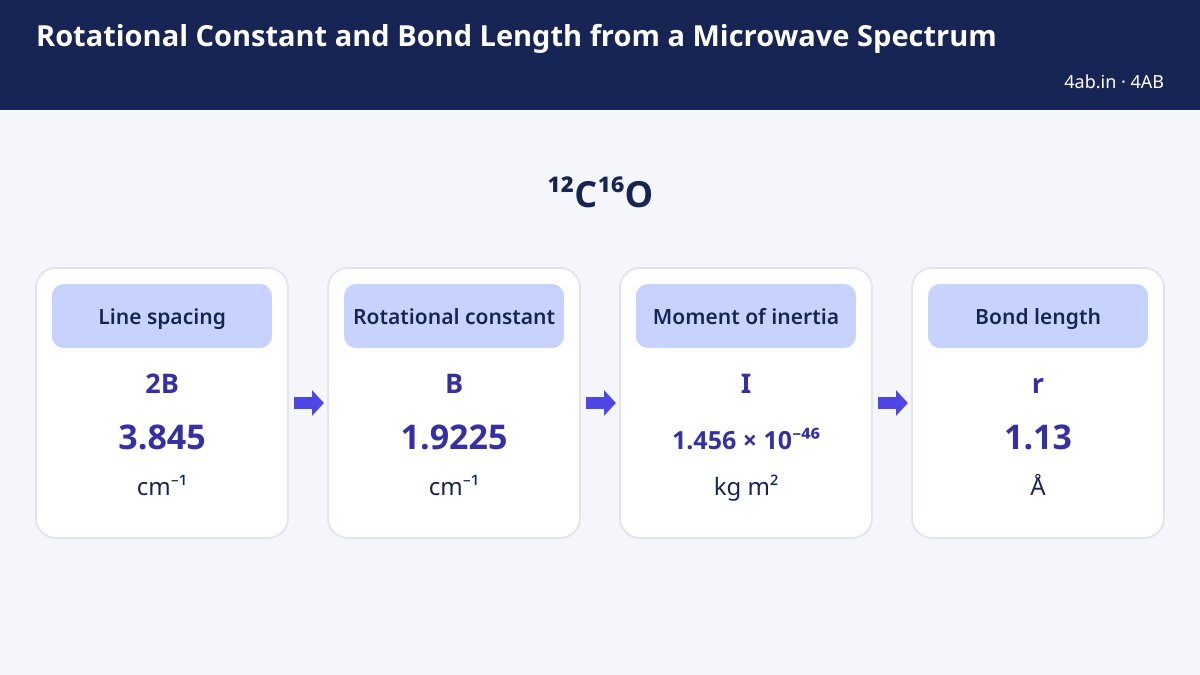
Microwave (pure rotational) spectroscopy is the cleanest way to measure the bond length of a small molecule. It is a standard topic in the physical chemistry sections of IIT-JAM, GATE, CSIR-NET and CUET-PG, and the numerical is always the same chain: line spacing → B → moment of inertia → bond length. This page works through that chain with four examples, including an isotope-shift question and a population question.

The rigid rotor model
A diatomic molecule is treated as two point masses fixed at distance r, rotating about the centre of mass. The energy levels are
B = h / (8π2 c I), I = μ r2, μ = m1m2 / (m1 + m2)
Line positions: ν̃(J → J+1) = 2B (J + 1) cm−1
- B is the rotational constant. It is large for light molecules and small for heavy ones. Use c in cm/s (2.998 × 10¹⁰) when you want B in cm−1.
- I is the moment of inertia in kg m2; μ is the reduced mass in kg (1 atomic mass unit = 1.6605 × 10⁻²⁷ kg).
- Selection rules: the molecule must have a permanent dipole moment, and ΔJ = +1 for absorption. So CO and HCl show a pure rotational spectrum; N2, H2 and O2 do not.
- Adjacent lines are therefore equally spaced by 2B, and the first line (J = 0 → 1) sits at 2B.
- Real molecules stretch slightly as they spin (centrifugal distortion), so measured spacings shrink a little at high J. The rigid rotor model ignores this.
Example 1: bond length of 12C16O from line spacing. The rotational lines of 12C16O are spaced by 3.845 cm−1. Find the bond length. Use masses 12.000 u and 15.995 u.
Spacing = 2B, so B = 3.845 / 2 = 1.9225 cm−1.
Reduced mass: μ = (12.000 × 15.995) / (12.000 + 15.995) = 191.94 / 27.995 = 6.856 u = 6.856 × 1.6605 × 10−27 = 1.1385 × 10⁻²⁶ kg.
I = h / (8π2 c B) = 6.626 × 10⁻³⁴ / (8 × 9.8696 × 2.998 × 1010 × 1.9225) = 6.626 × 10⁻³⁴ / 4.551 × 1012 = 1.456 × 10−46 kg m2.
r = √(I / μ) = √(1.456 × 10−46 / 1.1385 × 10⁻²⁶) = √(1.279 × 10⁻²⁰) = 1.131 × 10⁻¹⁰ m = 1.13 Å.
Example 2: the same molecule from a frequency. The J = 0 → 1 absorption of 12C16O is observed near 115.27 GHz. Check that this gives the same bond length.
For J = 0 → 1, the frequency equals 2B (in frequency units), so B = 115.27 / 2 = 57.635 GHz.
In wavenumbers: B = 57.635 × 10⁹ / 2.998 × 1010 = 1.9225 cm−1, the same as Example 1.
Directly in SI units, I = h / (8π2B) with B in Hz: I = 6.626 × 10⁻³⁴ / (78.957 × 5.7635 × 1010) = 1.456 × 10−46 kg m2, so r = 1.13 Å, as before. Using both routes is a good self-check in the exam.
Example 3: isotope substitution. If 12C is replaced by 13C (13.003 u), find the new B and the new line spacing. Assume the bond length does not change.
μ(13C16O) = (13.003 × 15.995) / (13.003 + 15.995) = 207.98 / 28.998 = 7.172 u.
B ∝ 1/I = 1/(μr2), and r is the same, so B(13CO) = 1.9225 × (6.856 / 7.172) = 1.838 cm−1.
New spacing = 2B = 3.676 cm−1, which is 0.17 cm−1 smaller than before. The heavier isotope gives a smaller B and lines that are closer together. This is how isotopic substitution is used to get bond lengths of molecules with more than two atoms.
Example 4: which J level is most populated? For CO (B = 1.9225 cm−1) at 300 K, estimate the J of the most populated level.
Population of level J is proportional to (2J + 1) exp[−hcBJ(J+1)/kT]. The factor (2J + 1) is the degeneracy and rises with J; the exponential falls. Setting the derivative to zero gives
Jmax = √(kT / 2hcB) − 1/2.
kT/hc at 300 K = (1.3806 × 10−23 × 300) / (6.626 × 10−34 × 2.998 × 1010) = 208.5 cm−1.
kT / 2hcB = 208.5 / (2 × 1.9225) = 54.2, √54.2 = 7.36, so Jmax = 7.36 − 0.5 = 6.86, i.e. J ≈ 7.
So the strongest line in the spectrum is near J = 7, not J = 0. The intensity pattern rises and then falls.
Common mistakes
- Using the mass of one atom instead of the reduced mass μ.
- Treating the line spacing as B. The spacing is 2B.
- Mixing units: B in cm−1 needs c in cm/s; if you use c in m/s, convert B to m−1 first.
- Forgetting to convert atomic mass units to kg before taking r = √(I/μ).
- Applying pure rotational selection rules to a homonuclear molecule. N2 has no permanent dipole and no microwave absorption.
- Assuming the heavier isotope shifts lines to higher wavenumber. B decreases when μ increases.
Exam-relevance table
| Quantity | Formula | Typical question |
|---|---|---|
| Line spacing | 2B | Find B from two adjacent lines |
| Moment of inertia | I = h/(8π2cB) | Find I, then r = √(I/μ) |
| Isotope effect | B ∝ 1/μ | Predict B or line shift after substitution |
| Most populated level | √(kT/2hcB) − 1/2 | Find the strongest line |
| Selection rule | ΔJ = ±1, permanent dipole | Which molecules are microwave active? |
Question styles and the exact constants given vary between exams, so check the latest official notification and the data sheet in your own paper. When no data is supplied, memorising h, c, k and u to four figures is enough for these numericals.
Look up h, c, k and the atomic mass unit to full precision before you do the arithmetic.
Open the Scientific Constants Tool →Previous-year CSIR-NET questions and timed quizzes to check what you just read.
More Concepts articles