Biography · Chemist no. 183 of 350
Aaron Ciechanover: A Doctor Who Became a Protein Chemist
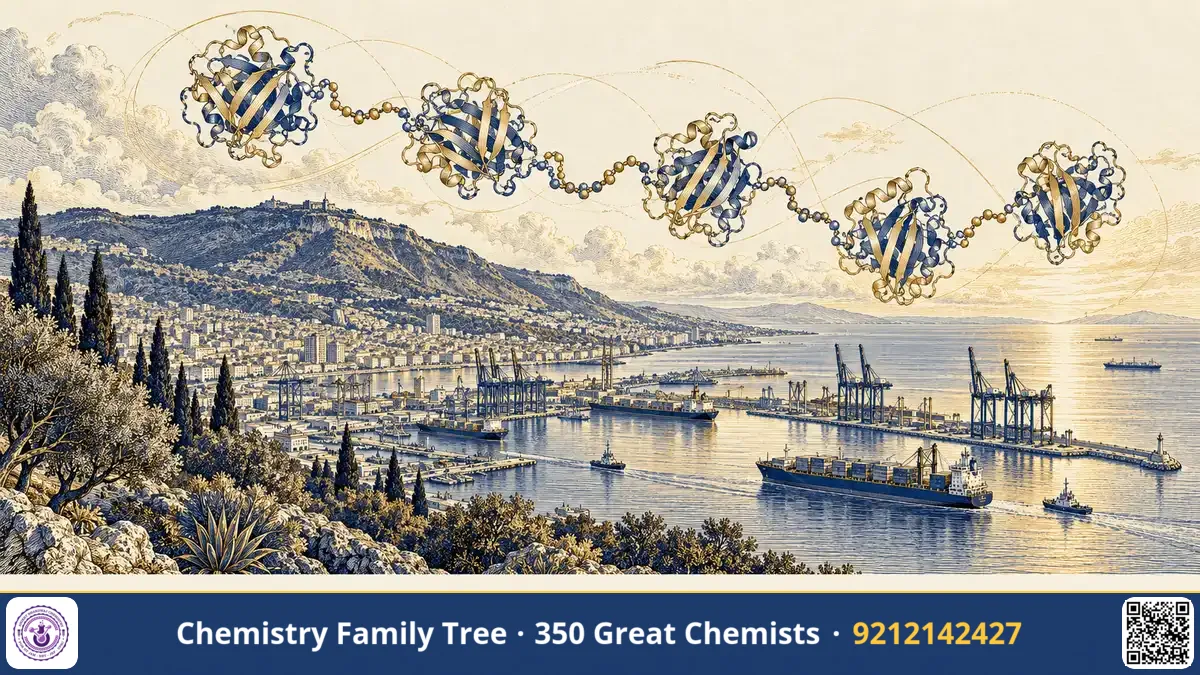
Aaron Ciechanover (born 1 October 1947) is an Israeli biochemist and physician at the Technion – Israel Institute of Technology in Haifa. As a graduate student he performed the experiments that revealed how cells tag proteins with ubiquitin for destruction. He shared the 2004 Nobel Prize in Chemistry with his teacher Avram Hershko and with Irwin Rose.
Early Life and Family
Ciechanover was born in Haifa, then in the final period before the State of Israel was founded in 1948. His parents had emigrated from Poland to the land of Israel before World War II. He grew up in a modest home in a country that was building institutions from nothing, in a culture that prized education. Haifa, a port city with the Technion on the slopes of Mount Carmel, was also the place where his scientific career would blossom.
Education and Mentors
He studied medicine at the Hebrew University–Hadassah Medical School in Jerusalem, receiving his MD in 1973. After military service as a physician in the Israel Defense Forces, he began work towards a doctorate under Avram Hershko at the Technion's Faculty of Medicine. He completed the DSc (doctor of science) in 1982. Hershko, who had been trained in medicine and then biochemistry, gave his student freedom to follow his curiosity. For short periods Ciechanover and Hershko also worked at Irwin Rose's laboratory at the Fox Chase Cancer Center in Philadelphia, where the three men refined the picture of the enzyme system. Ciechanover also did postdoctoral work at the Massachusetts Institute of Technology with Harvey Lodish, studying cell biology.
Career Timeline
| Year | Event |
|---|---|
| 1947 | Born in Haifa |
| 1973 | MD, Hebrew University–Hadassah Medical School, Jerusalem |
| Late 1970s | Graduate work with Hershko; ATP-dependent protein conjugation by a small protein (APF-1, later identified as ubiquitin) |
| 1982 | DSc from the Technion |
| 1980s | Postdoctoral work at MIT; returned to the Technion |
| Later career | Professor in the Rappaport Faculty of Medicine, Technion |
| 2004 | Nobel Prize in Chemistry (shared) |
Major Scientific Contributions
Ciechanover's main contribution is the biochemical discovery of the ubiquitin conjugation system. He showed that a small heat-stable protein, labelled with iodine-125, became covalently attached to proteins in the presence of ATP; that multiple copies could be attached; and that this tagging was necessary for degradation. Together with Hershko and Rose he defined the E1–E2–E3 enzyme cascade, in which ubiquitin is activated by E1 using ATP, transferred through an E2 as a thioester and linked via an isopeptide bond to a lysine residue on the substrate with the help of an E3 ligase. A chain of four or more ubiquitins on Lys48 sends the protein to the 26S proteasome. See the discovery article for the complete scheme.
His later research examined how specific proteins, such as p53, the cell-cycle regulator, and proteins involved in cancer and cystic fibrosis, are recognised by the system. He has also written widely about how to translate basic findings into medicine.
Awards, Honours and Nobel Prize
- Nobel Prize in Chemistry 2004: shared equally by Aaron Ciechanover, Avram Hershko and Irwin Rose "for the discovery of ubiquitin-mediated protein degradation". This is a Chemistry prize, though the work is of huge importance to medicine.
- Lasker Basic Medical Research Award (2000), shared with Hershko and Alexander Varshavsky.
- Israel Prize, awarded in 2003 to Ciechanover and Hershko (for life sciences).
- Membership in the US National Academy of Sciences and other academies, and many honorary degrees.
Personality, Struggles and Lesser-Known Facts
- Student making history: The original experiments were done while he was still a graduate student, so a good fraction of the Nobel prize rests on a PhD-level project.
- Persistence in a small lab: Technion laboratories in the 1970s had few resources compared to American ones, yet careful biochemistry was enough.
- Controversy in sharing: The prize left out some scientists who had contributed significantly, and Ciechanover has spoken openly about the difficulty of any shared credit; for example, Alexander Varshavsky's work on degradation signals was also very influential.
- A teacher and speaker: He often speaks to young scientists on integrity, curiosity and the role of luck in science.
- Doctor's viewpoint: He kept an interest in disease from his medical training, leading to translational research.
Legacy and Influence on Modern Chemistry
The ubiquitin system is a central topic in biochemistry textbooks. It controls the cell cycle, DNA repair, immune responses and protein quality control. The proteasome inhibitor bortezomib became a standard treatment for multiple myeloma, and new drugs known as PROTACs use E3 ligases to destroy disease proteins. Students in India meet these ideas in the biochemistry paper of CSIR-NET Life Sciences and in chemistry courses that discuss enzyme mechanisms and thioester chemistry.
Lessons for Students
- Careful, patient biochemistry in a small laboratory can lead to world-class results.
- Look at what does not fit existing ideas, such as ATP needed for degradation.
- Pick good mentors and be willing to work with others across countries.
- Combine clinical interest with basic research.
- Be generous in sharing credit; science is a team effort.
Quick Facts Box
- Born: 1 October 1947, Haifa
- Died: Living
- Nationality: Israeli
- Field: Biochemistry, cell biology
- Famous for: Ubiquitin-mediated protein degradation
- Nobel: Chemistry 2004 (shared with Avram Hershko and Irwin Rose)
FAQ
Who was Ciechanover's supervisor?
Avram Hershko at the Technion; they shared the 2004 Nobel Prize with Irwin Rose.
Was it a Nobel Prize in Medicine?
No, the prize was in Chemistry.
Where does he work?
At the Technion – Israel Institute of Technology in Haifa.
What did he discover in simple words?
That cells mark unwanted proteins with a chain of small ubiquitin proteins, using ATP, so that the proteasome can destroy them.
Published by ABC Chemistry — IIT-JAM | CSIR-NET | GATE Chemistry Coaching. Visit abcchemistry.com
About the chemist
Aaron Ciechanover
1947- · Israel · Nobel Chemistry 2004
Ubiquitin-mediated protein degradation