The discovery, explained · Chemist no. 183 of 350
Aaron Ciechanover and the Ubiquitin Tag: The Kiss of Death for Proteins
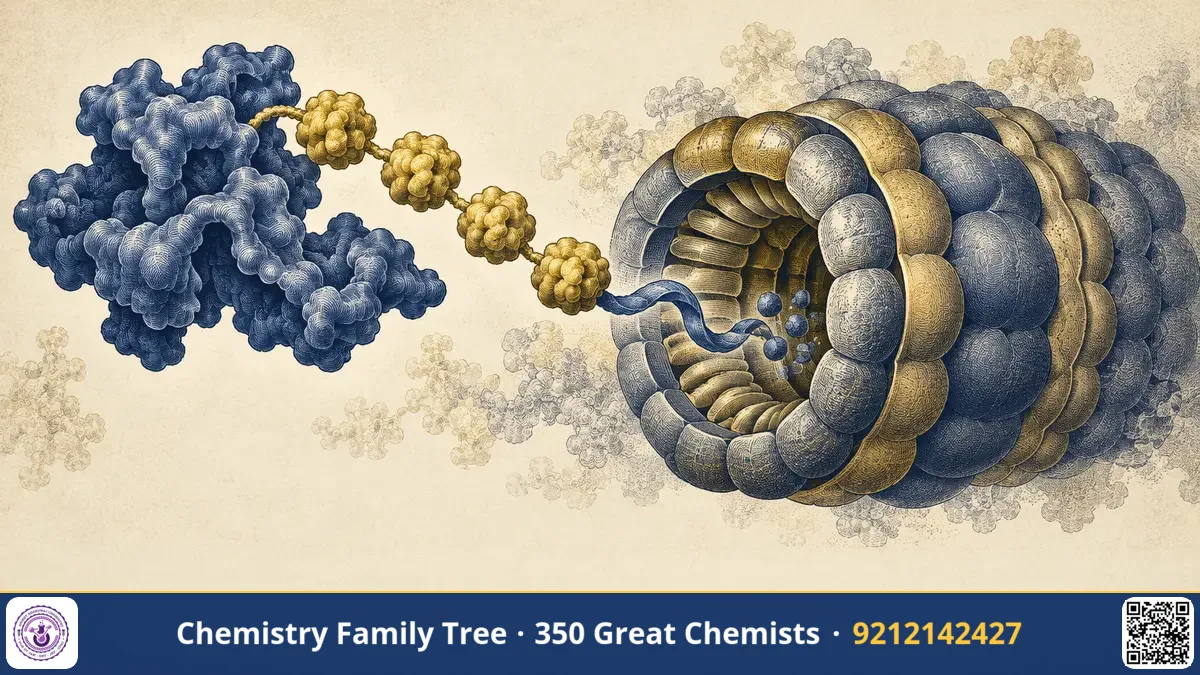
A cell is not only busy making proteins; it must also destroy them, quickly and selectively. Damaged proteins must be removed, and regulatory proteins such as cyclins and the tumour suppressor p53 must be switched off at exactly the right moment. In the late 1970s a young Israeli biochemist, Aaron Ciechanover, working in the laboratory of Avram Hershko at the Technion in Haifa, helped to uncover the mechanism: proteins are marked for destruction by attachment of a small protein called ubiquitin.
For this work Ciechanover, Hershko and Irwin Rose shared the 2004 Nobel Prize in Chemistry "for the discovery of ubiquitin-mediated protein degradation". This post concentrates on the experiments and the enzymatic cascade.
The Scientific Problem Before the Discovery
Until the 1970s, most biochemists worked on how proteins are made. Degradation was considered a boring, unregulated process: proteins were thought to be digested in lysosomes, the cell's "stomach", which were discovered by Christian de Duve. But several puzzles did not fit:
- Many proteins have very short lifetimes (minutes), while others last days. Lysosomes could not explain this selectivity.
- Protein degradation in cells requires energy (ATP), but simple hydrolysis of a peptide bond (R–CO–NH–R′ + H₂O → R–COOH + H₂N–R′) is exergonic and should not need ATP.
- Reticulocytes (immature red blood cells) have no lysosomes, yet they break down abnormal haemoglobin by an ATP-dependent process.
Thus there had to be a non-lysosomal, energy-requiring, highly selective system.
The Discovery: Step by Step
Using a cell-free extract of rabbit reticulocytes (developed by others as a model of ATP-dependent proteolysis), the Technion group asked: what does the extract contain? Ciechanover, as a graduate student, did the careful fractionation.
- Fractionation: The extract was separated by ion-exchange chromatography into two fractions. Neither fraction alone could degrade proteins, but together, with ATP, they could. So a heat-stable, small protein component (called APF-1, ATP-dependent proteolysis factor 1) was needed.
- Labelling: APF-1 was radioactively labelled with iodine-125. When labelled APF-1 was incubated with ATP and a target protein, it became covalently attached to the target protein, forming high-molecular-weight conjugates that survived SDS treatment. The attachment was resistant to boiling in SDS, so it was a true covalent bond.
- Multiple tags: A single protein could carry many APF-1 molecules, giving a ladder of bands on gels. This meant the tag was added repeatedly.
- Identity of APF-1: Later it was recognised as the same as ubiquitin, a 76-amino-acid protein (about 8.5 kDa) already isolated in 1975 from many tissues and named for being "ubiquitous", whose function was unknown.
- Enzymes: With Hershko and Rose, he showed that three classes of enzymes act in sequence: E1, E2 and E3.
The Chemistry Behind It
The ubiquitin system is a beautiful piece of organic and enzyme chemistry, because the carboxyl group at the C-terminus of ubiquitin (Gly-76) is joined to a lysine amino group (ε-NH₂) of the target protein, making an isopeptide bond. That requires activation, as with amino acid activation in protein synthesis:
E1 + ATP + Ub → E1~Ub-AMP + PPi         (adenylation of Ub C-terminus)
E1~Ub-AMP → E1–S–Ub (thioester) + AMP     (transfer to E1 cysteine)
E1–S–Ub + E2–SH → E2–S–Ub + E1–SH        (transthiolation)
E2–S–Ub + Protein–Lys-NH₂ →(E3)→ Protein–NH–CO–Ub + E2–SH
Thus ATP provides the energy for forming the high-energy thioester, which then drives the formation of the isopeptide bond. The roles are:
- E1 (activating enzyme): one or a few types; uses ATP.
- E2 (conjugating enzyme): tens of types; carries activated ubiquitin.
- E3 (ligase): hundreds of types; recognise specific substrates and provide the specificity of the whole system.
When four or more ubiquitins are linked through lysine-48 of each ubiquitin, the polyubiquitin chain is the signal for the 26S proteasome, a barrel-shaped protease complex. The proteasome unfolds the protein, removes the chain (with deubiquitinating enzymes) and cuts the protein into short peptides, while ubiquitin is recycled.
Applications Today
- Cancer therapy: The proteasome inhibitor bortezomib is used to treat multiple myeloma.
- Cell cycle control: Cyclins are destroyed by ubiquitination at the right time, so cells move through mitosis in order.
- Immunity: Proteasome products are displayed on MHC class I molecules.
- Neurodegeneration: Faulty clearance of proteins is linked to Parkinson's and Alzheimer's diseases.
- New drug types: PROTACs, small molecules that bring a disease protein close to an E3 ligase to destroy it, use the same system.
Exam Corner
- Ciechanover, Hershko and Rose shared the Nobel Prize in Chemistry 2004 (not Medicine).
- Ubiquitin: 76 amino acids, about 8.5 kDa, highly conserved; first called APF-1 in the proteolysis context.
- E1 uses ATP to form a ubiquitin thioester; E2 transfers; E3 gives substrate specificity.
- Ubiquitin is attached through an isopeptide bond to the ε-amino group of lysine.
- A chain of four or more Lys48-linked ubiquitins signals degradation by the 26S proteasome.
Common Misconceptions
- "Ubiquitin itself digests proteins." No, it is only a tag; the proteasome does the cutting.
- "ATP is used to break peptide bonds." ATP is used for activating ubiquitin and for unfolding substrates, not for the hydrolysis step itself.
- "Lysosomes do all degradation." They do much, but the ubiquitin-proteasome system handles most short-lived regulatory proteins.
Quick Revision Box
- Ciechanover: graduate student turned Nobel laureate, Technion, Haifa.
- Radioactive-ubiquitin experiments showed covalent, multiple tagging.
- Cascade: E1 (activate), E2 (carry), E3 (select substrate).
- Bond: isopeptide between Gly-76 carboxyl and Lys ε-NH₂.
- Lys48-linked polyubiquitin sends proteins to the 26S proteasome.
- Drug link: bortezomib for myeloma.
FAQ
Why is it called ubiquitin?
Because it is found almost everywhere in living cells (ubiquitous) and its sequence is nearly identical across yeast, plants and humans.
What is the role of E3 ligase?
E3 enzymes recognise the target protein and bring it close to the E2 carrying ubiquitin, which gives the system its selectivity.
Can ubiquitination do things besides degradation?
Yes. Other linkages and single ubiquitin tags regulate DNA repair, trafficking and signalling.
Why is the discovery in Chemistry?
The prize recognised a chemical mechanism: enzyme cascade, thioester intermediates and covalent bond formation.
Published by ABC Chemistry — IIT-JAM | CSIR-NET | GATE Chemistry Coaching. Visit abcchemistry.com
About the chemist
Aaron Ciechanover
1947- · Israel · Nobel Chemistry 2004
Ubiquitin-mediated protein degradation