Biography · Chemist no. 117 of 350
Adolf Butenandt: The Chemist of Hormones and Pheromones
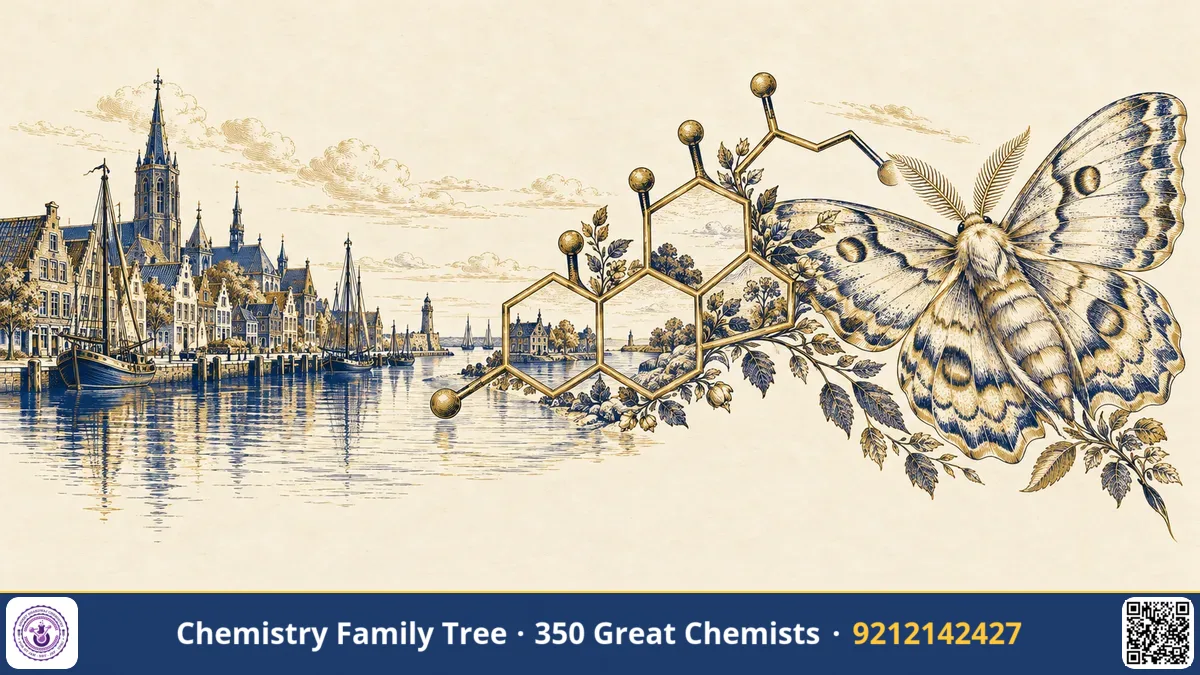
Adolf Friedrich Johann Butenandt (1903-1995) was a German biochemist and organic chemist. He isolated the first pure sex hormones, helped to make steroid hormones available as drugs, discovered the insect moulting hormone ecdysone and the first pheromone bombykol, and later led the Max Planck Society. He won a share of the 1939 Nobel Prize in Chemistry. His legacy is the proof that the body's chemical messengers can be isolated, drawn as formulas and made in the laboratory.
Early Life & Family
Butenandt was born on 24 March 1903 in Lehe, near Bremerhaven, a port town on the North Sea coast of Germany (Lehe is today part of Bremerhaven). Details of his family background are modest, and he grew up in northern Germany attending school in the region. At school he was interested in the natural sciences, and he completed his school education before starting university in the 1920s, a time when Germany was recovering from war and inflation.
He later married Erika von Ziegner, who was herself trained in science, and the couple had seven children. In his later life he lived and worked in Munich, where his family stayed.
Education & Mentors
Butenandt began his studies in chemistry and biology at the University of Marburg and then moved to the University of Göttingen. There he became a student of Adolf Windaus, who had won the Nobel Prize in Chemistry in 1928 for his work on sterols and their relation to vitamins. Butenandt completed his doctorate in 1927 under Windaus, with a thesis on rotenone, an insecticidal natural product.
He remained in Göttingen as an assistant, and it was here that he began the work on estrone that made him famous. Windaus gave him the freedom and the laboratory resources to try an ambitious project of isolating a hormone from large quantities of urine. He qualified as a university lecturer in 1931. In 1933 he became professor of organic chemistry at the Technical University of Danzig.
Career Timeline
| Year | Event |
|---|---|
| 1903 | Born in Lehe, near Bremerhaven |
| 1927 | Doctorate at Göttingen under Adolf Windaus |
| 1929 | Isolates crystalline estrone |
| 1931 | Isolates androsterone |
| 1933 | Professor at the Technical University of Danzig |
| 1934 | Isolates progesterone |
| 1935 | Prepares testosterone from cholesterol |
| 1936 | Director of the Kaiser Wilhelm Institute for Biochemistry, Berlin-Dahlem |
| 1939 | Awarded the Nobel Prize in Chemistry; forced by the government to decline |
| 1945 | Institute moves to Tübingen; he becomes professor there |
| 1949 | Receives the Nobel diploma and medal |
| 1954 | Isolates ecdysone with Peter Karlson |
| 1956 | Moves to the University of Munich and the Max Planck Institute for Biochemistry |
| 1959 | Reports bombykol, the first pheromone to be identified |
| 1960-1972 | President of the Max Planck Society |
| 1995 | Dies in Munich |
Major Scientific Contributions
His most important work is the isolation and structure of sex hormones: estrone (1929), androsterone (1931), progesterone (1934), and the conversion of cholesterol to testosterone (1935). These works are explained in more detail in our discovery post, together with the story of bombykol and ecdysone.
Other lines of research include:
- Insect eye pigments. He showed that the amino acid tryptophan is converted to kynurenine and then to the ommochrome pigments in insect eyes, one of the first examples of a gene-controlled biochemical pathway in animals. He worked with the geneticist Alfred Kühn on this.
- Biochemical genetics. His work on eye colour mutants of the flour moth and fruit fly pointed to the "one gene, one enzyme" idea.
- Cancer research and viruses. At the Max Planck institutes he supported research on tumour biology and viral biochemistry.
- Administration of science. He helped to rebuild German research after the Second World War.
Awards, Honours & Nobel Prize
In 1939 the Nobel Prize in Chemistry was divided between Butenandt, "for his work on sex hormones", and Leopold Ružička, "for his work on polymethylenes and higher terpenes". Butenandt was compelled to decline because of the German government's decree, and he received the diploma and medal in 1949. He was awarded many honours later in life, including membership in academies in many countries, foreign membership in the Royal Society, and honorary doctorates. He also received the Grand Cross of Merit of the Federal Republic of Germany.
Personality, Struggles & Lesser-Known Facts
- Persistent collector of raw material. His group worked with thousands of litres of urine, tonnes of silkworm pupae and some half a million moths to get a few milligrams of pure compounds.
- Young director. He became head of a major Kaiser Wilhelm Institute while in his early thirties.
- The declined prize. The government decree that barred Germans from accepting Nobel Prizes forced him to wait ten years for his medal.
- The Nazi-era record. He joined the Nazi party in 1936 and worked in institutions of that state. In later decades historians have examined the role of the Kaiser Wilhelm Society and its scientists in this period, including Butenandt, and this has become part of the assessment of his career. In the post-war years he supported the rebuilding of German science.
- Mentor of Karlson. Peter Karlson, his co-worker in ecdysone and bombykol studies, became a respected biochemist and the author of a widely used textbook.
Legacy & Influence on Modern Chemistry
The pure sex hormones that Butenandt isolated opened the way for steroid drugs: contraceptives, anti-inflammatory steroids, and hormone replacement therapy. His work showed that the many different activities of hormones come from small changes on a shared ring skeleton. In chemical ecology, bombykol began the whole field of pheromone chemistry, which today supports pest control and the study of animal communication. Through his years as President of the Max Planck Society he influenced the direction of basic research in Germany. In India, steroid chemistry and endocrinology are taught on the foundations that he and Ružička laid.
Lessons for Students
- Persistence is a scientific method. Isolating milligrams from a huge volume of material takes careful planning.
- Work with other fields. Butenandt joined chemistry with genetics, zoology and medicine.
- A good assay is half the discovery. Each purification step was guided by a biological test.
- Reflect on the context of science. The history of science includes ethical questions, and students should study them.
Quick Facts Box
- Born: 24 March 1903, Lehe (now Bremerhaven), Germany
- Died: 18 January 1995, Munich, Germany
- Nationality: German
- Field: Biochemistry, steroid chemistry
- Famous for: Sex hormones, ecdysone, bombykol (first pheromone)
- Nobel: Chemistry, 1939 (shared with Leopold Ružička; accepted in 1949)
FAQ
Who was Butenandt's doctoral supervisor?
Adolf Windaus at the University of Göttingen, a Nobel laureate in Chemistry (1928).
Why did Butenandt receive the Nobel Prize ten years late?
The German government forbade citizens from accepting Nobel Prizes, so he had to decline in 1939 and received the medal and diploma in 1949.
What is bombykol?
It is the sex pheromone of the female silkworm moth, (10E,12Z)-hexadeca-10,12-dien-1-ol, the first pheromone to be chemically identified.
What role did Butenandt have in the Max Planck Society?
He was its President from 1960 to 1972, guiding it through a period of growth in West Germany.
Published by ABC Chemistry — IIT-JAM | CSIR-NET | GATE Chemistry Coaching. Visit abcchemistry.com
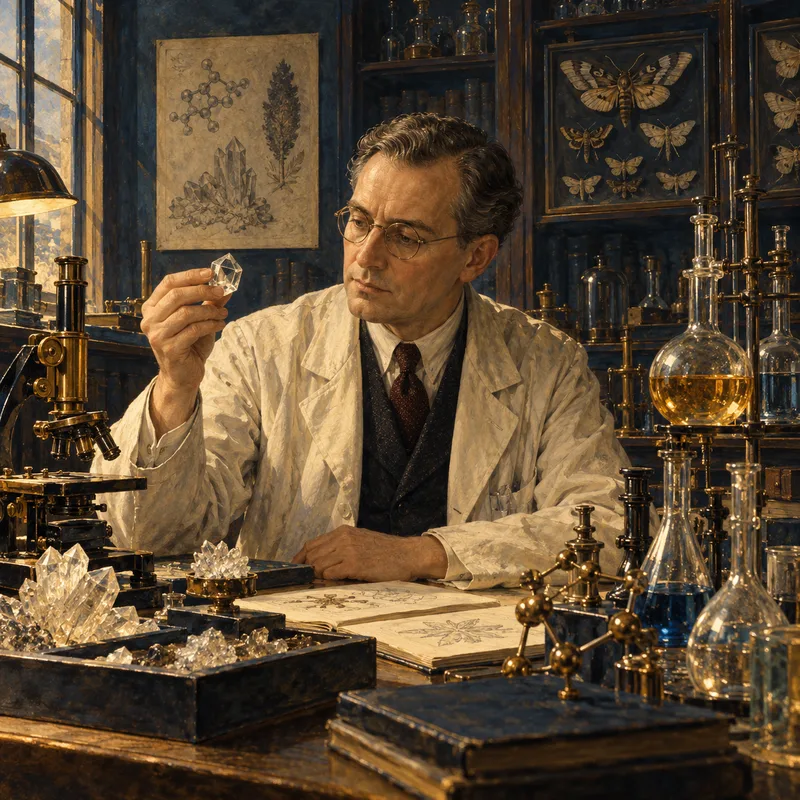
About the chemist
Adolf Butenandt
1903-1995 · Germany · Nobel Chemistry 1939
Isolation of sex hormones