The discovery, explained · Chemist no. 117 of 350
Adolf Butenandt: From Sex Hormones to the First Pheromone
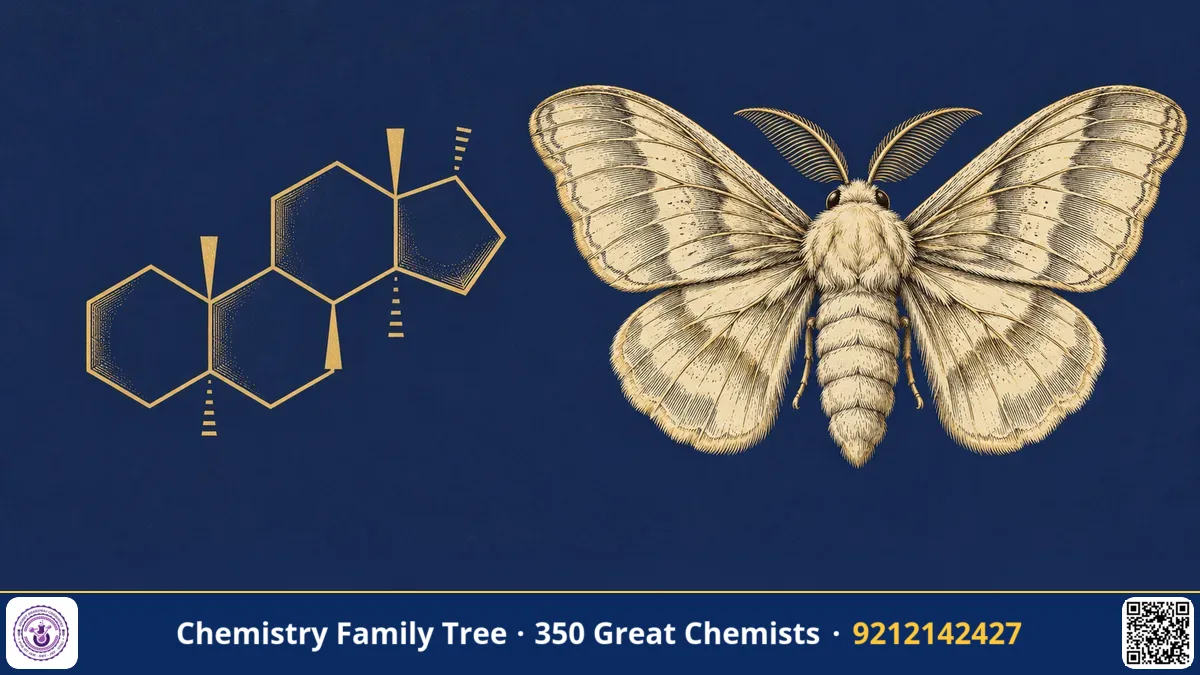
In 1929 a young German chemist isolated a pure crystalline sex hormone from the urine of pregnant women. Within a few years he had also obtained progesterone and androsterone, and had made testosterone from cholesterol. Later he and his colleagues identified the first insect moulting hormone, ecdysone, and the first chemically defined pheromone, bombykol, the sex attractant of the silkworm moth. The man was Adolf Butenandt, and for his work on sex hormones he shared the Nobel Prize in Chemistry for 1939 with Leopold Ružička. This post follows his main discoveries, shows the chemistry behind them, and points out what is most useful for exams.
The Scientific Problem Before the Discovery
By the 1920s physiologists knew that the ovaries and testes release chemical messengers, called hormones, which control the sexual organs and secondary sexual characters. Removal of ovaries from animals caused changes that could be reversed by injection of extracts. But the extracts were crude mixtures. No one had a pure compound, and so no one knew whether the active substance was a protein, a lipid or something else.
- The amounts of active material in tissue and urine are extremely small, in the milligram per thousands of litres range.
- Chemical tests were limited. Structure work depended on elemental analysis, melting point, degradation and a biological assay such as the Allen-Doisy test in rodents.
- The connection between hormones, sterols and bile acids was not yet clear. Adolf Windaus and Heinrich Wieland had been working on cholesterol and bile acids, but the full ring structure of sterols was still being corrected.
The Discovery: Step by Step
Butenandt, working at Göttingen with Windaus' support, took up the problem of the female hormone. His method was to start from large volumes of material and follow the biological activity through each purification step.
- Estrone (1929). From urine of pregnant women he isolated a crystalline compound with the formula C₁₈H₂₂O₂. He separated phenolic from neutral material by extraction with alkali, then purified by distillation and crystallisation. Edward Doisy in the United States isolated the same compound at nearly the same time, and the priority is shared. He later reported the related estriol.
- Androsterone (1931). From about 15,000 litres of male urine he extracted around 15 mg of crystalline androsterone, a male sex hormone, C₁₉H₃₀O₂.
- Progesterone (1934). He isolated progesterone, the hormone of pregnancy, from the ovaries of sows, using many thousands of kilograms of tissue. Several groups were working on the corpus luteum hormone at about the same time. In the same year he proved its structure and converted it from stigmasterol, a plant sterol, in a partial synthesis, which opened a source of the hormone that was not animal.
- Testosterone (1935). Testosterone had been obtained from bull testes by Ernst Laqueur's group in the Netherlands. Butenandt, working with Hanisch, made testosterone from cholesterol. Ružička's group in Zürich achieved the same conversion within days.
Estrone : aromatic A ring, C-3 phenol, C-17 ketone  (C₁₈H₂₂O₂)
Progesterone : Δ4-3-keto, C-20 ketone side chain  (C₂₁H₃₀O₂)
Testosterone : Δ4-3-keto, 17β-OH  (C₁₉H₂₈O₂)
Insect hormones and pheromones
In later decades Butenandt moved to insects. With Peter Karlson, he isolated ecdysone, the moulting hormone, in 1954 from several tonnes of silkworm pupae, obtaining a few tens of milligrams. Its structure was determined later with the help of X-ray crystallography. Ecdysone is a polyhydroxylated steroid that triggers moulting and metamorphosis.
In 1959 Butenandt's group reported bombykol, the sex attractant produced by the female silkworm moth Bombyx mori. It was extracted from the scent glands of about half a million moths and gave a few milligrams of pure substance. Its structure is (10E,12Z)-hexadeca-10,12-dien-1-ol, a 16-carbon primary alcohol with two conjugated double bonds of different geometry. Males respond to extremely small amounts. Bombykol was the first pheromone ever to be chemically identified, and Karlson and Lüscher introduced the word "pheromone" in the same year.
The Chemistry Behind It
Steroid skeleton. All these hormones are built on cyclopentanoperhydrophenanthrene, which has three six-membered rings (A, B, C) and one five-membered ring (D). Carbon numbering runs from C-1 in ring A to C-17 in ring D. The 18- and 19-carbon members come from cholesterol by loss of the side chain.
Estrone versus testosterone. Estrogens have an aromatic A ring, which is a phenol, and no methyl group at C-10. Androgens and progestogens have a Δ4-3-keto group (an α,β-unsaturated ketone) in ring A and a methyl group at C-10 (C-19). In biosynthesis, testosterone is converted to estradiol by aromatase, in which the C-19 methyl group is lost as formaldehyde or formic acid and ring A becomes aromatic.
Partial synthesis. Butenandt's route from stigmasterol to progesterone shows how plant sterols can become hormones by cleavage of a side chain and oxidation of an alcohol (Oppenauer oxidation) to the Δ4-3-ketone. The same idea led later to the Marker degradation and the steroid drug industry.
Pheromone chemistry. In bombykol, the geometry of the conjugated diene matters. The other geometric isomers are much less active, which shows that the receptor protein in the moth antenna recognises shape as well as functional group. This is an example of molecular recognition in the same way as an enzyme and its substrate.
Applications Today
- Medicine. Oral contraceptives, hormone replacement therapy, treatment of endocrine deficiency and some cancers depend on synthetic estrogens, progestins and androgens, all descended from Butenandt's and Ružička's work.
- Pharmaceutical industry. The steroid drug industry, which includes corticosteroids, started from plant sterols such as diosgenin and stigmasterol. India has a significant steroid and hormone manufacturing sector.
- Pest control. Synthetic insect pheromones are used in traps and mating disruption in cotton, rice and fruit crops, giving a more selective alternative to broad pesticides.
- Research. Ecdysone analogues are studied for insect growth control and are used as gene switches in laboratory biology.
Exam Corner
- Steroid nucleus: cyclopentanoperhydrophenanthrene; rings A, B, C are six-membered and D is five-membered; 17 ring carbons.
- Estrone has an aromatic A ring (phenol); testosterone and progesterone have a Δ4-3-ketone.
- Bombykol is (10E,12Z)-hexadeca-10,12-dien-1-ol, the first pheromone to be identified.
- Ecdysone is the insect moulting hormone, a polyhydroxylated steroid.
- Butenandt shared the 1939 Nobel Prize in Chemistry with Ružička; this was awarded for sex hormone research.
Common Misconceptions
- "Estrogens are only female and androgens only male hormones." Both sexes make both types, in different amounts. Testosterone is the biosynthetic precursor of estradiol.
- "Hormones are all proteins." Steroid hormones are lipids derived from cholesterol. Insulin and growth hormone are proteins.
- "Pheromones are the same as hormones." Hormones act inside the same body. Pheromones are released outside and act on another individual of the same species.
Quick Revision Box
- Estrone isolated 1929; androsterone 1931; progesterone 1934; testosterone prepared 1935.
- About 15 mg androsterone from about 15,000 L of male urine.
- Bombykol: first pheromone, from Bombyx mori, 1959.
- Ecdysone isolated 1954 with Peter Karlson.
- Nobel Prize in Chemistry 1939 (shared with Ružička); accepted only in 1949.
- Aromatase converts testosterone to estradiol.
FAQ
Why is the sex hormone work called a chemistry prize?
The prize recognised the isolation, structure determination and synthesis of the hormones, which are chemical achievements. The biology of the hormones was honoured separately in other Nobel Prizes.
What was the first pheromone identified?
Bombykol, the sex attractant of the female silkworm moth, identified by Butenandt's group in 1959.
How are steroid hormones related to cholesterol?
Cholesterol loses part of its side chain to give pregnenolone, which is converted to progesterone, androgens and estrogens, so all share the same four-ring skeleton.
Which other chemist shared the 1939 prize?
Leopold Ružička of Zürich, who was honoured for polymethylenes and higher terpenes and also worked on sex hormones.
Published by ABC Chemistry — IIT-JAM | CSIR-NET | GATE Chemistry Coaching. Visit abcchemistry.com
About the chemist
Adolf Butenandt
1903-1995 · Germany · Nobel Chemistry 1939
Isolation of sex hormones