Biography · Chemist no. 25 of 350
Adolf von Baeyer: The Chemist Who Made Indigo and Trained a Generation
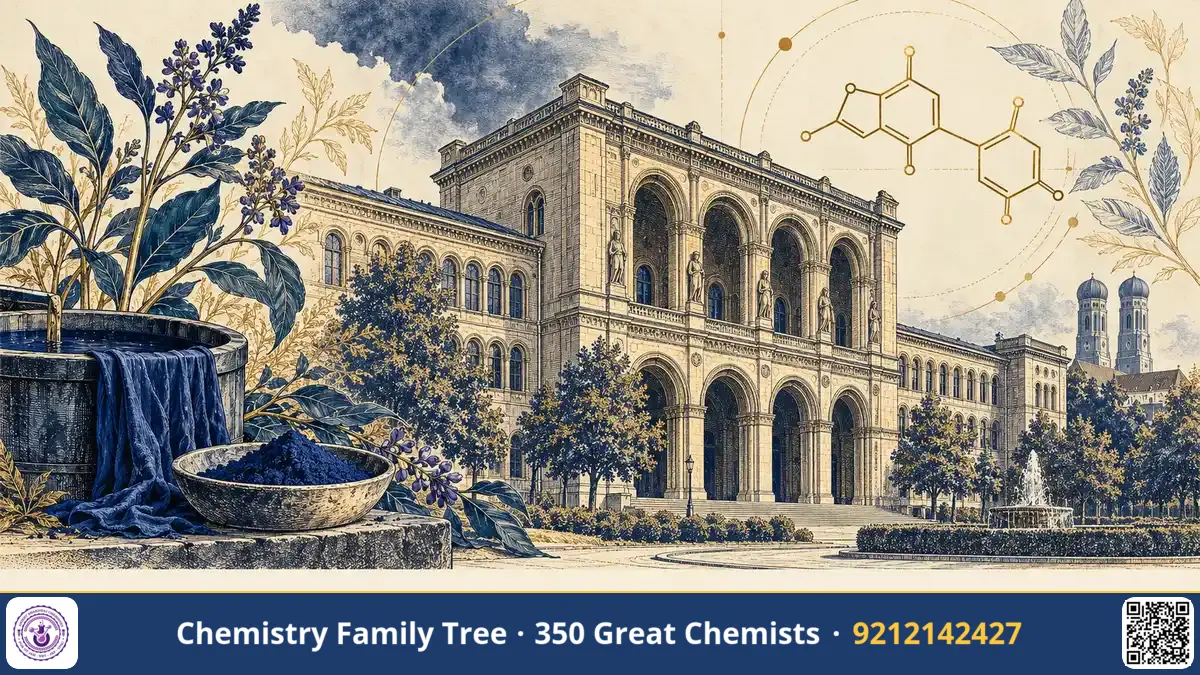
Johann Friedrich Wilhelm Adolf von Baeyer (1835–1917) was a German organic chemist and one of the greatest teachers in the history of chemistry. He synthesised the dye indigo, discovered barbituric acid and the phthalein dyes, proposed the strain theory of rings and shared the name of the Baeyer–Villiger oxidation. He won the 1905 Nobel Prize in Chemistry. His legacy lies in the molecules he made and in the students who followed him, among whom were several Nobel laureates.
Early Life and Family
Baeyer was born on 31 October 1835 in Berlin. His father, Johann Jacob Baeyer, was an army officer and geodesist, an expert in measuring the shape of the Earth, who founded what became the European network of geodetic measurements. His mother, Eugenie Hitzig, came from a family of scholars. The household was cultured and scientific. As a child he was curious, and when he was about twelve he is reported to have prepared a new double salt of copper on his own, an early sign of his talent for experiment.
In 1868 he married Adelheid Bendemann, the daughter of the painter Eduard Bendemann. They had three children, and their son Otto became a physicist and another son, Hans, an orthopaedic surgeon. The family lived in Munich, in a house of artistic and scientific hospitality.
Education and Mentors
Baeyer studied mathematics and physics at the University of Berlin before turning to chemistry. He went to Heidelberg, where he worked with Robert Bunsen and August Kekulé. The influence of Kekulé was particularly important, and Baeyer followed him in 1858 to Ghent, Belgium, as an assistant. He received his doctorate at Berlin in 1858 with a thesis on organic arsenic compounds. After a period as Kekulé's assistant, he started teaching in Berlin at the Trade Academy (Gewerbeakademie) in 1860.
Career Timeline
| Year | Event |
|---|---|
| 1835 | Born in Berlin, 31 October |
| 1858 | Doctorate at Berlin; assistant to Kekulé in Ghent |
| 1860 | Lecturer at the Gewerbeakademie in Berlin |
| 1864 | Discovers barbituric acid |
| 1871 | Discovers phthalein dyes, including phenolphthalein |
| 1872 | Professor at the new University of Strasbourg |
| 1875 | Succeeds Justus von Liebig as professor at Munich |
| 1880–1883 | Synthesis and structure of indigo |
| 1885 | Strain theory of rings; receives hereditary nobility ("von") |
| 1899 | Baeyer–Villiger oxidation with Victor Villiger |
| 1905 | Awarded the Nobel Prize in Chemistry |
| 1915 | Retires; succeeded by Richard Willstätter |
| 1917 | Dies at Starnberg near Munich, 20 August |
Major Scientific Contributions
- Indigo. Synthesis in 1880 and the right structure in 1883. See our discovery post for the reactions.
- Phthalein dyes. Fluorescein, eosin and phenolphthalein, from phthalic anhydride and phenols.
- Barbituric acid (1864). From urea and malonic acid; the parent of barbiturate drugs.
- Strain theory (1885). The idea that rings distort bond angles away from 109°28′.
- Hydroaromatic compounds and terpenes. Studies on partially reduced benzene derivatives and compounds from plants, which helped to clarify the structure of benzene.
- Oxidation reactions. The Baeyer–Villiger oxidation and the use of alkaline permanganate as a test for double bonds (Baeyer's reagent).
- Polyacetylenes and explosive carbon chains. In the 1880s he explored compounds with many triple bonds, and observed how unstable they were. This led him towards the strain idea.
Awards, Honours and Nobel Prize
Baeyer was awarded the Nobel Prize in Chemistry in 1905 "in recognition of his services in the advancement of organic chemistry and the chemical industry, through his work on organic dyes and hydroaromatic compounds". He received the Davy Medal of the Royal Society in 1881, the Royal Society's Copley Medal in 1903 and other awards. In 1885 the Bavarian crown granted him the title of nobility that gave him the name "von Baeyer". The German Chemical Society later created the Adolf von Baeyer memorial medal in his honour.
Personality, Struggles and Lesser-Known Facts
- A successor to Liebig. In 1875 he was chosen to follow Justus von Liebig in Munich, a position of high prestige. He built a large new chemistry laboratory there.
- The teacher who loved the bench. Baeyer was fond of laboratory work and often worked with his own hands. He wanted his assistants to experiment, not only to read.
- Struggle with indigo. He worked on indigo for about fifteen years. Although his own routes were not used by industry, his discoveries inspired industrial chemists, and he was proud of the use of science in industry.
- Long working life. He continued teaching and research until 1915, when he was almost eighty, and he is remembered as active at the bench for most of his career.
- Famous students. His students and assistants included Emil Fischer, Victor Villiger and Richard Willstätter, all of whom made important contributions to chemistry. Fischer and Willstätter later won Nobel Prizes.
Legacy and Influence on Modern Chemistry
Baeyer's school at Munich became one of the world's leading organic chemistry centres. His synthesis of indigo showed that natural products could be made in a factory, and shaped the world dye industry, which had a deep impact on India's indigo trade. His strain theory stimulated the study of conformations; Sachse, Mohr and later Derek Barton and Odd Hassel won recognition for building on it, with the Nobel Prize in 1969 for conformational analysis. The Baeyer–Villiger oxidation remains a standard tool in synthesis, and phenolphthalein is the indicator used in thousands of titrations in Indian laboratories every day.
Lessons for Students
- Persist: Baeyer spent years on indigo before it was solved.
- An imperfect theory can still be very useful. Strain theory was wrong about planar rings but led to better ideas.
- Be a bench scientist. Hands-on work builds intuition.
- Teach and share. His students extended his influence far beyond his own discoveries.
Quick Facts Box
- Born: 31 October 1835, Berlin, Prussia
- Died: 20 August 1917, Starnberg, Bavaria, Germany
- Nationality: German
- Field: Organic chemistry, dyes
- Famous for: Synthesis and structure of indigo, strain theory, phthalein dyes, Baeyer–Villiger oxidation
- Nobel: Chemistry, 1905
FAQ
Whom did Baeyer succeed at Munich?
He succeeded Justus von Liebig in 1875.
Which Nobel laureates studied with Baeyer?
Emil Fischer was his student and assistant. Richard Willstätter worked with him in Munich and later became his successor.
What was Baeyer's father's profession?
He was a Prussian army officer and a geodesist who helped to organise European measurements of the shape of the Earth.
What is the Baeyer test used for?
Cold dilute alkaline potassium permanganate is used to detect double or triple carbon–carbon bonds, shown by loss of the purple colour.
Published by ABC Chemistry — IIT-JAM | CSIR-NET | GATE Chemistry Coaching. Visit abcchemistry.com
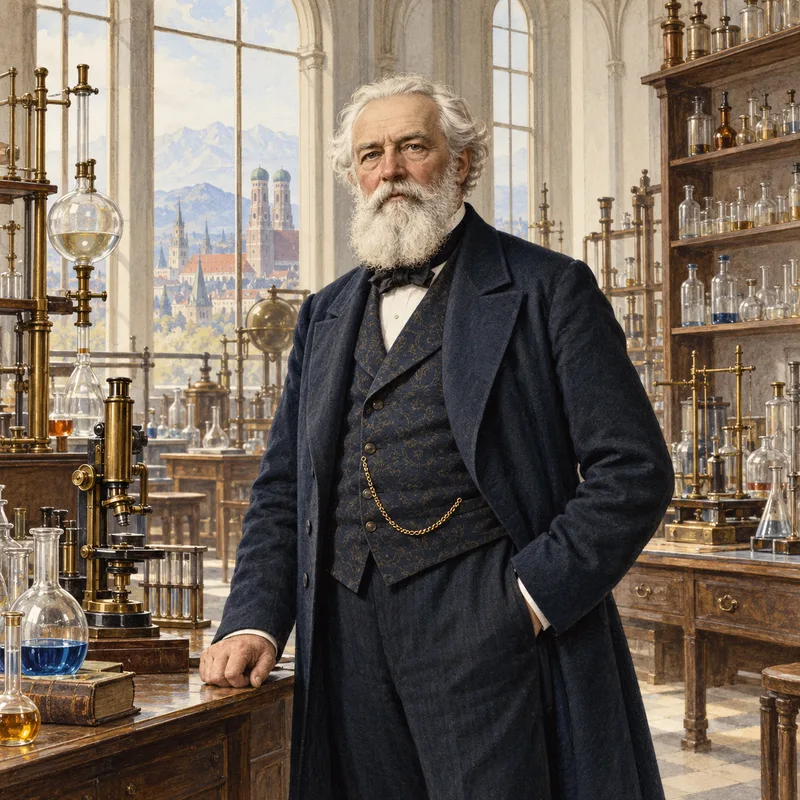
About the chemist
Adolf von Baeyer
1835-1917 · Germany · Nobel Chemistry 1905
Indigo synthesis; Baeyer strain theory