The discovery, explained · Chemist no. 25 of 350
Adolf von Baeyer: Indigo, Ring Strain and Clever Oxidations
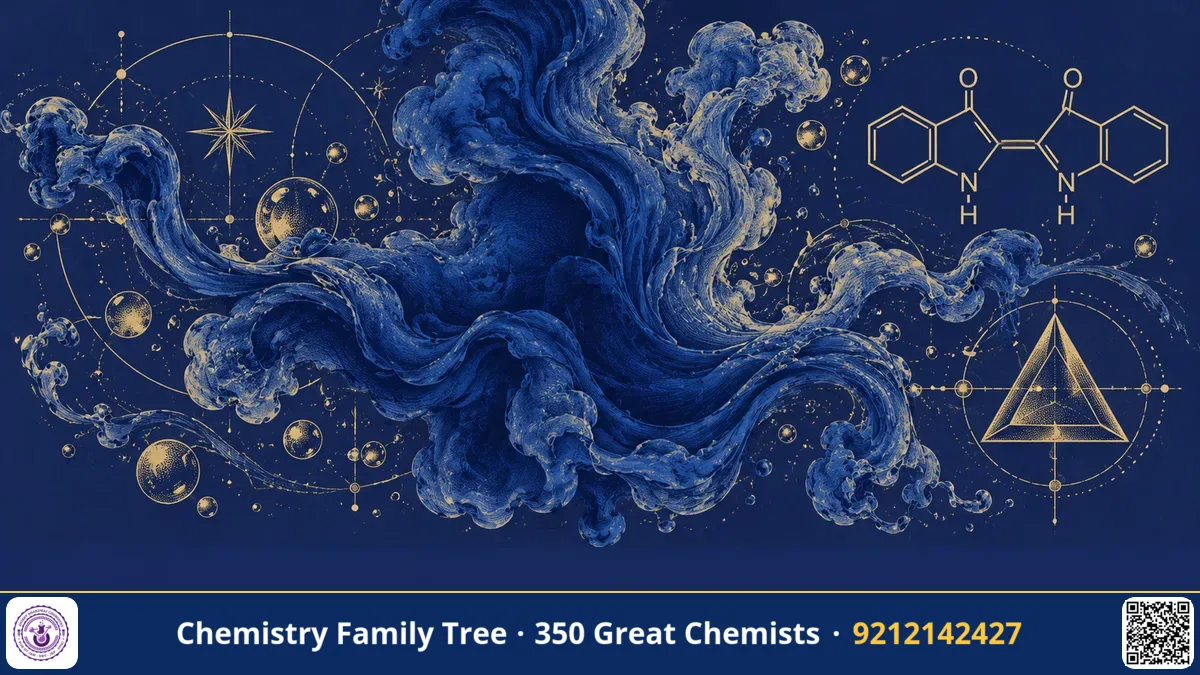
Why is cyclopropane so reactive while cyclohexane is calm? How did a plant dye that coloured the world's jeans and silks come to be made in a factory? The answers connect to Adolf von Baeyer, a German chemist who worked in Berlin, Strasbourg and Munich. He synthesised indigo in 1880 and determined its structure in 1883, proposed the angle strain theory of rings in 1885, discovered the phthalein dyes and barbituric acid, and with Victor Villiger developed the Baeyer–Villiger oxidation in 1899. In 1905 he received the Nobel Prize in Chemistry for his work on organic dyes and hydroaromatic compounds.
The Scientific Problem Before the Discovery
Indigo. For centuries, indigo, the deep blue dye, was extracted from the leaves of Indigofera plants. India was one of the world's main producers, and Indian indigo was exported to Europe in large quantities, as part of a trade that deeply affected farmers in Bengal and Bihar. Chemists knew the formula of indigo, C₁₆H₁₀N₂O₂, but not its structure, and no one could make it from simple coal tar chemicals. A synthetic route would be of great value to the growing German dye industry.
Ring compounds. After Kekulé proposed the benzene ring and van 't Hoff the tetrahedral carbon, chemists discovered many cyclic hydrocarbons. Rings of three, four, five and six carbons were known, yet rings of seven and larger were hard to make. Why were some rings easy to form and others not? Why did cyclopropane open so readily with reagents?
The Discovery: Step by Step
1. Indigo (1880–1883). Baeyer began work on indigo in the 1860s, reducing isatin to indole and studying its relatives. In 1880 he made indigo from o-nitrocinnamic acid, but the starting material was too costly for industry. In 1882 he and Viggo Drewsen found a simpler laboratory route using o-nitrobenzaldehyde and acetone in alkaline solution:
2 o-O₂N–C₆H₄–CHO + 2 CH₃COCH₃ + base → indigo + 2 CH₃COOH + 2 H₂O
In 1883 he proposed the correct structure of indigo, with two indole-type units joined through a central C=C bond. Industrial chemists at BASF and Hoechst, using other routes, made synthetic indigo commercially by 1897. The price of natural indigo fell sharply, and the planting of indigo in India collapsed in the following years.
2. Strain theory (1885). Baeyer reasoned that a carbon atom prefers bond angles of 109°28′ (tetrahedral). In a ring, which he assumed to be flat, the bond angle is forced away from this value, and the ring is strained. He defined the angle deviation as:
d = ½ (109°28′ − α) where α is the internal angle of the planar ring.
| Ring | Planar angle α | Deviation d (Baeyer) |
|---|---|---|
| Cyclopropane | 60° | 24°44′ |
| Cyclobutane | 90° | 9°44′ |
| Cyclopentane | 108° | 0°44′ |
| Cyclohexane | 120° | −5°16′ |
3. Baeyer–Villiger oxidation (1899). Baeyer and Villiger found that a peracid converts a ketone into an ester (or a cyclic ketone into a lactone):
R–CO–R' + R"CO₃H → R–CO–OR' + R"CO₂H
The Chemistry Behind It
What strain theory got right and wrong. The theory correctly predicted that three- and four-membered rings are highly strained and reactive. Experimentally, the heats of combustion per CH₂ group show the same trend, and the strain energy of cyclopropane is about 115 kJ/mol, of cyclobutane about 110 kJ/mol, of cyclopentane about 26 kJ/mol, and of cyclohexane close to zero. However, Baeyer assumed all rings are planar. This is wrong for cyclohexane. Hermann Sachse (1890) and Ernst Mohr (1918) showed that cyclohexane adopts a puckered chair conformation with all angles close to 109.5°, so it is virtually strain-free. Also, the theory predicts increasing strain for larger rings, which is not found.
Mechanism of Baeyer–Villiger. The peracid adds to the carbonyl to form a tetrahedral intermediate (Criegee intermediate). One group then migrates from carbon to the adjacent oxygen as the carboxylate leaves. The migrating group keeps its configuration. The migratory aptitude is roughly: tertiary alkyl > cyclohexyl > secondary alkyl > benzyl > phenyl > primary alkyl > methyl. For example, cyclohexanone gives ε-caprolactone, and methyl ketones of tertiary alkyl groups give tert-alkyl acetates.
The Baeyer test. Cold, dilute, alkaline KMnO₄ is decolourised (purple to brown MnO₂) by alkenes, which are converted into diols: 3 C=C + 2 KMnO₄ + 4 H₂O → 3 diol + 2 MnO₂ + 2 KOH. This is the classical test for unsaturation, sometimes called Baeyer's reagent.
Applications Today
- Denim: almost all blue jeans are dyed with synthetic indigo, which descends from the work of Baeyer and the industrial chemists. Indigo is applied by a vat dyeing process, in which indigo is reduced to the soluble, colourless leuco form and re-oxidised in air on the fibre.
- Indicators: phenolphthalein, made by Baeyer from phthalic anhydride and phenol in 1871, is the pink indicator for titrations in Indian school and college laboratories. It is colourless below pH about 8.3 and pink above about 10.
- Medicines: barbituric acid, which he made in 1864 from urea and malonic acid, is the parent compound of the barbiturate sedatives.
- Polymers: Baeyer–Villiger oxidation of cyclohexanone gives caprolactone, used for making polycaprolactone and related polymers.
- Synthesis: the reaction is widely used in making steroids and natural products, and it can be done with enzymes (Baeyer–Villiger monooxygenases) for green chemistry.
- Dyes: fluorescein and eosin, from the phthalein family, are used as tracers and stains.
Exam Corner
- Baeyer angle deviation: d = ½(109°28′ − α). Order of strain: cyclopropane > cyclobutane > cyclopentane > cyclohexane (approx. zero).
- Limitation: assumes planar rings; cyclohexane is actually in a chair form with angle about 109.5°. Rings larger than six are not strained as predicted.
- Baeyer–Villiger: ketone + peracid (such as mCPBA, CF₃CO₃H) → ester; migrating group retains configuration; cyclic ketone gives lactone.
- Baeyer's reagent (cold, dilute alkaline KMnO₄) tests for C=C; it converts alkene to cis-1,2-diol.
- Indigo C₁₆H₁₀N₂O₂ is a vat dye; Baeyer–Drewsen synthesis uses o-nitrobenzaldehyde, acetone and NaOH.
Common Misconceptions
- "Baeyer's strain theory is fully correct." It is partly correct: it works for small rings but fails for cyclohexane and larger rings.
- "The Baeyer–Villiger reaction inserts oxygen in a random position." Oxygen inserts next to the carbonyl on the side of the better migrating group.
- "Synthetic indigo is a different compound from natural indigo." They are chemically identical.
Quick Revision Box
- Indigo structure proposed in 1883; Baeyer–Drewsen route in 1882.
- Strain theory in 1885: deviation d = ½(109°28′ − α).
- Cyclopropane has the largest deviation (24°44′).
- Baeyer–Villiger oxidation (1899): ketone to ester using peracid.
- Phenolphthalein and fluorescein made by Baeyer in the early 1870s.
- Nobel Prize in Chemistry 1905.
FAQ
Why did natural indigo farming decline?
Synthetic indigo from German factories became cheaper than plant-based indigo around the end of the nineteenth century, which hit indigo planting in India hard.
Why is cyclohexane not strained?
It is not flat. In the chair conformation, all C–C–C angles are about 109.5° and the hydrogens are staggered.
Which peracids are used in the Baeyer–Villiger reaction?
Common examples are peracetic acid, trifluoroperacetic acid and meta-chloroperbenzoic acid (mCPBA).
Who was Victor Villiger?
He was a Swiss chemist who worked with Baeyer as a student and collaborator, and with him found the peracid oxidation of ketones.
Published by ABC Chemistry — IIT-JAM | CSIR-NET | GATE Chemistry Coaching. Visit abcchemistry.com
About the chemist
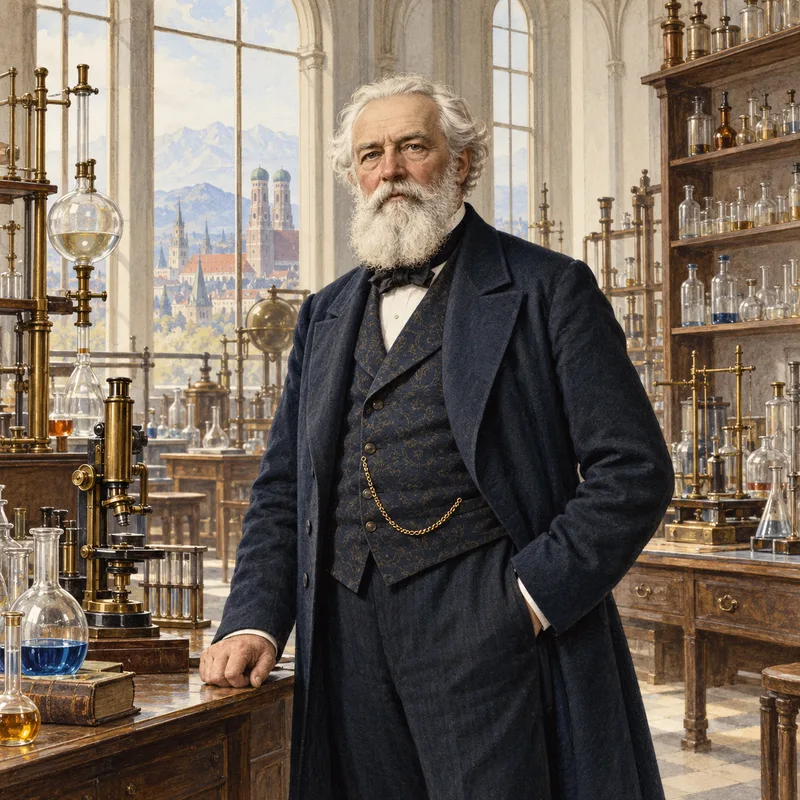
Adolf von Baeyer
1835-1917 · Germany · Nobel Chemistry 1905
Indigo synthesis; Baeyer strain theory