The discovery, explained · Chemist no. 109 of 350
Adolf Windaus: Sterols, Cholesterol and the Origin of Vitamin D
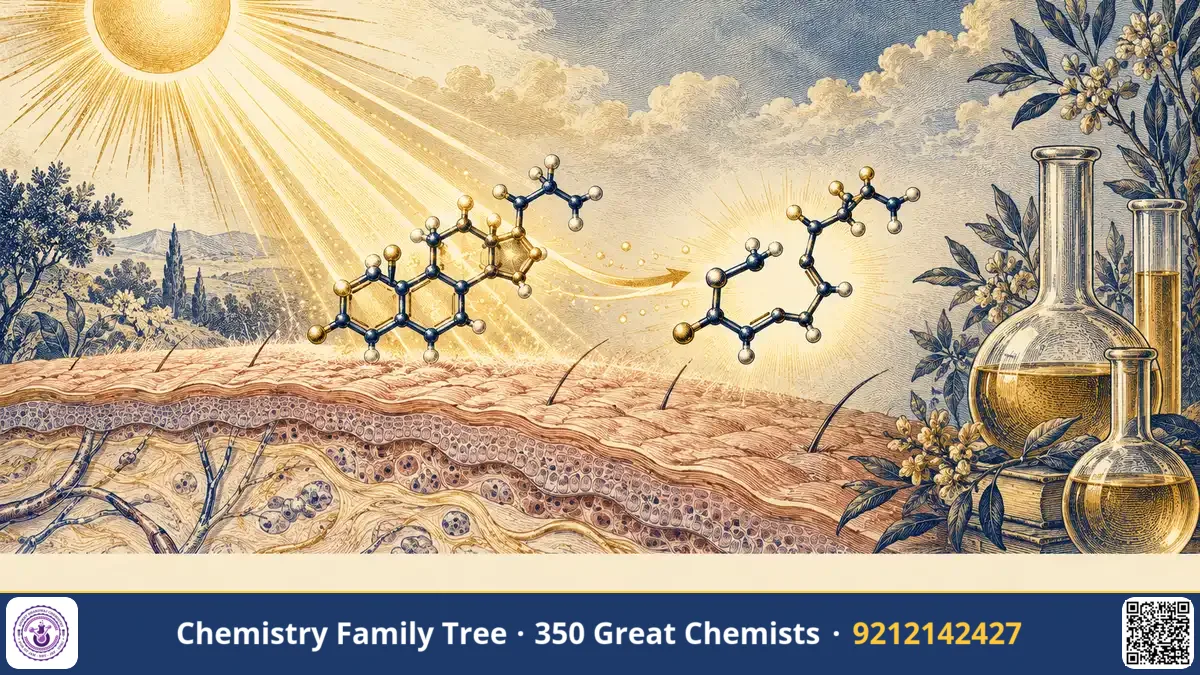
A child with bent legs, a swollen wrist and weak bones: this was rickets, a common disease in the crowded, smoky industrial cities of nineteenth-century Europe, where children seldom saw the sun. For a long time doctors argued whether it was caused by infection, by a lack of some food factor, or by lack of light. The German chemist Adolf Windaus showed the chemical link: a sterol found in yeast and in the skin, when struck by ultraviolet light, turns into the antirachitic vitamin D. Windaus spent his career working out the chemistry of cholesterol and the other sterols, and for this he received the Nobel Prize in Chemistry in 1928 "for the services rendered through his research into the constitution of the sterols and their connection with the vitamins".
The Scientific Problem Before the Discovery
Cholesterol was first isolated from gallstones in the eighteenth century and named in the early nineteenth. By 1900 it was known to be an alcohol of formula C27H46O, found in animal tissues, with plant relatives called phytosterols and fungal ones like ergosterol. But the structure was a mystery. It was clear that the molecule had a ring system, but the number and arrangement of rings could not be established. Proposed formulas by different chemists contradicted each other.
The second problem was medical. Experiments by Edward Mellanby in Britain (1919) showed that rickets could be cured with cod-liver oil and could be produced in dogs by a deficient diet, so a fat-soluble vitamin was suspected. Meanwhile, Kurt Huldschinsky and Alfred Hess showed that ultraviolet light or sunlight also cured rickets. The two facts seemed to point in different directions. Harry Steenbock in the United States and Hess then showed in 1924 that irradiating foods and certain materials with ultraviolet light made them antirachitic. What was the substance in the food that UV light was activating? That question brought together the sterol chemistry of Windaus with nutrition science.
The Discovery: Step by Step
- Cholesterol chemistry (from 1900). As a young researcher at Freiburg, Windaus worked on digitonin, the glycoside from foxglove that precipitates cholesterol as an insoluble complex. This gave him a reliable way to isolate and quantify cholesterol and related sterols.
- Cholesterol in disease (1910). He found that cholesterol and its esters are present in much greater amount in atherosclerotic plaques than in healthy arteries, an early clue to the link between cholesterol and cardiovascular disease.
- Degradation to bile acid relationship. By oxidation experiments, he showed that cholesterol and bile acids share a common skeleton, working in parallel with Wieland.
- Irradiated ergosterol (1920s). After the reports of Steenbock and Hess, it was found that the substance in food that is converted by UV light was a sterol. Work by Rosenheim and Webster in London, and by Windaus and others, identified it as ergosterol, found in yeast and ergot.
- Isolation of the vitamin (1930s). Windaus and his co-workers, together with groups in Britain, isolated the crystalline vitamin made by irradiating ergosterol. It was called vitamin D2 (calciferol).
- Vitamin D3 (1936). Windaus and his team showed that a second form, vitamin D3 (cholecalciferol), is made from 7-dehydrocholesterol, a cholesterol precursor present in skin. This explained why sunlight cures rickets in humans.
- The final structure. The correct steroid skeleton of 1932 allowed the vitamin D structure to be shown as a "seco-steroid", a steroid in which ring B has been opened.
The Chemistry Behind It
The reaction is a photochemical electrocyclic ring opening. 7-Dehydrocholesterol, which has a conjugated 5,7-diene in rings A and B, absorbs UV-B light (around 290–315 nm). The bond between C-9 and C-10 breaks, opening ring B to form previtamin D3, a triene. This then isomerises thermally, by a [1,7]-sigmatropic hydrogen shift, to vitamin D3:
7-Dehydrocholesterol  --(UV-B, hν)-->  Previtamin D3  --(heat, [1,7]-H shift)-->  Vitamin D3
C27H44O                                 C27H44O                                     C27H44O
Ergosterol (C28H44O) is converted in a similar way into vitamin D2 (ergocalciferol, C28H44O). The two differ in the side chain: D2 has a double bond at C-22 and a methyl group at C-24, while D3 has a saturated side chain.
In the body, vitamin D3 is hydroxylated twice: first in the liver at C-25 to give calcidiol (25-hydroxyvitamin D3), then in the kidney at C-1 to give calcitriol (1,25-dihydroxyvitamin D3), which is the active hormone. Calcitriol increases the absorption of calcium and phosphate from the gut and supports bone mineralisation.
Key ideas for students:
- The ring opening is a photochemical 6π electrocyclic reaction (conrotatory by the Woodward–Hoffmann rules), and the following [1,7] hydrogen shift is thermal and antarafacial.
- Windaus's digitonin test: sterols with a 3β-OH group precipitate with digitonin.
- Cholesterol has 8 stereocentres. Its formula is C27H46O, and it has one double bond, between C-5 and C-6.
Windaus also contributed to other areas. In 1907 with Vogt he synthesised histamine (imidazolylethylamine), and in the 1930s he worked on the structure of vitamin B1 (thiamine), with Grewe.
Applications Today
- Prevention of rickets and osteomalacia: vitamin D supplements and fortified foods (milk, cereals, oils). In India, vitamin D deficiency is widespread despite abundant sunshine, because of indoor lifestyles and clothing; supplements of cholecalciferol are among the most commonly prescribed.
- Osteoporosis treatment: calcitriol and its analogues are used for bone and kidney disease.
- Cholesterol-lowering medicine: understanding of the cholesterol structure and biosynthesis led to statins.
- Steroid hormone drugs: a whole family of drugs relies on knowledge of the steroid nucleus.
- Sunlight and health: short sun exposure helps skin make vitamin D3; this is the reason for public health advice on sunlight.
Exam Corner
- Adolf Windaus received the Nobel Prize in Chemistry in 1928 for his research on the constitution of sterols and their connection with vitamins.
- Vitamin D3 (cholecalciferol) is formed in the skin from 7-dehydrocholesterol by UV-B; vitamin D2 (ergocalciferol) is formed from ergosterol of yeast and fungi.
- Vitamin D is a secosteroid, with ring B opened between C-9 and C-10. Active form: calcitriol (1,25-dihydroxyvitamin D3).
- Deficiency causes rickets in children and osteomalacia in adults.
- Cholesterol: C27H46O, steroid nucleus, 3β-OH, double bond C5=C6; precipitated by digitonin.
Common Misconceptions
- "Vitamin D is only a vitamin." It acts as a hormone, since the body can make it and its active form works through nuclear receptors.
- "Cholesterol is always bad." It is a vital membrane component and a precursor of bile acids, steroid hormones and vitamin D.
- "Sunscreen has no effect on vitamin D." UV-B blockers reduce skin synthesis, although normal use does not usually cause deficiency.
Quick Revision Box
- Nobel Prize in Chemistry, 1928, Adolf Windaus.
- Ergosterol + UV-B → vitamin D2; 7-dehydrocholesterol + UV-B → vitamin D3.
- Vitamin D is a secosteroid: B-ring open.
- Activation: liver (25-OH), kidney (1α-OH) gives calcitriol.
- Digitonin precipitates 3β-hydroxy sterols.
- Also synthesised histamine (1907) and worked on thiamine.
FAQ
How does sunlight produce vitamin D?
UV-B light opens ring B of 7-dehydrocholesterol in the skin to give previtamin D3, which converts by heat to vitamin D3 within hours.
What is the difference between vitamin D2 and D3?
D2 comes from ergosterol (plants and fungi) and has an extra double bond and methyl group in its side chain. D3 comes from 7-dehydrocholesterol (animals) and is generally more effective in raising blood levels.
Did Windaus discover vitamin D?
No single person did. Mellanby, Hess, Steenbock and others made the discoveries about its biological action, while Windaus's chemistry identified the provitamins and the structures.
Is this chapter in the JAM, NET and GATE syllabus?
Photochemistry, pericyclic reactions, steroids and vitamins are all part of organic chemistry courses, so questions on the electrocyclic ring opening and sigmatropic shifts of vitamin D are possible.
Published by ABC Chemistry — IIT-JAM | CSIR-NET | GATE Chemistry Coaching. Visit abcchemistry.com
About the chemist
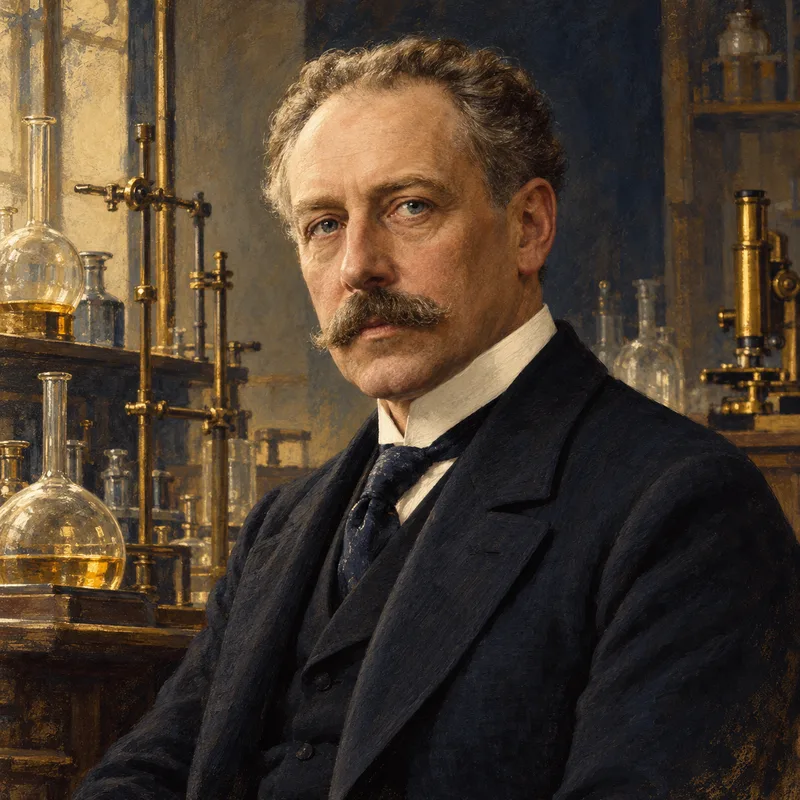
Adolf Windaus
1876-1959 · Germany · Nobel Chemistry 1928
Sterols and vitamin D