Biography · Chemist no. 344 of 350
Agnes Pockels: The Kitchen Scientist Who Founded Surface Film Research
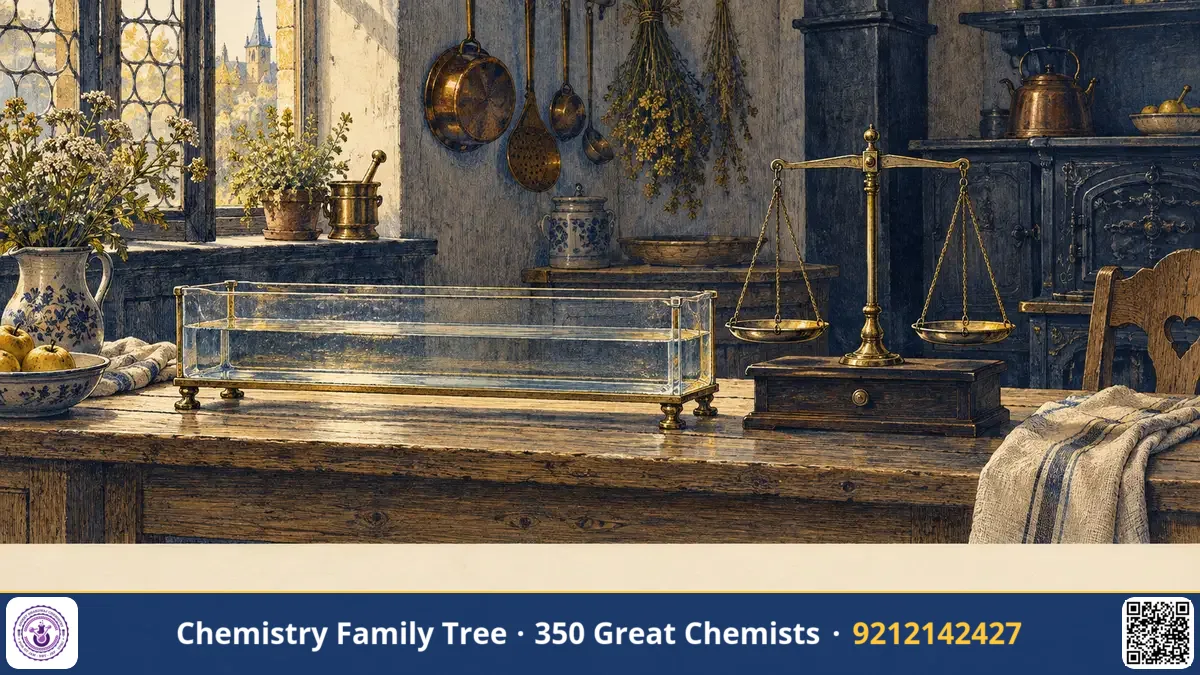
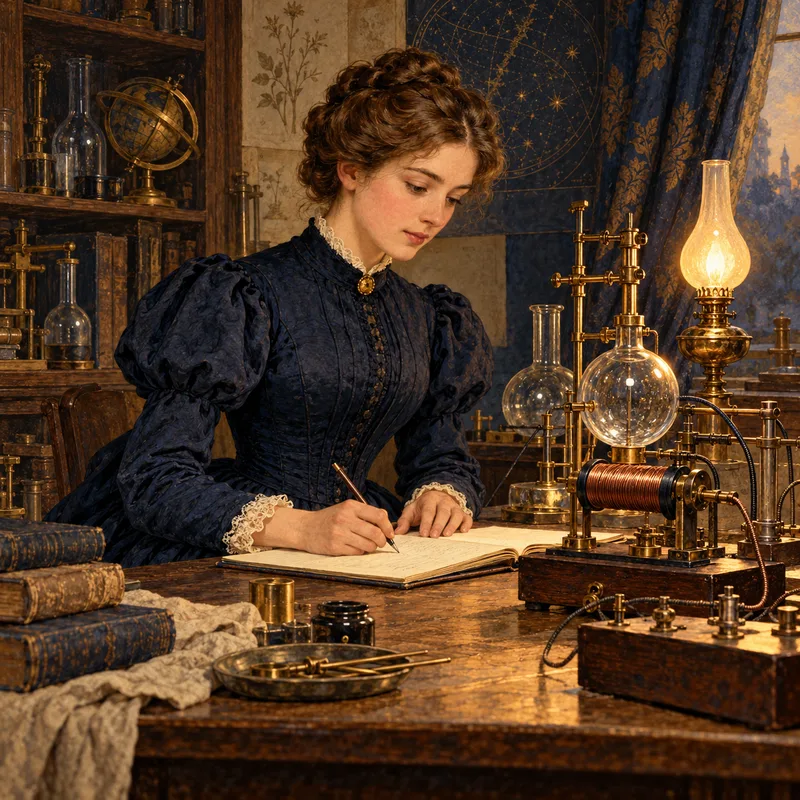
Agnes Pockels (1862-1935) was a German scientist who had no university education and no laboratory, yet made basic discoveries about surface tension and the behaviour of films on water. Working at the kitchen table of her family home in Braunschweig, she designed an apparatus, the trough with a movable barrier, that is still the model for modern film-balance instruments. Her one-line legacy: she showed that curiosity, patience and careful measurement matter more than a grand laboratory, and she opened a field that grew into modern surface chemistry.
Early Life and Family
Agnes Luise Wilhelmine Pockels was born on 14 February 1862 in Venice, which was then part of the Austrian Empire, where her father was stationed as an officer in the Austrian army. The family later moved to Braunschweig (Brunswick) in Germany, which became her home for the rest of her life. Her father fell ill with malaria and was unable to continue his military career, and the family lived modestly. Agnes was a bright child with a deep interest in science, but opportunities for girls were severely limited. Girls could attend school but were not admitted to universities in the German states at that time. Her younger brother, Friedrich Pockels, was able to study physics, and eventually became a professor.
Education and Mentors
Agnes finished the girls' high school in Braunschweig, then stayed at home and looked after her parents. She had no formal training in physics beyond school. Her teacher was her brother: when Friedrich went off to study physics at the University of Göttingen, he shared his textbooks and told her about what he learned, and she studied the books on her own. In this way she taught herself physics and chemistry. Her main outside mentor was Lord Rayleigh (John William Strutt), the English physicist who later won the Nobel Prize in Physics (1904). He did not teach her directly, but he recognised her talent and helped to bring her work before the scientific public.
Career Timeline
| Year | Event |
|---|---|
| 1862 | Born in Venice, then in the Austrian Empire |
| 1870s | Family settles in Braunschweig; Agnes completes school there |
| 1880s | Begins kitchen experiments on surface tension and builds her trough and balance |
| 1891 | Her letter to Lord Rayleigh is translated and published in Nature as "Surface Tension" |
| 1890s to 1900s | Publishes further papers on surface films and related topics in scientific journals |
| 1932 | Receives an honorary doctorate from the Technical University of Braunschweig |
| 1935 | Dies in Braunschweig |
Major Scientific Contributions
- The trough with movable barrier: a way to vary and clean the surface area and study the film, now the basis of the Langmuir trough.
- Surface tension measurement: a simple button-and-balance method for measuring the force to pull a disc off a liquid surface.
- Effect of contamination: evidence that small amounts of grease, oil or soap greatly change the surface tension of water.
- Film compression behaviour: she observed that surface tension stays nearly constant until a film is compressed to a certain area, then drops, which pointed to a continuous layer. Langmuir later showed such layers are one molecule thick.
Key equations include surface tension γ = F / l and surface pressure π = γ₀ − γ. Read the discovery article for the full chemistry.
Awards, Honours and Nobel Prize
Pockels did not receive a Nobel Prize. Her recognition came late in life:
- Publication in Nature (1891), a rare honour for a self-taught woman at that time.
- An honorary doctorate from the Technical University of Braunschweig (1932), granted when she was 70.
- Lasting recognition by historians of science as a founder of surface film research, whose trough design was developed by Irving Langmuir.
Personality, Struggles and Lesser-Known Facts
- Locked out of university. She had the ability but not the right of admission. Her education came from her brother's books.
- A carer for her parents. Much of her adult life was spent looking after her sick parents, which left only limited time for science. She did her experiments in spare hours.
- No lab, no problem. Her first instruments were made from household materials: a kitchen table, a small trough, and a button that she balanced against weights.
- Rayleigh's help. She wrote to him in German about her results. He recognised their merit, translated her letter and sent it to Nature, which published it in March 1891.
- Brother's career. Friedrich Pockels became a physicist and professor, known for studies of the electro-optic effect that bears his name, the Pockels effect.
- Quiet persistence. She did not marry, and she kept working in her own way for many years, continuing to publish into the 1900s.
Legacy and Influence on Modern Chemistry
The Langmuir-Blodgett trough, used worldwide in nanotechnology, membrane biophysics and materials science, follows the design Pockels first used in her kitchen. Surface tension, surfactant action and monolayers are now basic parts of physical chemistry courses, and they matter for detergents, cosmetics, foods, paints and drugs. When Langmuir won the Nobel Prize in Chemistry in 1932 for his work on surface chemistry, many historians have noted that Pockels had pioneered some of the same ideas decades earlier. Her story is now used to highlight the contributions of women scientists who were kept out of formal science and to encourage students from all backgrounds.
Lessons for Students
- You can begin with simple tools. Careful observation and clean design count more than expensive equipment.
- Write to experts. A letter to Rayleigh changed her career. Do not be afraid to share your results.
- Control your variables. She cleaned the surface and varied only the film area; good experiments do this.
- Keep going despite barriers. Barriers of gender and class slowed her, but did not stop her.
- Learn from family and friends. Her brother's textbooks were her university.
Quick Facts Box
- Born: 14 February 1862, Venice (then Austrian Empire)
- Died: 21 November 1935, Braunschweig, Germany
- Nationality: German
- Field: Surface chemistry and physics
- Famous for: Trough with movable barrier; study of surface films and tension
- Nobel Prize: None; honorary doctorate 1932
FAQ
Why did Agnes Pockels not attend university?
Universities in Germany did not admit women at that time, so she studied independently using her brother's physics books.
How did her work become known?
She sent a letter to Lord Rayleigh in 1891, and he arranged for its translation and publication in Nature.
How is her work connected with Langmuir?
Langmuir developed the trough and film studies into a precise science and won the 1932 Nobel Prize in Chemistry; Pockels had used a similar approach earlier.
What should I remember for exams?
Remember surface tension, its units, its change with surfactants and temperature, and the idea of surface pressure measured in a film trough.
Published by ABC Chemistry — IIT-JAM | CSIR-NET | GATE Chemistry Coaching. Visit abcchemistry.com
About the chemist
Agnes Pockels
1862-1935 · Germany
Surface science; Pockels trough