The discovery, explained · Chemist no. 344 of 350
Agnes Pockels and the Kitchen-Sink Science of Surface Films
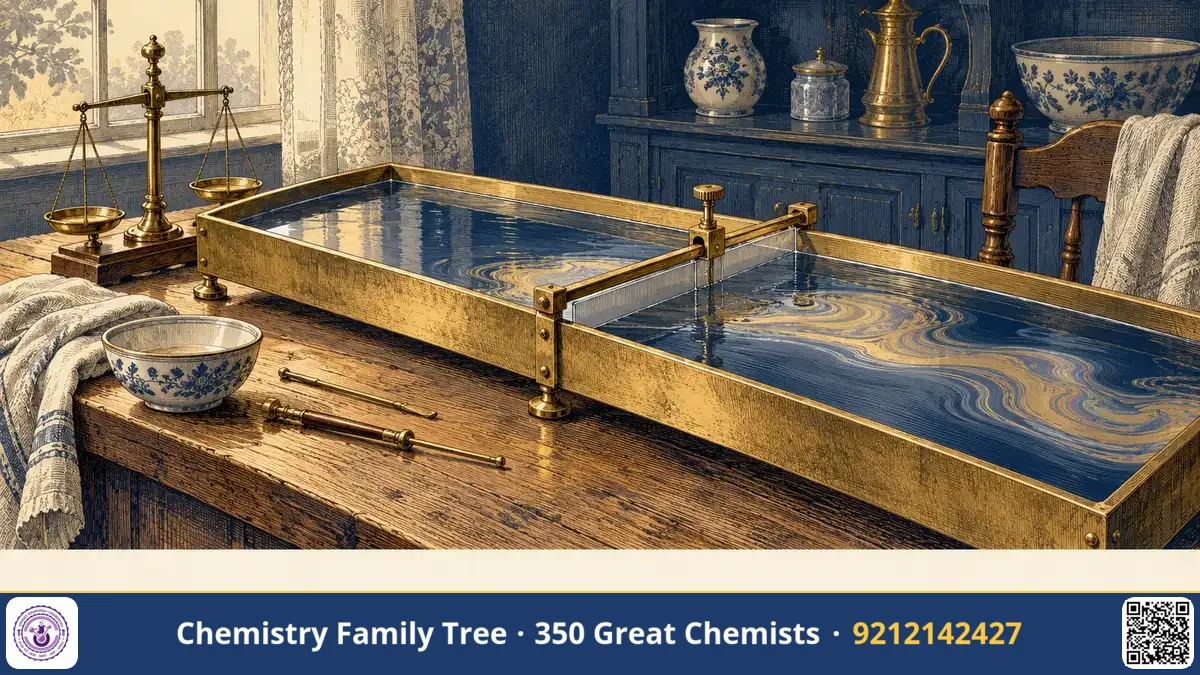
Why does a water drop form a bead? Why do small insects walk on a pond? Why does soap clean oily dishes? All three questions are about surface tension and surface films, and a self-taught German woman named Agnes Pockels answered them with apparatus she made from household items in her kitchen in the 1880s. She never attended university, yet in 1891 her work was published in the journal Nature after the great physicist Lord Rayleigh recognised its importance. Pockels invented a trough with a movable barrier for controlling and measuring films on water. Decades later, Irving Langmuir developed this basic design into the Langmuir trough that became the core instrument of surface chemistry. This article explains what she found and the chemistry behind it.
The Scientific Problem Before the Discovery
By the nineteenth century, scientists knew that liquids behave as if their surface were covered with a stretched elastic skin. Thomas Young and Pierre-Simon Laplace had given mathematical descriptions of the pressure differences across curved surfaces. Yet experiments on surface tension were hard to reproduce. Results changed from day to day, and nobody could say why. Today we know the reason: a trace of grease or soap on the surface of water changes the surface tension greatly. In the 1880s, without such knowledge, researchers could not control the surface condition of the liquid.
Another gap was that there was no simple way to measure surface tension without making the surface itself dirty or disturbing it. Pockels's observations on how washing water, oil and household substances behaved at the surface were an early step toward solving this.
The Discovery: Step by Step
- Watching the kitchen. While helping with housework, Pockels noticed that greasy dishwater behaved differently from clean water, and that surface contamination mattered.
- A simple balance. She built a device that used a small disc, or button, attached to one arm of a balance. She measured the force needed to pull the disc from the water surface, which depends on surface tension.
- Making a trough. She used a shallow rectangular trough filled to the brim with water and laid a movable strip, the barrier, across it. By moving the barrier she could sweep the surface clean or squeeze a film on it into a smaller area.
- Controlling the area. She varied the surface area available to the film and measured the surface tension at each area, thereby seeing how film compression affected it.
- Key observation. Surface tension remained almost steady until the film was compressed to a certain area, after which it fell sharply, which suggests that at that stage the substance had formed a continuous layer.
- Telling Rayleigh. She wrote a letter in German to Lord Rayleigh, who translated it and had it published as "Surface Tension" in Nature in March 1891.
The Chemistry Behind It
What is surface tension?
A molecule in the bulk of a liquid is pulled equally in all directions by its neighbours. A molecule at the surface has neighbours only below and beside it, so it experiences a net inward pull. To bring a molecule to the surface, energy must be spent. Surface tension is defined as the force per unit length acting along the surface, or equivalently the energy per unit area:
γ = F / l (N m⁻¹) or γ = ΔW / ΔA (J m⁻²)
Water has a high surface tension, about 72 mN/m at room temperature, because of strong hydrogen bonding. Surface tension decreases with temperature and becomes zero at the critical temperature.
Why do surfactants lower surface tension?
Soaps and detergents are amphiphilic: they have a hydrophilic head and a hydrophobic tail. They gather at the surface, with heads in water and tails in air, which reduces the cohesive force at the surface and lowers the tension. For a soap such as sodium stearate, CH₃(CH₂)₁₆COO⁻ Na⁺, the effect is large. This explains the behaviour Pockels saw in greasy dishwater.
Capillary rise and drops
Surface tension also causes liquid to rise in a narrow tube. The height is given by Jurin's law:
h = 2 γ cos θ / (r ρ g)
Here θ is the contact angle, r the tube radius, ρ the density of liquid and g acceleration due to gravity. This is useful in numericals.
Surface pressure and film area
The decrease in surface tension caused by a film is the surface pressure, π = γ₀ − γ. Plotting π against area per molecule gives an isotherm that reveals when molecules touch. The "critical area" Pockels saw is the beginning of this rise. Langmuir later used the same approach to find that fatty acid molecules stand upright, with a cross-section of about 0.2 nm² each.
Applications Today
- Detergents and cleaning: soaps and synthetic surfactants lower the surface tension and emulsify oils, which is the basis of laundry and dish-washing products.
- Pharmaceuticals: surfactants help dissolve and deliver poorly soluble drugs.
- Lung function: pulmonary surfactant lowers tension in the alveoli, so that babies can breathe easily; its lack causes respiratory distress in premature babies.
- Printing and paints: control of wetting and spreading of inks and coatings.
- Research tools: Langmuir troughs used in nanotechnology and membrane studies descend from Pockels's design.
- Oil spills and flotation: mineral flotation and spreading of oil on water depend on surface film behaviour.
Exam Corner
- Surface tension is the force per unit length (N m⁻¹) or the energy per unit area (J m⁻²); the dimensions are the same.
- Surface tension decreases as temperature increases and is zero at the critical temperature.
- Surfactants lower surface tension by adsorbing at the interface (positive adsorption).
- Capillary rise: h = 2γcosθ/(rρg). Water rises in glass (θ < 90°), mercury falls (θ > 90°).
- Surface pressure π = γ₀ − γ; this is the basis of the Langmuir trough measurement.
Common Misconceptions
- "Surface tension is a property of the whole liquid." It is a property of the surface or interface, and it changes with contamination.
- "Soap adds a layer that makes water stronger." It weakens the surface, since it lowers the surface tension.
- "A needle floats because of low density." A steel needle is denser than water; it floats because of surface tension, which supports its weight.
Quick Revision Box
- Pockels built a trough with a movable barrier at home in the 1880s.
- Her letter appeared in Nature in 1891 through Lord Rayleigh.
- Surface tension of water is about 72 mN/m near room temperature.
- Surfactants lower surface tension; surface pressure π = γ₀ − γ.
- Jurin's law: h = 2γcosθ/(rρg).
- Langmuir later built on her design in the Langmuir trough.
FAQ
Did Agnes Pockels go to university?
No. Women could not attend university in Germany at that time, and she taught herself physics from her brother's textbooks.
What is the Pockels trough?
It is a shallow trough of water with a movable barrier that compresses a surface film, used to study how surface tension changes with film area.
Why is pure water's surface tension so high?
Strong hydrogen bonds between water molecules create a large inward cohesive pull on surface molecules.
How is surface tension related to temperature?
It decreases as temperature rises because molecular cohesion weakens, reaching zero at the critical point.
Published by ABC Chemistry — IIT-JAM | CSIR-NET | GATE Chemistry Coaching. Visit abcchemistry.com

About the chemist
Agnes Pockels
1862-1935 · Germany
Surface science; Pockels trough