Biography · Chemist no. 83 of 350
Ahmed Zewail (1946-2016): The Egyptian Scientist Who Watched Molecules Move
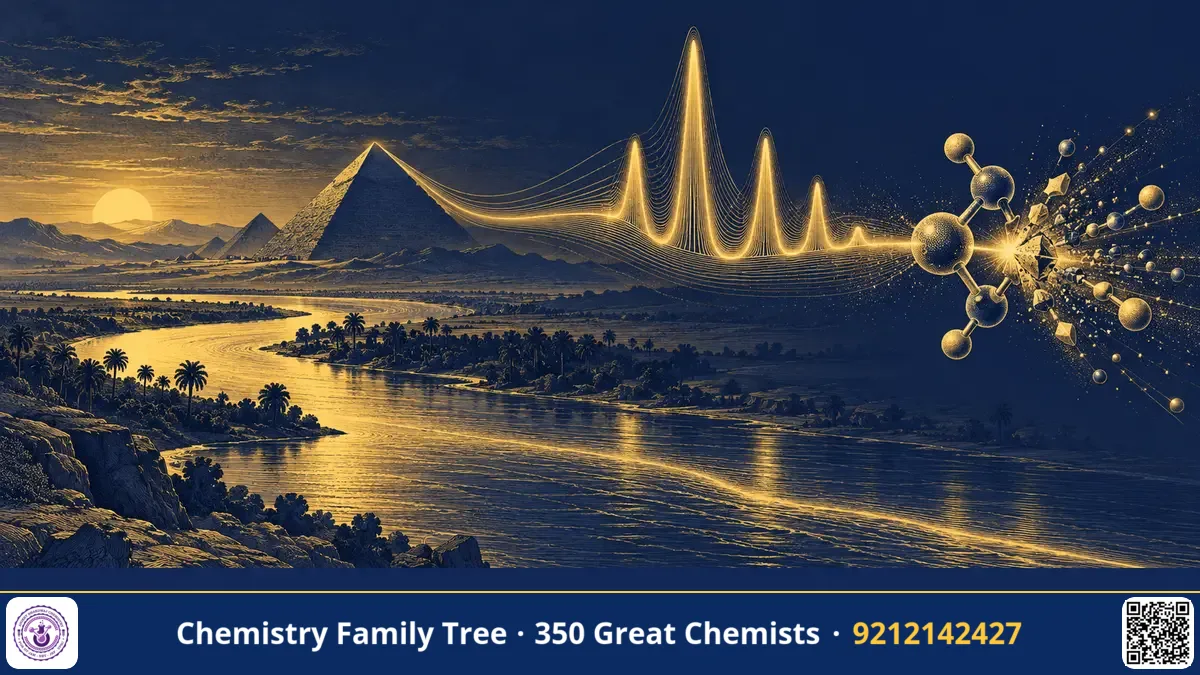
Ahmed Hassan Zewail was an Egyptian-American chemist who became the first person to observe chemical bonds breaking and forming in real time. His legacy in one line: he opened the femtosecond world to chemistry and received the Nobel Prize in Chemistry in 1999. He is also remembered as a bridge between science and society in the Arab world, and as a symbol that a student from a small Egyptian town can reach the highest level of world science. For students preparing for competitive exams, his name is linked with femtochemistry, the pump-probe method and the transition state.
Early Life & Family
Zewail was born on 26 February 1946 in Damanhur, a city in the Nile Delta of Egypt, and grew up in the nearby town of Disuq. As a boy he was curious about how things work and enjoyed science and mathematics. He later recalled the strong influence of his family and teachers on his education. Egypt in his youth was going through major political change, and the education system offered limited research facilities. Yet his own determination, and a scholarly environment at home and school, took him toward university science.
Education & Mentors
He studied at Alexandria University, receiving a bachelor's degree in chemistry in 1967 and a master's degree in 1969. For doctoral research he travelled to the United States and joined the University of Pennsylvania, where he worked with Robin Hochstrasser, an expert in molecular spectroscopy. He obtained his PhD in 1974. He then moved as a postdoctoral researcher to the University of California, Berkeley, to work with Charles B. Harris, where he studied energy transfer in molecular solids using lasers. This training in spectroscopy and lasers, coupled with his interest in the quantum mechanics of molecules, prepared him for his later breakthrough.
Career Timeline
| Year | Event |
|---|---|
| 1946 | Born in Damanhur, Egypt (26 February) |
| 1967 and 1969 | Bachelor's and master's degrees, Alexandria University |
| 1974 | PhD, University of Pennsylvania, under Robin Hochstrasser |
| 1974-1976 | Postdoctoral research at the University of California, Berkeley |
| 1976 | Joins the faculty of the California Institute of Technology (Caltech) |
| 1982 | Becomes a United States citizen |
| 1987-1988 | Femtosecond experiments on ICN and NaI |
| 1990 | Appointed Linus Pauling Professor of Chemical Physics at Caltech |
| 1999 | Nobel Prize in Chemistry |
| 2009 | Appointed US Science Envoy to the Middle East |
| 2016 | Dies in Pasadena, California (2 August) |
Major Scientific Contributions
- Femtochemistry: using pump-probe laser spectroscopy to follow the motion of atoms during reactions on the timescale of 10-15 second.
- Direct view of the transition state: experiments on ICN, I2 and NaI showed how bonds break and how molecules cross between potential energy curves.
- Organic and biological dynamics: extending the methods to ketones, to hydrogen-bonded systems and to biomolecules.
- Ultrafast electron diffraction and microscopy: the "4D" methods that combine atomic-scale resolution and femtosecond time resolution.
The details of the pump-probe method and the ICN and NaI experiments appear in the companion discovery blog on femtochemistry.
Awards, Honours & Nobel Prize
Zewail won the Nobel Prize in Chemistry 1999 alone, "for his studies of the transition states of chemical reactions using femtosecond spectroscopy". He was the first Egyptian to receive a Nobel Prize in a scientific field. Egypt honoured him with its highest civilian decoration, the Grand Collar of the Order of the Nile, and issued a postage stamp in his honour. Other awards include the Wolf Prize in Chemistry (1993) and the US National Medal of Science (2006). He was a member of several national academies and held many honorary degrees.
Personality, Struggles & Lesser-Known Facts
- He travelled abroad for advanced research training, yet he remained deeply attached to his homeland all his life.
- Many senior scientists in the 1980s believed it was impossible to see transition states. Zewail's persistence against this common belief is an example of scientific courage.
- He wrote a popular science book, Voyage Through Time: Walks of Life to the Nobel Prize, which describes his journey and his views on science.
- He worked on the idea of a new science university in Egypt, which grew into the Zewail City of Science and Technology.
- In 2009 he was named by the US President as the first US Science Envoy to the Middle East, to encourage cooperation in science and education.
Legacy & Influence on Modern Chemistry
Femtochemistry changed how chemists think about reactions. Before him, a reaction was drawn as an arrow between reactants and products. After him, the arrow became a movie. Today ultrafast laser laboratories around the world, including in India, study photosynthesis, vision, solar cells, DNA photodamage and catalysis using the same pump-probe principle. His "4D electron microscopy" is used to watch structural changes in materials. His life is also a model for science diplomacy and for the role of scientists in education and development.
Lessons for Students
- Believe in a big idea, even if experts say it is impossible. Wait for the technology and then use it.
- Learn tools well. Mastering lasers and spectroscopy allowed him to address a fundamental chemical question.
- Take the world as your classroom. Egypt, Pennsylvania, California: he learned from every place.
- Give back. He worked to improve science education in his home country.
Quick Facts Box
- Born: 26 February 1946, Damanhur, Egypt
- Died: 2 August 2016, Pasadena, California, USA
- Nationality: Egyptian-American
- Field: Physical chemistry, laser spectroscopy
- Famous for: Femtochemistry; observing transition states
- Nobel Prize: Chemistry, 1999 (sole recipient)
FAQ
Where did Zewail work for most of his career?
At the California Institute of Technology (Caltech) in Pasadena, from 1976 until the end of his life.
Which institution gave him his PhD?
The University of Pennsylvania, where he worked under Robin Hochstrasser.
Why is he called the father of femtochemistry?
Because he developed the experiments that first followed bond breaking and formation on the femtosecond timescale, and led the field for decades.
Was Zewail the first Egyptian Nobel laureate?
He was the first Egyptian to win a Nobel Prize in science. Earlier Egyptian laureates received the Peace and Literature prizes.
Published by ABC Chemistry — IIT-JAM | CSIR-NET | GATE Chemistry Coaching. Visit abcchemistry.com
About the chemist
Ahmed Zewail
1946-2016 · Egypt/United States · Nobel Chemistry 1999
Femtochemistry