The discovery, explained · Chemist no. 83 of 350
Femtochemistry: How Ahmed Zewail Filmed Chemical Bonds Breaking and Forming
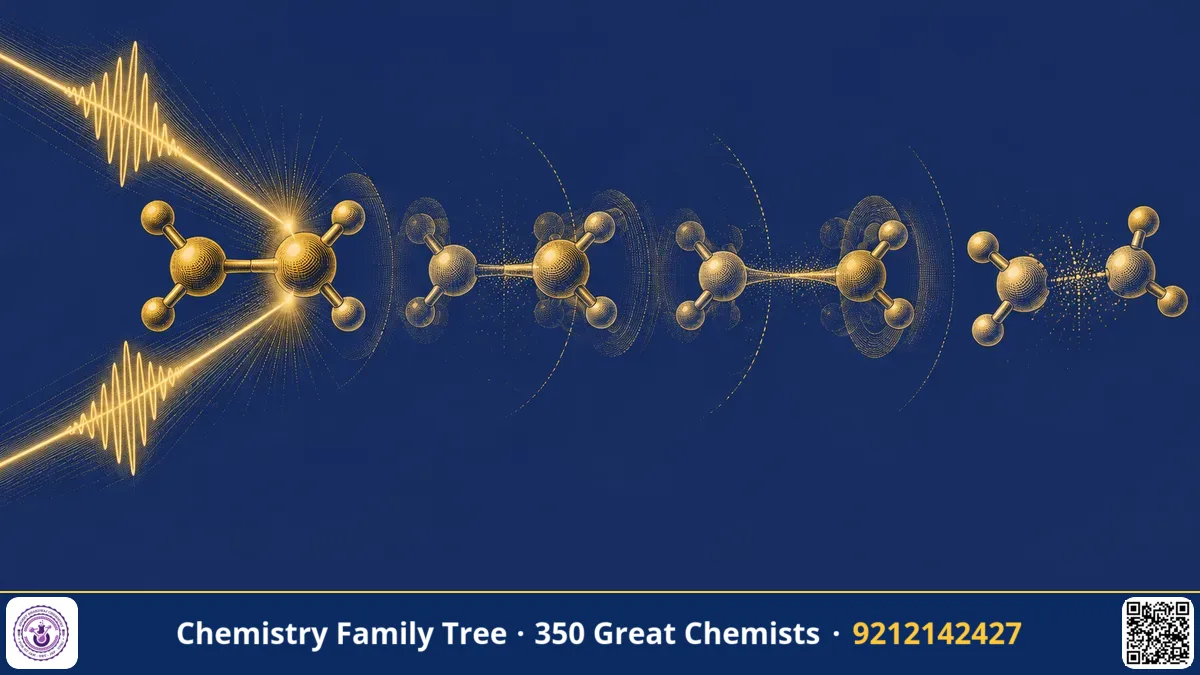
If you can photograph a running horse by freezing the motion with a very fast camera shutter, could you also photograph a molecule as its chemical bond breaks? For most of the history of chemistry, the answer was no. Chemists could mix reactants and analyse products, but the transition state, the most important moment of a reaction, was invisible. Ahmed Zewail changed this. Using laser pulses lasting only a few femtoseconds, he made "molecular movies" of reactions as they happen. This field is called femtochemistry, and Zewail received the Nobel Prize in Chemistry in 1999 for it. A femtosecond (fs) is 10-15 second, one millionth of one billionth of a second. In this time light travels only about 0.3 micrometre, much less than the width of a human hair.
The Scientific Problem Before the Discovery
Transition-state theory, developed by Eyring and others in the 1930s, says that a reaction proceeds through a high-energy arrangement of atoms at the top of the energy barrier:
A + BC → [A···B···C]‡ → AB + C
The rate constant is related to the barrier by the Arrhenius equation, k = A·exp(−Ea/RT). But the transition state exists for only a few tens or hundreds of femtoseconds, because atoms vibrate with periods of about 10 to 100 fs. Chemists believed this was too fast to measure. Before Zewail, the fastest chemical timescales measured with lasers were in the nanosecond (10-9 s) and picosecond (10-12 s) range. Reactions were seen only as "before" and "after". The question was whether technology could reach the femtosecond limit and whether molecules would show clear, observable motion on that scale.
The Discovery / Experiment — Step by Step
The pump-probe idea
Zewail's group at the California Institute of Technology (Caltech) used two ultrashort laser pulses from the same laser:
- The pump pulse excites the molecule, starting the reaction at a precisely known moment (time zero). This is like starting a stopwatch.
- The probe pulse arrives after a controlled delay and detects what the molecule looks like at that moment, for example by laser-induced fluorescence from one fragment.
- The delay is controlled by making the probe pulse travel a longer path, using a movable mirror. Since light travels about 0.3 µm in 1 fs, a change in path length of 0.3 µm adds a delay of 1 fs.
- The experiment is repeated for many delay times, and the signals are plotted against time. The result is a "film" of the reaction, built frame by frame.
First test: ICN dissociation (1987)
Zewail and co-workers studied the photodissociation of cyanogen iodide in a molecular beam:
ICN + hν → [I···CN]‡ → I + CN
The pump pulse broke the I-C bond, and the probe pulse was tuned to detect free CN fragments. The CN signal rose with time and reached its full value only after about 200 fs. This was the first direct measurement of the time taken for a bond to break, and it showed the transition state as a real, observable state with a lifetime.
The NaI experiment (1988)
An even more beautiful experiment used sodium iodide. The ground state of NaI is ionic (Na+I-), but after excitation the molecule is on a covalent-like potential curve that crosses the ionic curve. At the curve crossing, the molecule either stays bound or dissociates. The signals showed oscillations with a period of about one picosecond. Each time the nuclei moved to the crossing point, part of the wave packet escaped as free Na atoms, and the rest returned. Chemists could now "see" a vibrating molecule at a curve crossing and measure the fraction that leaks out each cycle.
The Chemistry Behind It
Wave packets
A femtosecond pulse has a broad range of frequencies (from the energy-time uncertainty principle, ΔE·Δt ≥ ħ/2). It therefore excites several vibrational states of the molecule together, creating a wave packet: a localised quantum state that moves like a classical particle on the potential energy surface. This is why the nuclei seem to have a position and velocity even though the molecule is quantum mechanical. When the packet reaches the transition-state region, the probe pulse can detect it.
Why timescales matter
| Process | Typical time |
|---|---|
| Molecular vibration (bond stretch) | 10 to 100 fs |
| Bond breaking in ICN | about 200 fs |
| Molecular rotation | picoseconds |
| Fluorescence | nanoseconds |
Zewail also extended femtochemistry to organic reactions, such as the Norrish type I cleavage of ketones and the question of whether two bonds break at once (concerted) or one after the other (stepwise). In cyclobutane-type fragmentation, the work showed a short-lived diradical intermediate. Later he developed ultrafast electron diffraction and ultrafast electron microscopy, which he called "4D" microscopy: three spatial dimensions plus time.
Applications Today
- Understanding photosynthesis and vision: the primary event in vision, the cis to trans isomerisation of retinal in rhodopsin, takes place in about 200 fs, and femtosecond methods are used to study it.
- Solar energy research: charge separation and electron injection in dye-sensitised solar cells are tracked in real time.
- Drug and protein dynamics: energy flow and structural changes in proteins and DNA, including photodamage and repair, are studied with ultrafast spectroscopy.
- Controlling reactions: shaped femtosecond pulses can steer a reaction toward a chosen product, an idea called coherent control.
- Materials: ultrafast electron microscopy is used to study phase changes and nanoscale motion in materials.
Exam Corner — 5 Likely Points
- 1 fs = 10-15 s; 1 ps = 10-12 s; 1 ns = 10-9 s.
- Femtochemistry uses pump-probe spectroscopy with delay lines; the delay is set by path length (c × t).
- The transition state can be observed as a short-lived species of about 10 to 200 fs lifetime.
- ICN dissociation took about 200 fs; NaI showed oscillations of about 1 ps, due to a curve crossing between ionic and covalent states.
- Femtosecond pulses create wave packets, a consequence of the uncertainty principle.
Common Misconceptions
- "Zewail photographed individual atoms with a normal camera." No. He used laser spectroscopy and later electron diffraction, which measure molecular structure and dynamics indirectly.
- "Transition states are just a mathematical idea." Femtochemistry showed that they are observable regions of the potential energy surface with a measurable lifetime.
- "A femtosecond laser can change reaction rates just by being fast." The pulse starts the reaction; the reaction itself still follows chemistry and quantum mechanics.
Quick Revision Box
- Femtochemistry studies chemical reactions on the 10-15 s timescale.
- Pump pulse starts the reaction; probe pulse measures it after a time delay.
- ICN → I + CN took about 200 fs; NaI oscillations near 1 ps.
- Wave packets arise from the broad frequency range of short pulses.
- Later developments: ultrafast electron diffraction and 4D electron microscopy.
- Nobel Prize in Chemistry 1999 awarded to Ahmed Zewail alone.
FAQ
How short is a femtosecond?
One femtosecond is 10-15 second. There are as many femtoseconds in one second as there are seconds in about 32 million years.
Why do we need two laser pulses?
One pulse starts the reaction and the other pulse measures the system after a known delay. Electronics are too slow for such short times, so the delay is created by optics.
Did Zewail disprove transition-state theory?
No. He confirmed and refined it by observing the transition-state region directly.
What is 4D electron microscopy?
It is a technique that uses ultrashort electron pulses to image structures with atomic-scale spatial resolution and femtosecond time resolution, so the fourth dimension is time.
Published by ABC Chemistry — IIT-JAM | CSIR-NET | GATE Chemistry Coaching. Visit abcchemistry.com
About the chemist
Ahmed Zewail
1946-2016 · Egypt/United States · Nobel Chemistry 1999
Femtochemistry