Biography · Chemist no. 95 of 350
Akira Suzuki: The Hokkaido Chemist Whose Boron Chemistry Changed Drug Making
Akira Suzuki (born 1930) is a Japanese organic chemist who spent most of his career at Hokkaido University in Sapporo. He is the "S" in the Suzuki coupling, a reaction used in laboratories and factories all over the world to join carbon rings and chains. In 2010 he shared the Nobel Prize in Chemistry with Richard Heck and Ei-ichi Negishi. His legacy in one line: he showed that gentle, stable boron compounds can become powerful building blocks when combined with palladium.
Early Life and Family
Suzuki was born on 12 September 1930 in Mukawa, a town in Hokkaido, the northernmost main island of Japan. His childhood fell in the years of the Second World War and the difficult post-war recovery in Japan, when many universities and laboratories had limited resources. Hokkaido is known for its cold winters and agriculture, and the island had a strong tradition of applied science. Suzuki grew up in a modest setting and, like many of his generation, was drawn to a field that could rebuild the country: chemistry. He later remained in Hokkaido for most of his working life, which is unusual for a scientist of world fame.
Education and Mentors
Suzuki studied chemistry at Hokkaido University, where he received his undergraduate degree in the 1950s and a doctorate in 1959. Early in his career he became interested in organic synthesis. A decisive step came in 1963, when he went to Purdue University in the United States as a postdoctoral researcher with Herbert C. Brown, who had discovered hydroboration and later won the Nobel Prize himself (1979). Brown's lab was full of ideas about organoboranes. Suzuki returned to Hokkaido in 1965 with deep knowledge of boron chemistry and the determination to make it useful. The relationship between the two chemists is an example of how a short stay abroad can set the direction of a lifetime of research.
Career Timeline
| Year | Event |
|---|---|
| 1930 | Born in Mukawa, Hokkaido, Japan |
| 1950s | Studied chemistry at Hokkaido University |
| 1959 | Received doctorate from Hokkaido University |
| 1963-1965 | Postdoctoral research with H. C. Brown at Purdue University |
| 1973 | Became professor at Hokkaido University |
| 1979 | Published the palladium-catalysed coupling of organoboron compounds with Norio Miyaura |
| 1994 | Retired from Hokkaido University; later taught at other Japanese universities |
| 2010 | Nobel Prize in Chemistry (with Heck and Negishi) |
Major Scientific Contributions
The Suzuki-Miyaura coupling. The central contribution is the Pd-catalysed reaction:
R¹–BY₂ + R²–X --[Pd(0), base]--> R¹–R²
where BY₂ is B(OH)₂ or a boronate ester and X is a halide or triflate. The base activates the boron reagent. The reaction proceeds through oxidative addition, transmetalation and reductive elimination (see our discovery post on Suzuki coupling for the full cycle).
Organoborane chemistry. Beyond the coupling, Suzuki's group developed many reactions of organoboranes: stereocontrolled synthesis of alkenes, dienes and conjugated polyenes, and boron-based routes for natural product synthesis. His long interest in hydroboration products shows that the famous reaction grew out of decades of basic research.
Synthesis of natural products. The coupling was used to build polyene structures where double-bond geometry must be preserved, an important requirement for biologically active compounds.
Awards, Honours and Nobel Prize
The Nobel Prize in Chemistry 2010 was shared equally by Richard F. Heck, Ei-ichi Negishi and Akira Suzuki "for palladium-catalyzed cross couplings in organic synthesis". In the same year, the Government of Japan honoured him with the Order of Culture, one of the country's highest civilian distinctions for cultural contribution. He also received recognition from chemical societies in Japan and abroad, and he holds the title of professor emeritus at Hokkaido University. The Nobel Prize came more than 30 years after the original paper, which shows how long it can take for a good idea to be recognised and used.
Personality, Struggles and Lesser-Known Facts
- A student of Brown: Suzuki's hydroboration background is the source of the idea. Brown's Nobel Prize in 1979 and Suzuki's in 2010 show how a mentor's field can grow in the hands of a student.
- No patent: Suzuki is widely reported not to have patented the reaction. This helped chemists around the world to adopt it freely, and it became one of the most used reactions in industry.
- Teamwork: His co-author Norio Miyaura was a close collaborator; their names are linked in the term Suzuki-Miyaura reaction.
- Loyalty to Hokkaido: Despite worldwide fame, he built his career in Sapporo and trained generations of Japanese chemists there.
- A gentle reaction from a patient mind: The reagents he chose are mild and stable, a reflection of a careful approach to chemistry.
Legacy and Influence on Modern Chemistry
Suzuki coupling is among the most widely used carbon-carbon bond-forming reactions in the pharmaceutical industry. A typical drug discovery laboratory will use it every week to make libraries of biaryl compounds. It also helped to create a generation of organic electronics, from OLED displays to polymers for solar cells. Because boron compounds are of low toxicity and the by-products are simple inorganic salts, the reaction also fits the aims of green chemistry. For Indian students, it provides a good case study of how a fundamental discovery in one country can become the basis of an industry in another, for instance in the manufacture of generic medicines.
Lessons for Students
- Build deep knowledge in one area. Suzuki's mastery of organoboranes gave him the idea.
- Combine fields. Boron chemistry plus palladium catalysis gave a new method.
- Value mentors. A postdoctoral year with H. C. Brown shaped his scientific life.
- Share freely. Open adoption helped the reaction spread worldwide.
- Be patient. Recognition may take decades.
Quick Facts Box
- Born: 12 September 1930, Mukawa, Hokkaido, Japan
- Died: Living (no death recorded at the time of writing)
- Nationality: Japanese
- Field: Organic chemistry, organoboron chemistry
- Famous for: Suzuki-Miyaura cross-coupling reaction
- Nobel: Chemistry 2010 (shared with Heck and Negishi)
FAQ
Who was Akira Suzuki's postdoctoral supervisor?
Herbert C. Brown at Purdue University, the discoverer of hydroboration.
When was the Suzuki coupling discovered?
The first report with Norio Miyaura appeared in 1979, and the scope was widened in the early 1980s by using arylboronic acids.
Why did Suzuki win the Nobel Prize?
For developing palladium-catalysed cross-coupling reactions of organoboron compounds, shared with Richard Heck and Ei-ichi Negishi.
Where did Suzuki work?
Mostly at Hokkaido University in Sapporo, where he became professor in 1973.
Published by ABC Chemistry — IIT-JAM | CSIR-NET | GATE Chemistry Coaching. Visit abcchemistry.com
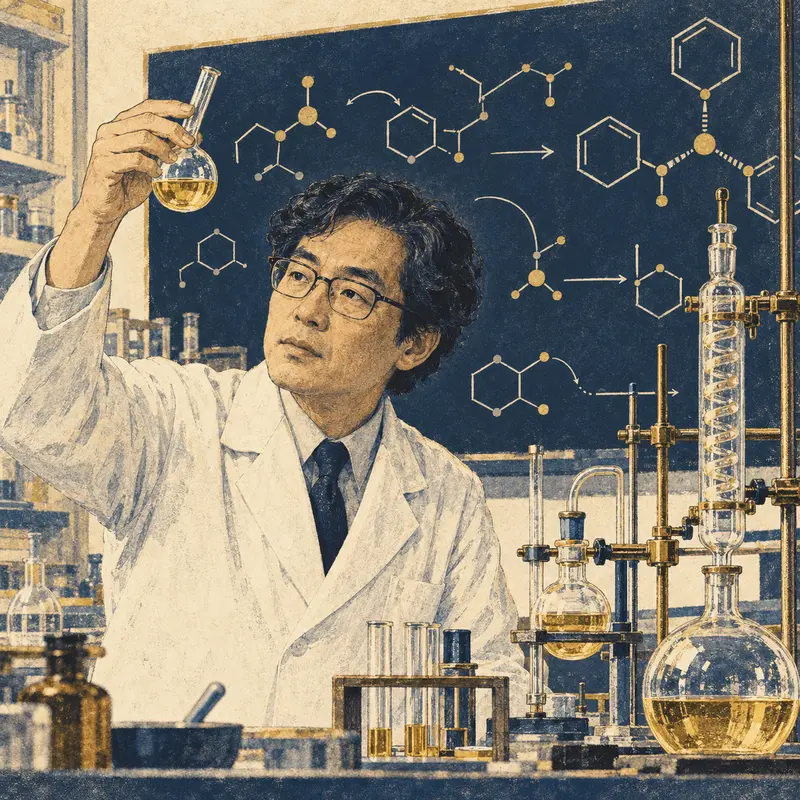
About the chemist
Akira Suzuki
1930- · Japan · Nobel Chemistry 2010
Suzuki cross-coupling reaction