The discovery, explained · Chemist no. 95 of 350
Akira Suzuki and the Coupling Reaction That Joins Carbon Rings Together
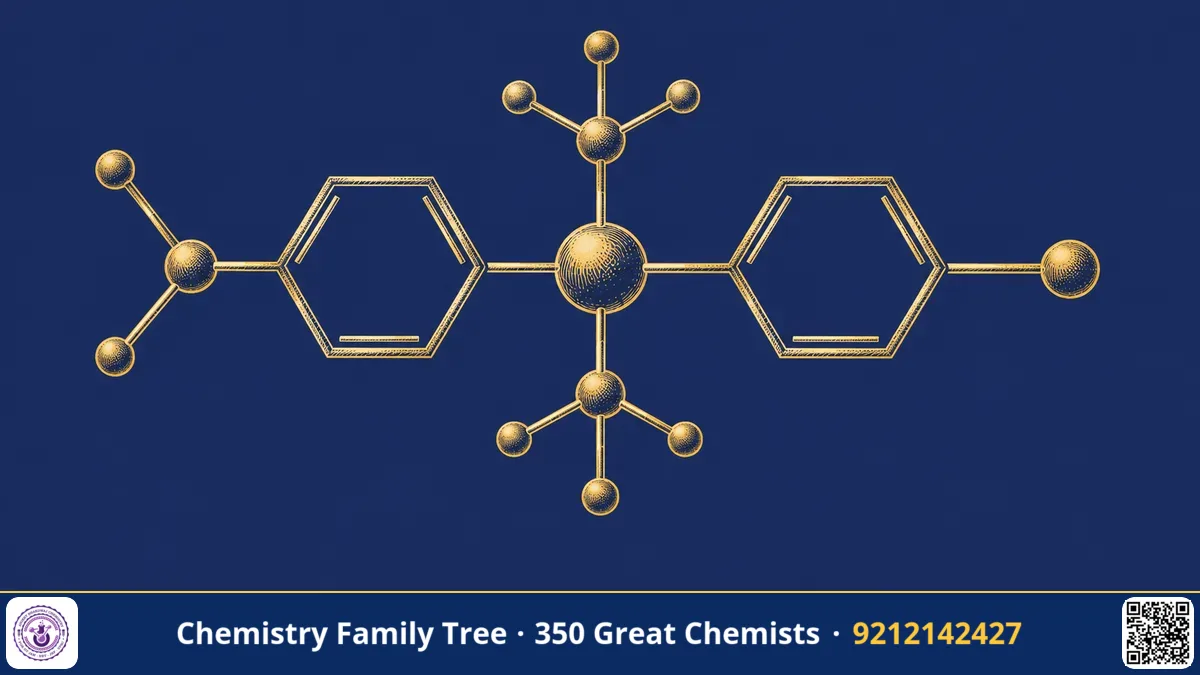
If you look at the structures of many modern drugs, flat-panel display materials and agrochemicals, you often see two aromatic rings joined by a single bond: a biaryl. Making that bond in a clean, predictable way was once difficult. In 1979 Akira Suzuki and Norio Miyaura at Hokkaido University reported a palladium-catalysed reaction between an organoboron compound and an organic halide in the presence of a base. This became known as the Suzuki coupling or Suzuki-Miyaura coupling. It is mild, tolerant of many functional groups, uses relatively non-toxic boron reagents, and works in water-containing solvents. In 2010 Suzuki shared the Nobel Prize in Chemistry with Richard Heck and Ei-ichi Negishi "for palladium-catalyzed cross couplings in organic synthesis". For exams, it is among the most frequently asked named reactions.
The Scientific Problem Before the Discovery
Organic chemists wanted a reliable way to join two carbon fragments, especially sp²-sp² carbons, as in biaryls and conjugated dienes. Older methods had drawbacks. The Ullmann reaction needed copper and very high temperatures. Grignard and organolithium reagents are strong bases and nucleophiles, so they cannot be used with many functional groups such as esters, nitriles or ketones. Organotin reagents (Stille coupling) are effective but toxic. Palladium-catalysed couplings with organomagnesium (Kumada) and organozinc (Negishi) compounds were being developed, but the nucleophilic partners were still moisture-sensitive.
Suzuki had worked as a postdoctoral researcher with Herbert C. Brown, the pioneer of hydroboration. He knew that organoboranes are easy to make from alkenes and alkynes, are stable, and are normally unreactive towards organic halides. The challenge was to find a way to make the boron-carbon bond "transfer" its organic group. The solution was palladium plus a base.
The Discovery: Step by Step
- Make the organoboron reagent. An alkyne reacts with catecholborane (hydroboration), giving a (E)-alkenylborane with syn addition: R–C≡CH + HB(cat) → (E)-R–CH=CH–B(cat).
- Couple with a halide. In 1979 Miyaura and Suzuki combined the alkenylborane with an alkenyl or aryl halide, using Pd(PPh₃)₄ as catalyst and a base such as sodium ethoxide. The product was a conjugated diene or styrene-type compound with retention of double bond geometry.
- Broaden to boronic acids. Within a short time the group showed that arylboronic acids, ArB(OH)₂, which are easy to handle solids, also couple. This gave biaryls under mild conditions.
- Spread to the world. The reaction was soon adopted by pharmaceutical and materials chemists everywhere.
The general equation is:
Ar–X + Ar'–B(OH)₂ --[Pd(0) catalyst, base]--> Ar–Ar' + X–B(OH)₂ (as borate salt)
where X = I, Br, OTf (triflate), and with special ligands also Cl.
The Chemistry Behind It
The catalytic cycle has three main steps, which every student should write from memory.
- Oxidative addition. Pd(0) inserts into the Ar–X bond: Pd(0) + Ar–X → Ar–Pd(II)–X. The palladium oxidation state goes from 0 to +2. The reactivity order of halides is I > Br ≈ OTf >> Cl.
- Transmetalation. The boronic acid is not nucleophilic enough by itself. The base (for example K₂CO₃, K₃PO₄, NaOH) converts it into a tetrahedral boronate, Ar'B(OH)₃⁻, which transfers the aryl group to Pd: Ar–Pd–X + Ar'B(OH)₃⁻ → Ar–Pd–Ar' + X⁻ + B(OH)₃. The base may also exchange with the halide on palladium, forming Ar–Pd–OH or Ar–Pd–OR, which reacts with the neutral boronic acid. Both pathways explain why a base is essential.
- Reductive elimination. The two aryl groups on Pd(II) join, forming the C–C bond and regenerating Pd(0): Ar–Pd–Ar' → Ar–Ar' + Pd(0).
Stereochemistry matters. The coupling of alkenyl partners proceeds with retention of the double bond configuration, so (E)-alkenyl boron compounds give (E)-products. Chiral centres on sp³ carbons are harder to control, which is why sp²-sp² coupling is the classic case.
Why is it so popular?
| Feature | Advantage |
|---|---|
| Boronic acids | Stable to air and water, commercially available, low toxicity |
| Conditions | Mild; can use aqueous solvents |
| By-products | Inorganic boron salts, easy to remove |
| Functional groups | Tolerates esters, ketones, nitriles, amides |
| Stereochemistry | Retention of alkene geometry |
Applications Today
- Pharmaceuticals: Biaryl-containing drugs such as the "sartan" class of blood pressure medicines (for example losartan) are made using Suzuki couplings. Many Indian pharmaceutical companies use this reaction in their API manufacturing.
- Agrochemicals: Some fungicides, such as boscalid, contain a biaryl fragment prepared by Suzuki coupling.
- Materials: Conjugated polymers used in organic light-emitting diodes (OLEDs) and solar cells are made by Suzuki polycondensation.
- Natural products: Complex natural products with polyene chains are assembled using alkenyl boron couplings.
- Education and research: The reaction is a common experiment in modern undergraduate labs because it works in simple conditions.
Exam Corner
- Suzuki coupling: organoboron compound + organic halide/triflate, Pd(0) catalyst, base. Forms C(sp²)–C(sp²) bond.
- Three steps: oxidative addition, transmetalation, reductive elimination. Palladium oscillates between Pd(0) and Pd(II).
- The base activates the boron compound as a borate; without base the reaction fails.
- Halide reactivity: R–I > R–Br > R–OTf >> R–Cl.
- Nobel Prize in Chemistry 2010: Heck, Negishi, Suzuki. Heck uses alkenes, Negishi uses organozinc, Suzuki uses organoboron. Stille uses tin.
Common Misconceptions
- "Palladium is consumed in the reaction." No, it is a catalyst, regenerated in the cycle; only small loadings are used.
- "The base is just for neutralising acid." The base has a more important mechanistic role: it activates the boron reagent for transmetalation.
- "Suzuki coupling is the same as Grignard coupling." Grignard reagents are far more reactive and less tolerant. Boron reagents are mild.
Quick Revision Box
- Reported in 1979 by Suzuki and Miyaura, Hokkaido University.
- Reagents: ArB(OH)₂ + Ar'X, Pd(0), base.
- Cycle: oxidative addition → transmetalation → reductive elimination.
- Base forms a borate, making the aryl group transferable.
- Retention of configuration of alkenes.
- Nobel Prize 2010 shared with Heck and Negishi.
FAQ
What is the Suzuki-Miyaura coupling?
It is a palladium-catalysed cross-coupling of an organoboron compound with an organic halide or triflate, in the presence of a base, giving a new carbon-carbon bond.
Why is a base required?
The base converts the boronic acid into a more nucleophilic borate or generates a Pd–OH/Pd–OR species, allowing transmetalation to occur.
Is the Suzuki coupling an example of green chemistry?
It is greener than many older methods because boron reagents have low toxicity, water can be used as a solvent, and the by-products are mostly inorganic salts.
How does Suzuki coupling differ from Heck coupling?
The Heck reaction couples an aryl or alkenyl halide with an alkene, whereas the Suzuki reaction couples it with an organoboron compound.
Published by ABC Chemistry — IIT-JAM | CSIR-NET | GATE Chemistry Coaching. Visit abcchemistry.com
About the chemist
Akira Suzuki
1930- · Japan · Nobel Chemistry 2010
Suzuki cross-coupling reaction