Biography · Chemist no. 216 of 350
Akira Yoshino: The Industrial Chemist Behind the Modern Battery
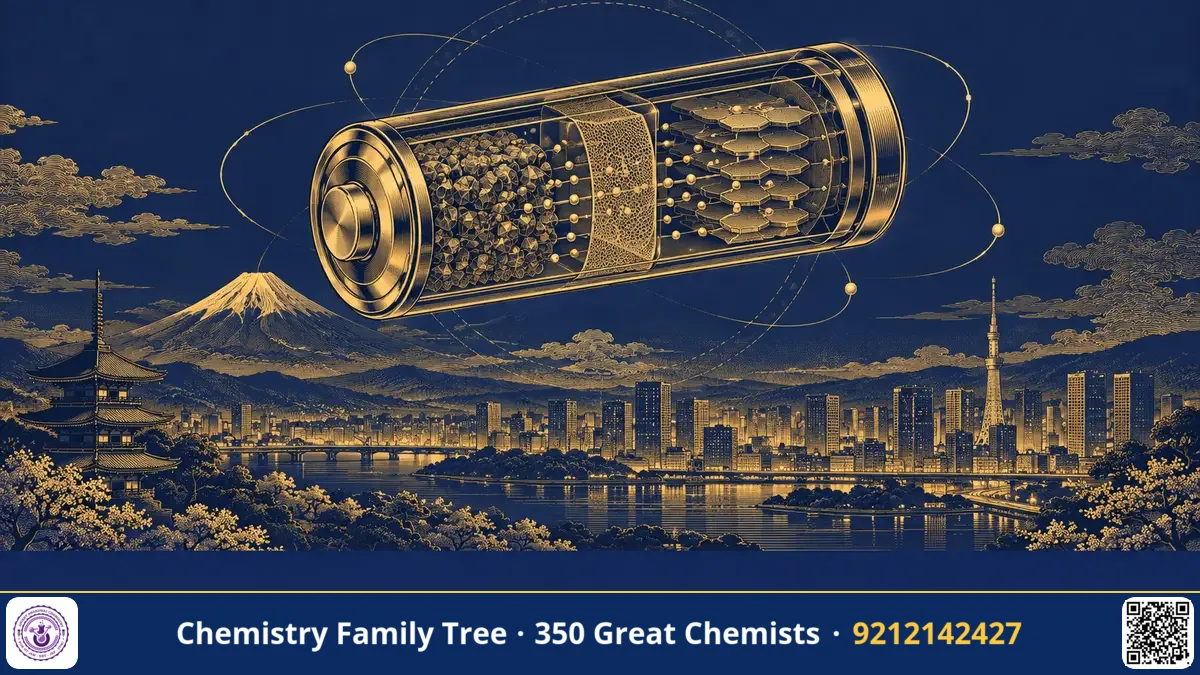
Akira Yoshino (born 30 January 1948) is a Japanese chemist who worked at Asahi Kasei Corporation for most of his career and is now an honorary fellow of the company and a professor at Meijo University in Nagoya. He shared the 2019 Nobel Prize in Chemistry with John B. Goodenough and M. Stanley Whittingham. His legacy in one line: he made the lithium-ion battery safe and practical by replacing lithium metal with a carbon anode.
Early Life and Family
Yoshino was born in Suita, a city in Osaka Prefecture, Japan. He has said that as a child he was fascinated by a book about the chemistry of a candle, which he has linked to Michael Faraday's famous lectures, The Chemical History of a Candle. His interest in chemistry began at an early age, and a teacher in elementary school encouraged him.
Education and Mentors
Yoshino studied petrochemistry at the Faculty of Engineering of Kyoto University, graduating in 1970, and completed a master's degree in 1972. He joined the chemical company Asahi Kasei in 1972 as a researcher. Later, in 2005, he received his doctorate in engineering from Osaka University. At Asahi Kasei he worked first on polymer materials and then on battery research. His exposure to conductive polymers, especially polyacetylene discovered by Hideki Shirakawa (co-winner of the 2000 Nobel Prize in Chemistry), influenced his early battery thinking.
Career Timeline
| Year | Event |
|---|---|
| 1948 | Born in Suita, Osaka, Japan |
| 1970-1972 | Studies at Kyoto University, graduating with a bachelor's and then a master's degree |
| 1972 | Joins Asahi Kasei Corporation |
| 1985 | Builds the prototype of the lithium-ion battery with a carbon anode and LiCoO₂ cathode |
| 1991 | First commercial lithium-ion batteries are launched by Sony |
| 2005 | Receives a doctorate from Osaka University |
| 2017 | Becomes a professor at Meijo University |
| 2019 | Shares the Nobel Prize in Chemistry |
Major Scientific Contributions
- The first practical lithium-ion cell: carbon-based anode with LiCoO₂ cathode.
- Understanding of carbon anodes: identification of carbonaceous materials that accept lithium reversibly at a low potential.
- Safety demonstrations: showing that the new cell did not ignite under severe mechanical abuse.
- Battery components: work with colleagues on aluminium current collectors and separators, which made large-scale manufacturing possible.
- Advocacy for sustainable society: he has promoted the idea that lithium-ion batteries enable the use of renewable energy and a more sustainable future.
The chemistry is covered in detail in our companion discovery post.
Awards, Honours and Nobel Prize
The 2019 Nobel Prize in Chemistry was awarded jointly to Goodenough, Whittingham and Yoshino "for the development of lithium-ion batteries". Earlier he received the Charles Stark Draper Prize of the United States National Academy of Engineering (2014), the Japan Prize (2018), and the Order of Culture (Bunka Kunsho) in Japan in 2019.
Personality, Struggles and Lesser-Known Facts
- Candle-inspired: His love of chemistry began with Faraday's story of a candle, as he mentioned in interviews.
- A company man: Unlike many laureates, he did not spend his career as an academic. He worked in industry for decades and pursued practical goals.
- Safety test: His famous demonstration involved dropping an iron block on the cell to show that it did not catch fire.
- Persistence through uncertainty: In the 1980s, there was no mobile phone market of today's size. He worked with a vision of future portable electronics.
- Modest and cheerful: At the Nobel ceremony and in press interviews, he stressed teamwork and the value of curiosity.
Legacy and Influence on Modern Chemistry
Yoshino's cell turned the laboratory discovery of intercalation chemistry into the technology that supports the mobile era. His design principle, two intercalation hosts without metallic lithium, remains the basis of nearly all commercial batteries. The ongoing development of solid-state electrolytes, silicon anodes and recycling methods builds on it. Many Indian start-ups and national missions on electric mobility are working with the same fundamental cell design.
Yoshino's career is a model of how industrial research can combine curiosity with discipline. He did not only invent a chemistry; he also considered how the cell would be built, how it would behave if damaged, and how it could be made in large numbers at a reasonable cost. Choices such as using an aluminium foil for the cathode current collector and a copper foil for the anode, and selecting a suitable porous separator, may sound small, but they are part of why the lithium-ion battery works at scale. After the Nobel Prize, he has spoken widely about the role of batteries in a sustainable society, including electric vehicles, renewable energy storage and the internet of things. He often encourages young scientists to follow their curiosity but also to ask what real problem their work can solve. For students in India, where battery manufacturing and recycling are growing quickly, his story shows how careful chemistry can meet national needs.
Lessons for Students
- Curiosity starts small. A book about a candle can begin a career.
- Test safety and practicality. A good lab result must work in the real world.
- Industry research matters. Great chemistry happens in company labs too.
- Combine pieces. Yoshino combined a cathode from one scientist with an anode idea of his own.
- Look ahead. He anticipated the need for light, rechargeable power before the market existed.
Quick Facts Box
- Born: 30 January 1948, Suita, Osaka, Japan
- Died: Living (as of this writing)
- Nationality: Japanese
- Field: Industrial chemistry, electrochemistry, battery science
- Famous for: First commercially viable lithium-ion battery (1985)
- Nobel: Chemistry 2019, shared with Goodenough and Whittingham
FAQ
Where did Yoshino work?
Mostly at Asahi Kasei Corporation in Japan, and later Meijo University.
What anode did he use?
A carbonaceous material, petroleum coke in the original cell; graphite became standard later.
Which other Japanese chemist influenced him?
Hideki Shirakawa, whose polyacetylene research inspired Yoshino's early experiments.
Is he a physicist?
No. He is a chemist, and his Nobel Prize was in Chemistry.
Published by ABC Chemistry — IIT-JAM | CSIR-NET | GATE Chemistry Coaching. Visit abcchemistry.com
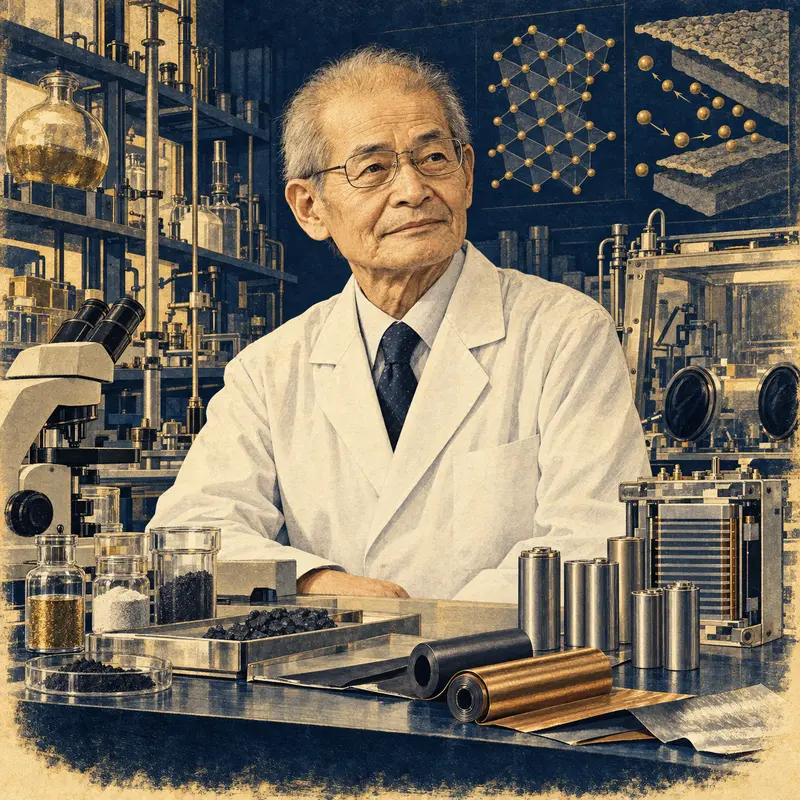
About the chemist
Akira Yoshino
1948- · Japan · Nobel Chemistry 2019
Commercial lithium-ion battery design