The discovery, explained · Chemist no. 216 of 350
Akira Yoshino and the Birth of the Practical Lithium-Ion Battery
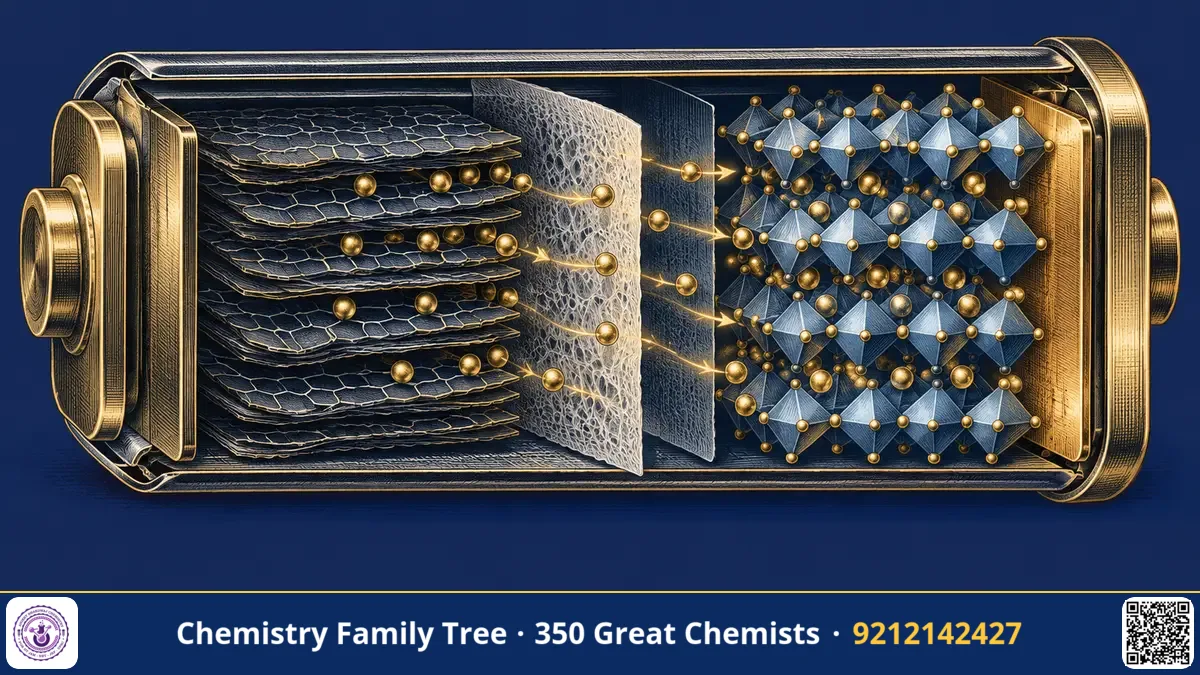
Lithium metal batteries had a fatal flaw: safety. Lithium metal anodes could form dendrites and catch fire. In 1985, Akira Yoshino, a Japanese chemist working at Asahi Kasei Corporation, solved this by building a cell with no metallic lithium at all. He paired Goodenough's lithium cobalt oxide cathode with a carbonaceous anode that stores lithium ions between its layers. The result was the first lithium-ion battery that was light, stable and safe enough for consumer use. For this, Yoshino shared the 2019 Nobel Prize in Chemistry with John B. Goodenough and M. Stanley Whittingham.
The Scientific Problem Before the Discovery
By the early 1980s, the pieces of a good battery were scattered. Whittingham had shown intercalation cathodes work with TiS₂, and Goodenough had found a 4 V cathode, LiCoO₂, in 1980. However, both cells still needed a lithium metal anode, which is reactive and dangerous. The cathode LiCoO₂ was an air-stable material that already contained lithium, so it did not need a lithium metal partner. The missing piece was a safe anode that could take up lithium ions at a potential close to lithium metal.
Researchers had tried graphite as an anode, but in the common electrolyte propylene carbonate, graphite was destroyed by solvent co-intercalation. Other carbon materials had not been tried systematically. Yoshino was interested in conductive polymers, and in particular polyacetylene, a research topic of the time, as a possible anode, but polyacetylene was too light and bulky and not stable enough.
The Discovery: Step by Step
- Start with polyacetylene. Yoshino tested polyacetylene, a conductive polymer, as an anode in combination with LiCoO₂. It worked in principle, but its low density meant low energy per volume, making it impractical.
- Try carbon materials. Searching for a denser alternative, he tested various carbonaceous materials. He found that a petroleum coke (a partially graphitised carbon) worked well: it could reversibly accept lithium ions without being destroyed by the electrolyte.
- Assemble the cell. The cell had LiCoO₂ as the positive electrode, petroleum coke as the negative electrode, a polyethylene or polypropylene porous membrane separator, and a non-aqueous electrolyte.
- Test safety. In deliberate tests, including dropping a heavy weight onto the cell, no fire or explosion occurred, whereas lithium metal cells behaved dangerously. This was a decisive demonstration.
- Commercialisation. The design was developed with Sony, and in 1991 the first commercial lithium-ion batteries were launched. Later cells moved to graphite anodes, with improved electrolytes containing ethylene carbonate that forms a protective layer on graphite.
The reactions are:
Cathode (discharge):  Li₁₋ₓCoO₂ + x Li⁺ + x e⁻ → LiCoO₂
Anode (discharge):    LiₓC₆ → x Li⁺ + x e⁻ + C₆
Overall (charge →):   LiCoO₂ + C₆ → Li₁₋ₓCoO₂ + LiₓC₆
This is called a "rocking-chair" battery: lithium ions rock back and forth between two host structures, moving to the anode on charging and back to the cathode on discharge.
The Chemistry Behind It
- Graphite intercalation: Graphite consists of stacked sheets of sp²-hybridised carbon. Lithium inserts between sheets forming LiC₆ at full charge, giving a theoretical capacity of 372 mAh/g.
- Potential of the anode: LiₓC₆ has a potential only about 0.1 V above lithium metal, so cell voltage stays high, about 3.6 to 4.2 V.
- Solid electrolyte interphase (SEI): On the first charge, the electrolyte partially decomposes on the anode surface and forms a thin passivating film that allows Li⁺ through but blocks electrons and solvent. It is essential for cycle life.
- Electrolyte: A lithium salt such as LiPF₆ in a mixture of organic carbonates such as ethylene carbonate and dimethyl carbonate.
- Safety: Without metallic lithium, there is no dendrite growth under normal operation, though overcharge and short circuits can still cause thermal runaway.
Applications Today
- Mobile world: Phones, laptops, tablets and wearables.
- Electric mobility: Cars, buses, e-rickshaws and scooters; India's EV push depends on this chemistry.
- Renewable energy: Storage of solar and wind power.
- Medical devices: Portable monitors and implantable devices.
- Recycling: Recovering lithium, cobalt and nickel from used batteries is a growing industry.
Exam Corner
- What did Yoshino use as anode? A carbon material (petroleum coke), later graphite.
- Why is the Li-ion cell safer than Li metal cells? No metallic lithium, so no dendrite formation.
- Charge-discharge reaction: LiCoO₂ + C₆ ⇌ Li₁₋ₓCoO₂ + LiₓC₆.
- Why "rocking chair"? Li⁺ ions shuttle back and forth between two hosts.
- What is SEI? A passivating film formed by electrolyte decomposition on the anode.
Common Misconceptions
- "Yoshino invented the cathode." The LiCoO₂ cathode was Goodenough's; Yoshino invented the cell with the carbon anode.
- "Li-ion batteries can never catch fire." They are safer than lithium metal cells but still need protection circuits.
- "Graphite stores lithium by forming a compound with new bonds." It is intercalation with weak host-guest interactions.
Quick Revision Box
- Yoshino made the first practical Li-ion cell in 1985 at Asahi Kasei.
- Cathode: LiCoO₂; anode: carbonaceous material (petroleum coke, later graphite).
- No metallic lithium, which means better safety.
- Rocking-chair mechanism of Li⁺ transfer.
- Sony commercialised the cell in 1991.
- Nobel Prize in Chemistry 2019 (shared three ways).
FAQ
Why is the anode potential important?
The cell voltage is the difference between cathode and anode potentials. A low-potential anode gives a high cell voltage and energy density.
What is the theoretical capacity of graphite?
372 mAh/g, corresponding to LiC₆.
Why is the electrolyte non-aqueous?
Lithium compounds react violently with water, and water decomposes at a voltage below 4 V.
Is this relevant for GATE and JAM?
Yes. Electrochemical cells, intercalation chemistry and energy materials appear in physical and inorganic chemistry sections.
Published by ABC Chemistry — IIT-JAM | CSIR-NET | GATE Chemistry Coaching. Visit abcchemistry.com
About the chemist
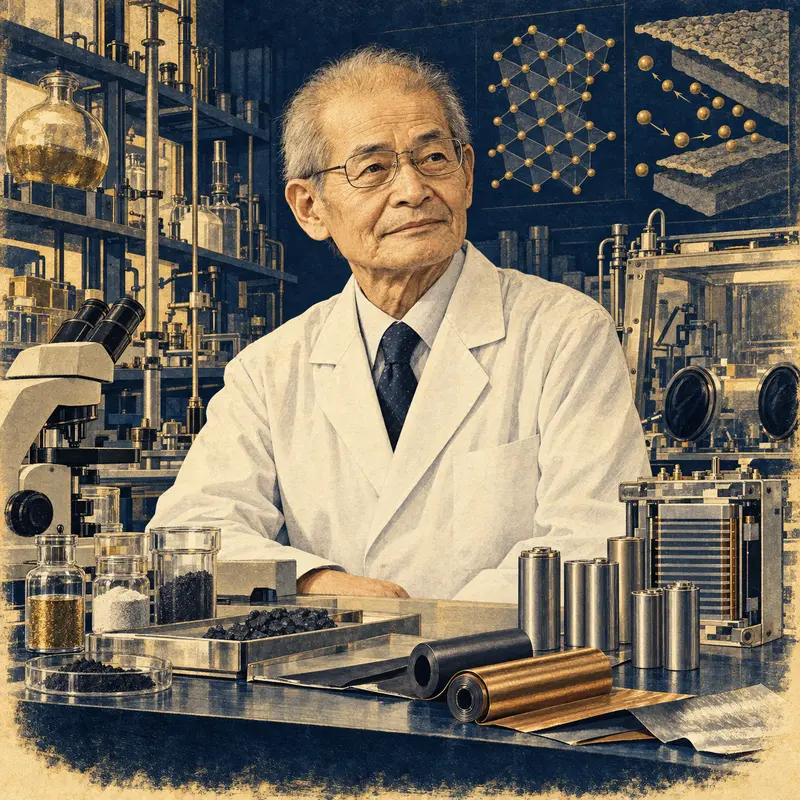
Akira Yoshino
1948- · Japan · Nobel Chemistry 2019
Commercial lithium-ion battery design