Biography · Chemist no. 173 of 350
Alan MacDiarmid: From a Poor Boy in New Zealand to a Nobel Laureate
Alan Graham MacDiarmid (1927–2007) was a New Zealand-born American chemist and a professor at the University of Pennsylvania. He shared the 2000 Nobel Prize in Chemistry with Alan Heeger and Hideki Shirakawa for the discovery and development of conductive polymers. His life is an inspiring story of a self-made scientist who studied by working hard, worked on many branches of chemistry and helped to create plastic electronics.
Early Life and Family
Alan MacDiarmid was born on 14 April 1927 in Masterton, New Zealand. He was one of several children in a family that struggled financially during the Great Depression. His father was an engineer who had trouble finding stable work. The family moved to Lower Hutt, near Wellington. MacDiarmid left school early to work, but he continued to study and read about chemistry by himself. He was fascinated by chemical reactions, and he used books from the library to teach himself. He is remembered as a person who valued education greatly because he had to fight for it.
Education and Mentors
MacDiarmid worked as a janitor in the chemistry department at Victoria University College in Wellington, and studied there in the evenings. He earned his bachelor's degree there in 1951 and a master's degree after that. He then went to the United States as a Fulbright scholar and earned a PhD in chemistry from the University of Wisconsin–Madison in 1953. He then completed a second PhD at the University of Cambridge in 1955, where he worked on the chemistry of silicon compounds, including silyl-containing molecules, under H. J. Emeléus. Emeléus was a leading inorganic chemist, and MacDiarmid built his inorganic knowledge on this base.
Career Timeline
| Year | Event |
|---|---|
| 1927 | Born in Masterton, New Zealand, on 14 April |
| 1951 | Bachelor's degree, Victoria University College, Wellington |
| 1953 | PhD, University of Wisconsin–Madison (Fulbright scholar) |
| 1955 | Second PhD, University of Cambridge |
| 1955 | Joined the University of Pennsylvania faculty, working on inorganic and silicon chemistry |
| 1970s | Studied the inorganic conducting polymer (SN)x with Heeger |
| 1977 | Co-discovered doped, conducting polyacetylene |
| 1980s | Developed polyaniline chemistry and protonic acid doping |
| 2000 | Nobel Prize in Chemistry, shared with Heeger and Shirakawa |
| 2000s | Continued research and teaching, including work at the University of Texas at Dallas |
| 2007 | Died on 7 February in Drexel Hill, Pennsylvania |
Major Scientific Contributions
- Main-group and silicon chemistry. In his early research he synthesised and studied volatile compounds of silicon, boron and other elements, such as silanes with nitrogen and phosphorus groups, and studied their structures. Disilyl and trisilyl compounds like N(SiH3)3 are examples that appear in inorganic chemistry courses for their planar nitrogen (pπ–dπ bonding discussions).
- Conducting polymer (SN)x. Collaboration with Heeger on this polymer brought him into the field.
- Doped polyacetylene (1977). This was the discovery that earned the Nobel Prize.
- Polyaniline chemistry. He developed the understanding of its oxidation states and protonic acid doping, which made conducting polymers more practical.
- Applications. He also worked on plastic batteries, electrochromic devices and "smart" fabrics using conducting polymers in his later years.
The details are discussed in our discovery post, including the colour and conductivity of the polyaniline forms.
Awards, Honours and the Nobel Prize
MacDiarmid shared the Nobel Prize in Chemistry in 2000 with Alan J. Heeger and Hideki Shirakawa. He also received honorary degrees and other awards from universities and scientific societies. New Zealand regards him as one of its most famous scientists.
Personality, Struggles and Lesser-Known Facts
- Janitor to professor. He worked as a cleaner in the same type of building where he later studied and taught. His story is often used to motivate students from poor families.
- Two PhDs. He took doctorates at two universities, Wisconsin and Cambridge, on two continents.
- Passion for teaching. He was known as an enthusiastic lecturer who liked to explain chemistry in simple terms and encouraged young researchers.
- A traveller. He gave lectures in many countries and worked with scientists across Asia, Europe and the Americas.
- Industrial vision. He believed in applying conducting polymers in everyday technology, such as light, flexible batteries and sensors, and he remained active in research until the end of his life.
Legacy and Influence on Modern Chemistry
Together with Heeger and Shirakawa, MacDiarmid helped to open organic electronics as an entirely new area of science. The materials he studied are used in antistatic coatings, corrosion protection, sensors and supercapacitors. His chemical approach, in which a polymer's properties can be controlled by redox and protonation, is a key part of materials chemistry teaching. In India, polyaniline and its composites are among the most studied conducting polymers.
Lessons for Students
- Do not let poverty stop you. MacDiarmid worked and studied at the same time.
- Be curious across fields. He moved from silicon chemistry to polymers.
- Collaboration multiplies ideas. His meeting with Shirakawa at a seminar changed science.
- Keep learning. He stayed active in research for over fifty years.
Quick Facts Box
- Born: 14 April 1927, Masterton, New Zealand
- Died: 7 February 2007, Drexel Hill, Pennsylvania, USA
- Nationality: New Zealander, later also American
- Field: Inorganic and materials chemistry
- Famous for: Conducting polymers (doped polyacetylene, polyaniline)
- Nobel: Chemistry, 2000 (shared with Alan Heeger and Hideki Shirakawa)
FAQ
Where did MacDiarmid teach?
He spent most of his career at the University of Pennsylvania in Philadelphia.
Was MacDiarmid a physicist?
No. He was a chemist, trained mainly in inorganic chemistry. His colleague Heeger was the physicist.
How many PhD degrees did he have?
Two, from the University of Wisconsin–Madison and the University of Cambridge.
When did he die?
He died on 7 February 2007 in Pennsylvania, aged 79.
Published by ABC Chemistry — IIT-JAM | CSIR-NET | GATE Chemistry Coaching. Visit abcchemistry.com
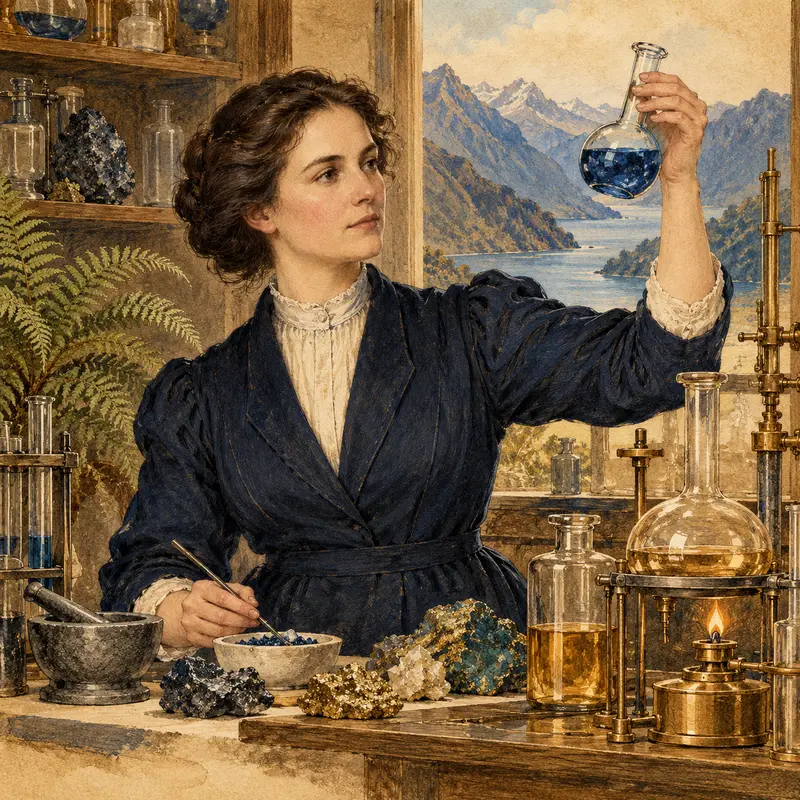
About the chemist
Alan MacDiarmid
1927-2007 · United States · Nobel Chemistry 2000
Conductive polymers