The discovery, explained · Chemist no. 173 of 350
Alan MacDiarmid and the Chemistry of Conducting Polymers
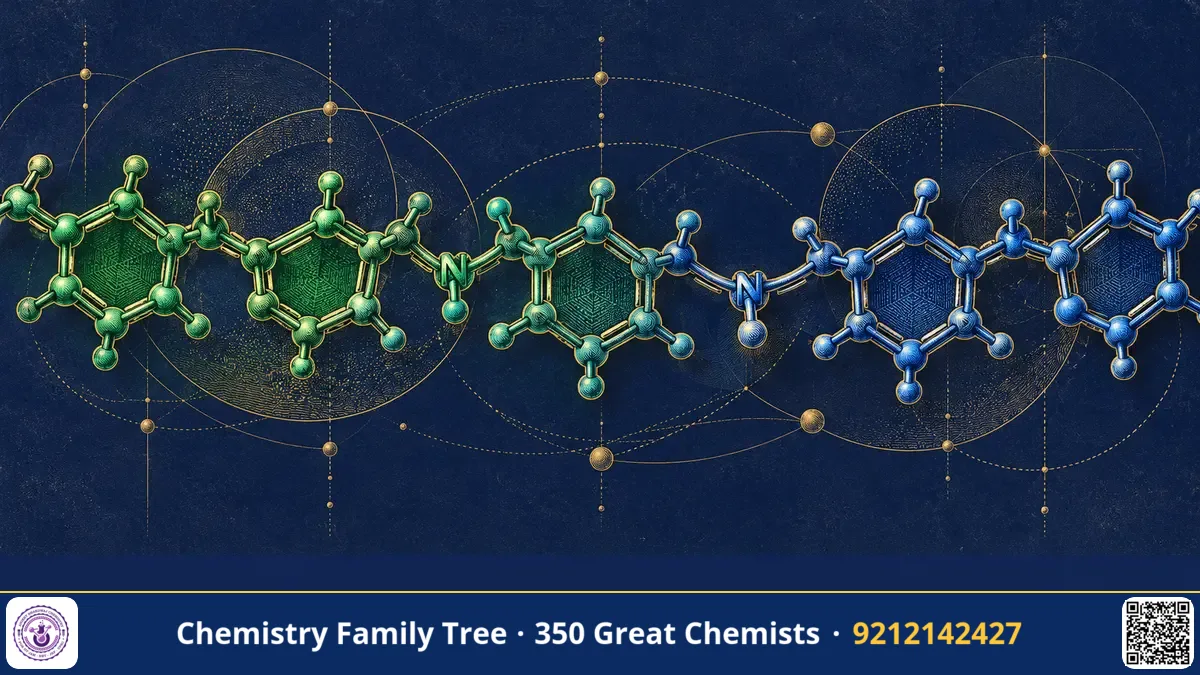
When people hear "conducting polymers", they often think of physics, but the discovery was equally a triumph of chemistry. Alan G. MacDiarmid, a New Zealand-born inorganic chemist at the University of Pennsylvania, brought a polymer called polysulfur nitride, (SN)x, and later polyacetylene and polyaniline into the story. With Alan Heeger and Hideki Shirakawa he shared the 2000 Nobel Prize in Chemistry. MacDiarmid's special role was to treat conducting polymers as chemical systems: they can be oxidised and reduced, protonated and deprotonated, and their properties tuned by chemical reactions. This post explains his contribution and the chemistry students need.
The Scientific Problem Before the Discovery
Organic polymers like polyethylene, PVC and nylon are insulators, because their electrons are held in localised σ bonds and have no easy path to move. Metals conduct because they have a partly filled band of delocalised electrons. The question was whether a material that is both a polymer and a conductor could exist: light, flexible, and processable like plastic, but conducting like a metal.
A hint came from an inorganic polymer. In 1975 researchers showed that the polymer (SN)x (polythiazyl), made from the explosive S2N2 and S4N4, is a metal-like conductor and even becomes superconducting at very low temperature, about 0.3 K. MacDiarmid and Heeger worked on this material at Penn. It showed that a polymer could conduct, but (SN)x was inorganic, fragile and dangerous to prepare. Organic polymers were needed.
The Discovery: Step by Step
- The (SN)x work. MacDiarmid, an expert in sulfur-nitrogen and main group chemistry, collaborated with Heeger on (SN)x in the early 1970s. They learned how to measure and think about conducting polymers.
- Meeting Shirakawa (1976). During a visit to Tokyo, MacDiarmid saw a silvery film of polyacetylene made by Hideki Shirakawa. He saw its resemblance to metal foil, and invited Shirakawa to Pennsylvania as a visiting researcher.
- Halogen doping (1977). Working at Penn, the team exposed the polyacetylene film to iodine vapour. Within minutes, the film's colour changed and its conductivity rose by about seven orders of magnitude. The result was published in 1977 in the Journal of the Chemical Society, Chemical Communications and in Physical Review Letters.
- Extension to polyaniline. In the 1980s, MacDiarmid's group focused on polyaniline, a polymer made by oxidation of aniline. It is cheaper and more stable than polyacetylene. They showed that its conductivity depends on the oxidation state and on protonation by acid.
The Chemistry Behind It
Polyacetylene doping
[–CH=CH–]ₙ + (3x/2) I₂ → [(–CH=CH–)ˣ⁺ (I₃⁻)ₓ]ₙ
Here the polymer is partly oxidised (p-doped), and positive charge carriers appear on the chain. Treating it with alkali metals gives n-doping instead. The conductivity increases from about 10−5 S/cm to over 102 S/cm.
Polyaniline: a polymer with three forms
Polyaniline (PANI) has a backbone containing benzene rings linked by nitrogen atoms. It exists in different oxidation states:
| Form | Oxidation state | Colour | Conducting? |
|---|---|---|---|
| Leucoemeraldine | Fully reduced | Pale yellow or colourless | No |
| Emeraldine base | Half oxidised | Blue | No (insulator) |
| Emeraldine salt | Half oxidised and protonated | Green | Yes (about 1–10 S/cm and higher) |
| Pernigraniline | Fully oxidised | Violet | No |
The key discovery from this work is that emeraldine base can be converted into the conducting emeraldine salt by acid protonation, without changing the number of electrons in the chain:
Emeraldine base (blue, insulator) + HCl → Emeraldine salt (green, conductor)
This is called protonic acid doping. Treatment with a base reverses it. This reversible switching also explains why polyaniline is used in pH sensors.
Synthesis of PANI
Polyaniline is made by chemical oxidation of aniline in acid with ammonium persulfate (NH4)2S2O8, or electrochemically. The reaction proceeds by radical cations and coupling at the para position of aniline.
Why conducting?
Conduction requires (1) a conjugated backbone and (2) mobile charges created by doping. In PANI, protonation produces polarons (radical cations), delocalised along the chain, and these give conductivity.
Applications Today
- Anticorrosion coatings: Polyaniline coatings protect steel and other metals, a subject of research in India for infrastructure and marine uses.
- Sensors: Conductivity and colour change in response to pH, ammonia, humidity and other gases.
- Batteries and supercapacitors: PANI stores charge by redox reactions.
- Antistatic and EMI shielding materials: Conducting polymer composites absorb or reflect electromagnetic waves.
- Electrochromic devices: Colour change with applied voltage is used in smart windows research.
Exam Corner
- (SN)x is a metal-like inorganic polymer that becomes superconducting at about 0.3 K.
- Emeraldine salt of polyaniline (green) is the conducting form; emeraldine base (blue) is an insulator. Protonation converts base to salt.
- Doping in conducting polymers means partial oxidation (p-doping) or reduction (n-doping), or protonation as in PANI.
- Polyaniline is typically synthesised by oxidising aniline with ammonium persulfate in acid.
- 2000 Nobel Prize in Chemistry: Heeger, MacDiarmid and Shirakawa.
Common Misconceptions
- "Doped polyacetylene is a metal with free electrons like copper." Its conduction involves charged defects on the chain and hopping between chains.
- "Protonation of PANI changes its oxidation level." In emeraldine base to emeraldine salt conversion, the number of electrons stays the same; protons are added to the imine nitrogens.
- "MacDiarmid discovered polyacetylene." Polyacetylene films were made by Shirakawa. The conducting form came from joint work at Penn.
Quick Revision Box
- MacDiarmid: inorganic chemist, University of Pennsylvania.
- (SN)x was an early polymer conductor and superconductor at 0.3 K.
- 1977: iodine-doped polyacetylene with Shirakawa and Heeger.
- Polyaniline: leucoemeraldine, emeraldine, pernigraniline; emeraldine salt conducts.
- Protonic acid doping is reversible.
- Nobel Prize in Chemistry 2000.
FAQ
What is special about polyaniline?
It is relatively stable in air, cheap to make, and its conductivity can be switched by acid and base, in addition to redox changes.
Why was (SN)x important?
It was the first polymer shown to conduct like a metal, and it prepared researchers to look for conducting organic polymers.
What is "doping" in conducting polymers?
It is a chemical oxidation, reduction or protonation that creates mobile charge carriers in a conjugated polymer.
Did MacDiarmid work alone?
No. The key discoveries came from his collaboration with Heeger and Shirakawa, and later with many co-workers and students.
Published by ABC Chemistry — IIT-JAM | CSIR-NET | GATE Chemistry Coaching. Visit abcchemistry.com

About the chemist
Alan MacDiarmid
1927-2007 · United States · Nobel Chemistry 2000
Conductive polymers