Biography · Chemist no. 297 of 350
Albert Eschenmoser (1925-2023): From Vitamin B12 to the Origin of Life
Introduction
Albert Eschenmoser was a Swiss organic chemist and one of the great synthetic chemists of the twentieth century. He is remembered for his part in the total synthesis of vitamin B12, for reactions that carry his name (Eschenmoser fragmentation, Eschenmoser-Claisen rearrangement, Eschenmoser's salt), for the Stork-Eschenmoser hypothesis of polyene cyclisation, and for his later research on why nature chose RNA and DNA as the molecules of heredity. His legacy in one line: he showed that synthesis can be used not only to make molecules, but also to ask deep questions about nature.
Early Life and Family
Eschenmoser was born on 5 August 1925 in Erstfeld, a small town in the canton of Uri in central Switzerland. He grew up in a rural Alpine environment, and went to school in the region before moving on to the canton school in Zürich. Switzerland remained neutral during the Second World War, so he could continue to study and work in peace, a fact that gave Swiss science a continuity that many European countries lacked.
Education and Mentors
He studied chemistry at the Swiss Federal Institute of Technology (ETH) in Zürich, where he came under the influence of Leopold Ružička, the Nobel laureate (1939) known for his work on terpenes and large-ring compounds. Eschenmoser earned his doctorate in 1951 under Ružička, with work on terpene chemistry. He remained at ETH, qualified as a lecturer, and became a professor in 1960. The Ružička school's tradition of elegant structural and mechanistic reasoning shaped his style for life.
Career Timeline
| Year | Event |
|---|---|
| 1925 | Born in Erstfeld, Switzerland |
| 1951 | Doctorate at ETH Zürich under Leopold Ružička |
| 1955 | Proposes, alongside Stork, the stereochemical rule for polyene cyclisations (Stork-Eschenmoser hypothesis) |
| 1960 | Becomes professor at ETH Zürich |
| 1960s | Develops fragmentation, Claisen variant and the iminium salt reagent |
| 1960s-1970s | Collaborates with R. B. Woodward on vitamin B12 |
| 1972 | The total synthesis of vitamin B12 is announced by the Woodward and Eschenmoser groups |
| 1980s-1990s | Studies the chemical etiology of nucleic acids (pyranosyl-RNA, TNA) |
| 1990s | Becomes affiliated with the Scripps Research Institute in La Jolla, California |
| 2023 | Dies at the age of 97 |
Major Scientific Contributions
1. Vitamin B12
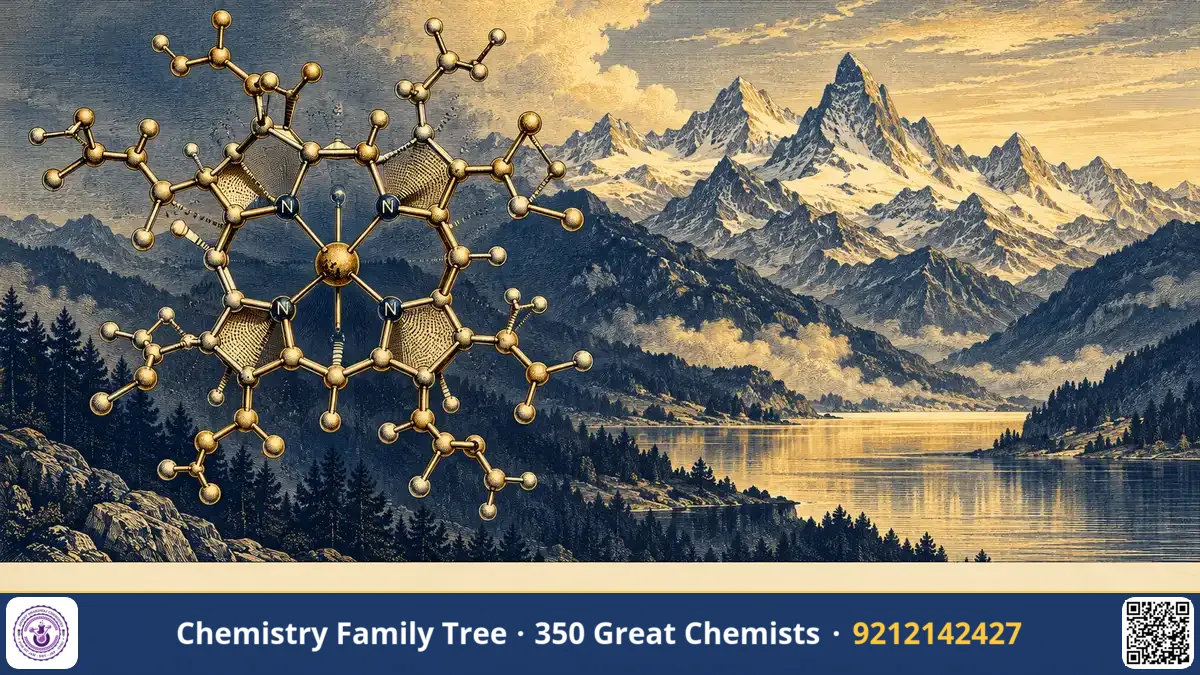
Vitamin B12 has a complex corrin ring with a central cobalt atom and at least nine stereocentres. Eschenmoser's laboratory in Zürich built the western part of the molecule (rings A and D) and developed a photochemical cycloisomerisation to close the corrin ring. Woodward's group at Harvard prepared another half. Combining the two efforts led to a total synthesis, announced in 1972, after many years of work by large teams of co-workers. It remains one of the great landmarks in synthetic chemistry.
2. Named reactions
The Eschenmoser fragmentation, the Eschenmoser-Claisen rearrangement and Eschenmoser's salt remain widely used. For their mechanisms, read our companion discovery article.
3. Polyene cyclisation
With Stork, he explained how a chain of trans double bonds folds into a chair-like arrangement and cyclises with anti addition. This rule explains the biosynthesis of lanosterol and other triterpenes.
4. Chemical etiology of nucleic acids
In his last decades he asked: why does nature use ribose and the furanose form of RNA? By synthesising alternatives such as pyranosyl-RNA and threose nucleic acid (TNA), and testing their ability to pair, he showed that RNA has special properties of base-pairing and structure. This research is a key piece of origin-of-life chemistry.
Awards, Honours and Nobel Prize
Eschenmoser did not receive a Nobel Prize, although he was often named as a leading candidate. He received many honours, including the Wolf Prize in Chemistry and membership of several national academies, among them foreign membership of the Royal Society and the United States National Academy of Sciences. He was awarded honorary doctorates by numerous universities.
Personality, Struggles and Lesser-Known Facts
- Decade-long project. The vitamin B12 synthesis required a very long collaboration across two continents, with a large team of postdoctoral researchers from many countries.
- A philosopher-chemist. He enjoyed discussing the nature of chemical creativity and often argued that chemistry is both a science and a form of design.
- Aesthetic sense. He referred to the beauty of molecules and the elegance of syntheses, and he stressed the value of simple, clear experiments.
- Swiss mountain roots. He came from a small Alpine town, and his career is a reminder that important science can start anywhere.
- Active into old age. He continued to write and lecture on the chemistry of life's origin into his nineties.
Legacy and Influence on Modern Chemistry
The B12 project drove advances in photochemistry, organometallic chemistry and the understanding of pericyclic reactions. The named reactions are used in laboratories around the world, including Indian research institutes, for building complex molecules. His work on nucleic acid analogues is cited as a starting point for xeno-nucleic acids (XNAs) in synthetic biology. His broader legacy is a style: pose a fundamental question, and answer it by designing and making molecules.
Lessons for Students
- Combine curiosity and craftsmanship: ask big questions and be careful at the bench.
- Collaborate across groups and countries, as the B12 project did.
- Learn mechanisms in depth, since they inspire new reactions.
- Think about the "why" behind nature's choices, not only the "how".
- Be patient with long projects.
Quick Facts Box
- Born: 5 August 1925, Erstfeld, Switzerland
- Died: 14 July 2023, aged 97
- Nationality: Swiss
- Field: Organic synthesis, bio-organic chemistry, origin of life
- Famous for: Vitamin B12 synthesis (with Woodward), Eschenmoser reactions, Stork-Eschenmoser hypothesis, TNA research
- Nobel Prize: None; Wolf Prize in Chemistry
FAQ
Who supervised Albert Eschenmoser?
He earned his doctorate at ETH Zürich under Leopold Ružička, who won the Nobel Prize in Chemistry in 1939.
What was Eschenmoser's role in the synthesis of vitamin B12?
His group developed the route to the A-D component and a photochemical ring closure to form the corrin macrocycle, while Woodward's group prepared the other half. The two groups combined their work into one total synthesis.
What is TNA?
TNA is threose nucleic acid, a synthetic analogue of RNA made with a four-carbon sugar. Eschenmoser's group studied it as a possible precursor or alternative to RNA.
Did Eschenmoser win a Nobel Prize?
No. Despite wide recognition and many honours, he did not receive the Nobel Prize.
Published by ABC Chemistry — IIT-JAM | CSIR-NET | GATE Chemistry Coaching. Visit abcchemistry.com
About the chemist
Albert Eschenmoser
1925-2023 · Switzerland
Vitamin B12 synthesis; chemical etiology