The discovery, explained · Chemist no. 297 of 350
Eschenmoser's Reactions: Fragmentation, Claisen Rearrangement and the Famous Salt
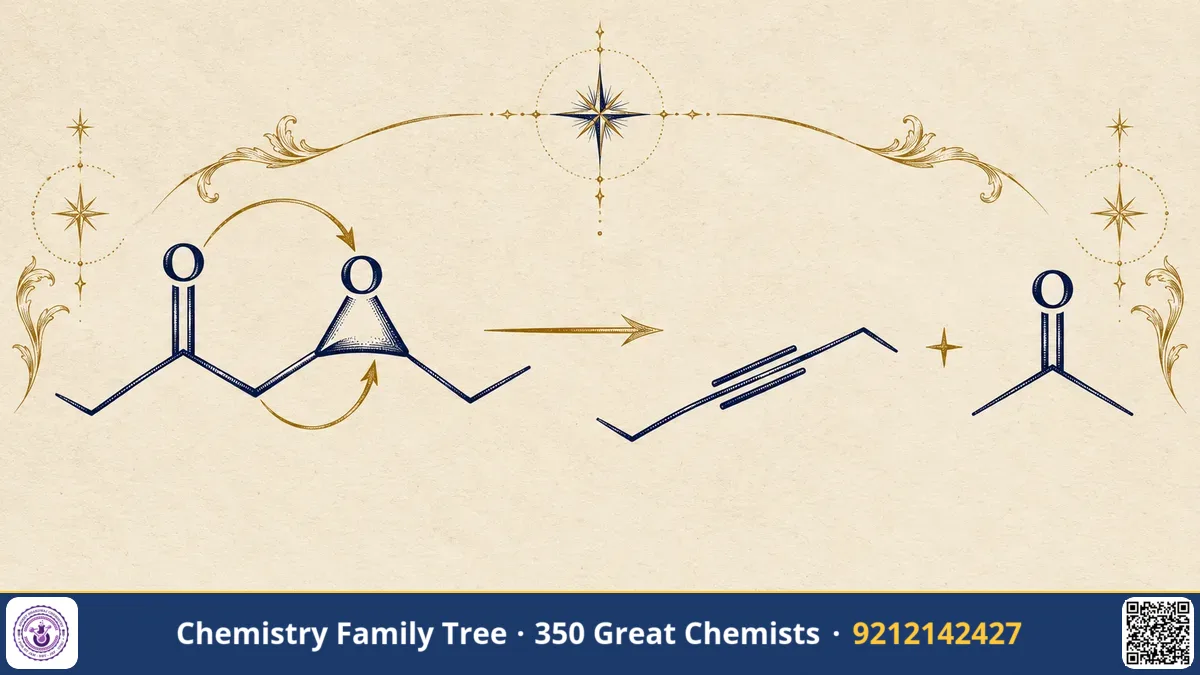
Few chemists have their name on as many useful reactions as Albert Eschenmoser (1925-2023) of ETH Zürich. A Swiss master of organic synthesis, he contributed to the total synthesis of vitamin B12, helped explain the stereochemistry of polyene cyclisations, and later turned to the chemical origin of life. In the laboratory, three tools carry his name: the Eschenmoser fragmentation, which cleaves a ring to create an alkyne and a carbonyl; the Eschenmoser-Claisen rearrangement, which builds a γ,δ-unsaturated amide; and Eschenmoser's salt, a reagent for aminomethylation. Each is a standard topic in advanced organic chemistry courses.
The Scientific Problem Before the Discovery
By the 1950s and 1960s organic chemists had many ways to join carbon atoms, but needed three kinds of tools for complex synthesis:
- A way to open a ring to create a long-chain alkyne with a ketone at a predictable site. Macrocyclic and medium-ring compounds were hard to make, and the reverse, ring cleavage with functional-group introduction, was equally useful.
- A stereocontrolled [3,3]-sigmatropic rearrangement that works under mild conditions with allylic alcohols. The classical Claisen rearrangement needs allyl vinyl ethers, which are inconvenient to make.
- A reliable electrophilic one-carbon amino source that avoids the messy mixture of formaldehyde and dimethylamine used in classical Mannich reactions.
The Discovery: Step-by-Step
1. Eschenmoser fragmentation (Eschenmoser-Tanabe)
An α,β-epoxy ketone reacts with p-toluenesulfonylhydrazine (tosylhydrazine). The sequence is:
- The ketone condenses with TsNHNH₂ to give an α,β-epoxy tosylhydrazone.
- Loss of the sulfinate (Ts⁻) from the hydrazone nitrogen, driven by opening of the epoxide, generates a diazo-type intermediate (a vinyl diazene).
- Fragmentation: the C-C bond between the former carbonyl carbon and the α-carbon breaks, nitrogen (N₂) is released, and a C≡C triple bond forms. The epoxide oxygen becomes a new carbonyl group.
α,β-Epoxy ketone + TsNHNH₂ → alkyne + carbonyl compound + N₂ + TsH (sulfinic acid)
If the starting epoxy ketone is cyclic, the result is a ring-opened alkynyl ketone or aldehyde. The fragmentation was independently described by Tanabe, so it is sometimes called the Eschenmoser-Tanabe fragmentation. It was used, for example, in the synthesis of muscone and exaltone from cyclic precursors.
2. Eschenmoser-Claisen rearrangement (1964)
An allylic alcohol is heated with N,N-dimethylacetamide dimethyl acetal, CH₃C(OCH₃)₂N(CH₃)₂. Loss of methanol gives a ketene N,O-acetal, which is an allyl vinyl ether in disguise. A [3,3]-sigmatropic shift then forms a new C-C bond and delivers a γ,δ-unsaturated amide.
R-CH=CH-CH₂-OH + CH₃C(OMe)₂NMe₂ → [allyl ketene N,O-acetal] → CH₂=CH-CHR-CH₂-C(=O)NMe₂
The reaction passes through a chair-like six-membered transition state, so the geometry of the allylic alkene determines the configuration at the new stereocentre. It is a favourite way to make quaternary carbon centres and to transfer chirality from an alcohol to a new C-C bond.
3. Eschenmoser's salt
Eschenmoser's salt is dimethylmethylideneammonium iodide, (CH₃)₂N⁺=CH₂ I⁻. It is a stable crystalline iminium salt that is a powerful electrophile. It reacts with enolates, enol silyl ethers and other nucleophiles to give α-(dimethylaminomethyl) ketones (Mannich bases), which can be quaternised and eliminated to give α-methylene ketones, a common feature in natural products.
R-CO-CH₃ → enolate → + CH₂=N⁺Me₂ I⁻ → R-CO-CH₂-CH₂-NMe₂ → (MeI, then base) → R-CO-CH=CH₂
The Chemistry Behind It
Fragmentation (Grob-type logic). The Eschenmoser fragmentation belongs to a family of reactions in which a good leaving group (here N₂) and an electron-donating push combine to cleave a σ bond. The driving force is the release of nitrogen gas, which makes the reaction irreversible.
Sigmatropic rearrangements. The Claisen rearrangement is a thermally allowed [3,3]-shift under the Woodward-Hoffmann rules, with six electrons in a chair-like cyclic transition state. The Eschenmoser variant is more convenient than the classical Claisen, and similar to the Johnson-Claisen (orthoester) and Ireland-Claisen (silyl ketene acetal) variants.
| Claisen variant | Reagent | Product |
|---|---|---|
| Classical | Allyl vinyl ether | γ,δ-Unsaturated aldehyde/ketone |
| Johnson | Allylic alcohol + triethyl orthoacetate, H⁺ | γ,δ-Unsaturated ester |
| Eschenmoser | Allylic alcohol + CH₃C(OMe)₂NMe₂ | γ,δ-Unsaturated amide |
| Ireland | Allylic ester, LDA, TMSCl | γ,δ-Unsaturated carboxylic acid |
Mannich chemistry. The classical Mannich reaction combines an enolisable carbonyl, formaldehyde and a secondary amine. Eschenmoser's salt provides the preformed iminium electrophile, so the reaction is faster and cleaner.
Applications Today
- Natural product synthesis: The Claisen variant creates quaternary stereocentres in terpenes and alkaloids. The fragmentation was applied in syntheses of fragrance macrocycles such as muscone.
- Medicinal chemistry: Aminomethylation using Eschenmoser's salt builds basic side chains and Mannich bases in drug candidates.
- Methylene lactones: α-Methylene-γ-butyrolactones, a motif in many bioactive natural products, are prepared with the salt.
- Origin-of-life chemistry: Eschenmoser's later work on nucleic acid analogues such as pyranosyl-RNA and threose nucleic acid (TNA) is used in synthetic biology and xenobiology.
- Teaching: These reactions are favourite topics in the synthesis sections of CSIR-NET and GATE papers.
Exam Corner
- Eschenmoser fragmentation: α,β-epoxy ketone + TsNHNH₂ gives an alkyne and a carbonyl compound with loss of N₂.
- Eschenmoser-Claisen: allylic alcohol + CH₃C(OMe)₂NMe₂ gives a γ,δ-unsaturated N,N-dimethylamide via a [3,3] shift.
- Eschenmoser's salt is (CH₃)₂N⁺=CH₂ I⁻; it is an aminomethylating electrophile (Mannich-type).
- Claisen variants: Johnson (orthoester, ester product), Ireland (silyl ketene acetal, acid product), Eschenmoser (amide acetal, amide product).
- Eschenmoser collaborated with R. B. Woodward in the total synthesis of vitamin B12, and with Stork on the stereochemical model for polyene cyclisation.
Common Misconceptions
- "The fragmentation forms an alkene." It forms an alkyne (C≡C) and a carbonyl group.
- "Eschenmoser-Claisen gives an ester." That is the Johnson variant. Eschenmoser's gives an amide.
- "Eschenmoser's salt is a base." It is a strong electrophile (an iminium ion) that is attacked by nucleophiles.
Quick Revision Box
- Fragmentation: epoxy ketone + tosylhydrazine → alkyne + carbonyl + N₂.
- Claisen: allylic alcohol + amide acetal → γ,δ-unsaturated amide (chair TS, 1964).
- Eschenmoser's salt: Me₂N⁺=CH₂ I⁻, a Mannich electrophile.
- All three exploit a driving force: loss of N₂, a six-electron pericyclic shift, and a ready iminium electrophile.
- Eschenmoser also worked on vitamin B12 and the Stork-Eschenmoser hypothesis.
FAQ
What does the Eschenmoser fragmentation produce?
It converts an α,β-epoxy ketone into an alkyne and a carbonyl compound (aldehyde or ketone), with loss of nitrogen gas. In a ring, this opens the ring.
How is the Eschenmoser-Claisen different from the Johnson-Claisen?
Both start from allylic alcohols, but the Johnson variant uses an orthoester and gives an ester, while the Eschenmoser variant uses an amide acetal and gives an amide.
What is Eschenmoser's salt used for?
It is used to introduce a dimethylaminomethyl (CH₂NMe₂) group onto nucleophilic carbons such as enolates. The product can be converted to an α-methylene carbonyl group.
Why is nitrogen release important in the fragmentation?
The formation of stable N₂ gas makes the step irreversible and provides the thermodynamic driving force for C-C bond cleavage.
Published by ABC Chemistry — IIT-JAM | CSIR-NET | GATE Chemistry Coaching. Visit abcchemistry.com
About the chemist
Albert Eschenmoser
1925-2023 · Switzerland
Vitamin B12 synthesis; chemical etiology