The discovery, explained · Chemist no. 277 of 350
Albert Ghiorso and the Discovery of Transuranium Elements: Making New Atoms One at a Time
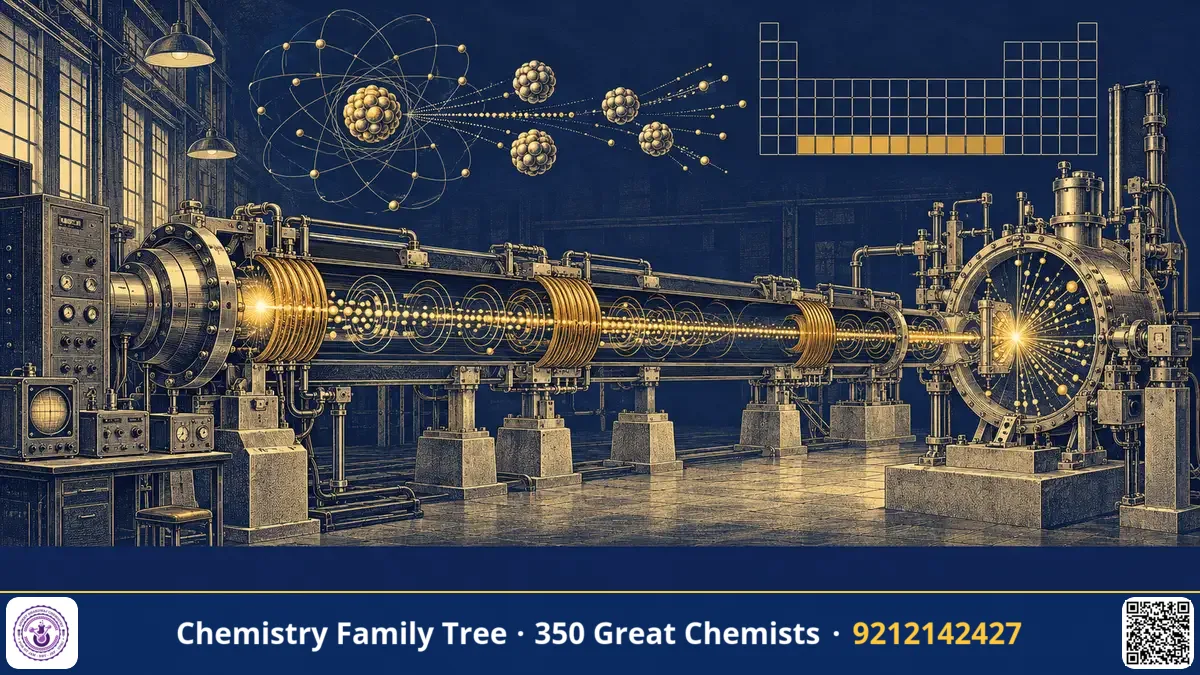
Albert Ghiorso is credited as a co-discoverer of twelve chemical elements, more than any other person: americium (95), curium (96), berkelium (97), californium (98), einsteinium (99), fermium (100), mendelevium (101), nobelium (102), lawrencium (103), rutherfordium (104), dubnium (105) and seaborgium (106). He was a brilliant instrument builder, and he helped to design the detectors and accelerators that made it possible to identify elements produced in quantities of a few atoms or even a single atom. His work, with Glenn Seaborg and others, filled the actinide row of the periodic table and began the search for superheavy elements.
The Scientific Problem Before the Discovery
By 1940, uranium (Z = 92) was the heaviest known element. Edwin McMillan and Philip Abelson made neptunium (93) at Berkeley in 1940, and Seaborg, McMillan, Kennedy and Wahl identified plutonium (94) in 1940–41. The question was how many more elements existed and what their chemistry would be. Seaborg proposed in 1944 the actinide concept: the elements from actinium onwards form a second inner-transition series in which 5f orbitals are filled, similar to the lanthanides. This predicted that elements 95 and 96 would have a stable +3 oxidation state, like the lanthanides. This idea helped chemists to separate them by ion-exchange methods.
The difficulty was that each new element was made in microscopic amounts and had a short half-life. Identification required reliable chemical separations and sensitive detectors for alpha particles.
The Discovery: Step by Step
Ghiorso studied electrical engineering at the University of California, Berkeley, and learned radiation detection, in which he was exceptionally skilled. He joined the Metallurgical Laboratory in Chicago in 1942 during the Manhattan Project. His principal contribution was to design instruments: multichannel pulse analysers, alpha-particle detectors, and later whole accelerator systems.
- Americium and curium (1944–45): Neutron irradiation and bombardment of plutonium and uranium targets gave elements 95 and 96, identified by chemical separation and alpha counters.
- Berkelium and californium (1949–50): Using the Berkeley cyclotron, alpha particles were fired at americium and curium targets:
²⁴¹Am + ⁴He → ²⁴³Bk + 2n
²⁴²Cm + ⁴He → ²⁴⁵Cf + n
- Einsteinium and fermium (1952–53): These were discovered in the fallout from the first hydrogen-bomb test ("Ivy Mike", 1952). Uranium nuclei had captured many neutrons in a very short time. The elements were found in coral debris collected by aircraft and ships.
- Mendelevium (1955): Only a tiny sample of einsteinium (about a billion atoms) was available. A target of ²⁵³Es was bombarded with alpha particles, and the nuclei produced by recoil were caught on a gold foil that was removed from the beam and dissolved. The atoms were separated by ion exchange and counted one at a time.
²⁵³Es + ⁴He → ²⁵⁶Md + n
Ghiorso devised the recoil technique: the newly formed atoms recoil out of the thin target and are collected on a catcher foil. The elution of the dissolved foil through an ion-exchange column was timed, and the drops from the column positions were measured for radiation. The arrival of Md in the position expected for a +3 actinide, just before fermium, showed the presence of the new element. Only a few atoms were made per experiment.
- Heavy-ion bombardment (1958–1974): The Berkeley Heavy Ion Linear Accelerator (HILAC) accelerated carbon, oxygen and later heavier ions:
²⁴⁶Cm + ¹²C → ²⁵⁴No + 4n          (nobelium; a disputed priority)
²⁴⁹Cf + ¹²C → ²⁵⁷Rf + 4n           (rutherfordium, 1969)
²⁴⁹Cf + ¹⁵N → ²⁶⁰Db + 4n           (dubnium, 1970)
²⁴⁹Cf + ¹⁸O → ²⁶³Sg + 4n           (seaborgium, 1974)
For elements 104 and above, Ghiorso and his team used an automated system that detected the alpha decay of the new nucleus and then its daughter, grandfather and so on, linking the unknown parent to known descendants. This "genetic correlation" method is the key tool of superheavy-element research today.
The Chemistry Behind It
The new elements fit logically into the periodic table:
| Element | Z | Group / Series | Typical behaviour |
|---|---|---|---|
| Americium (Am) | 95 | Actinide | +3 most stable in water; used in smoke detectors |
| Curium (Cm) | 96 | Actinide | +3; Cm³⁺ (5f⁷) resembles Gd³⁺ (4f⁷) |
| Mendelevium (Md) | 101 | Actinide | +3 and +2 |
| Nobelium (No) | 102 | Actinide | +2 is the most stable in water (5f¹⁴ filled subshell) |
| Lawrencium (Lr) | 103 | Last actinide | +3 (5f¹⁴ 7s² 7p¹ or 6d¹ debated) |
| Rutherfordium (Rf) | 104 | Group 4 | +4; resembles Zr and Hf |
| Seaborgium (Sg) | 106 | Group 6 | +6; forms SgO₂Cl₂ like Mo and W |
The nobelium case is important: No²⁺ is stable because it has a full 5f¹⁴ configuration, just as Yb²⁺ (4f¹⁴) is the stable divalent lanthanide. Relativistic effects become strong in heavy atoms: inner electrons move at speeds close to light, and orbital energies shift, so very heavy elements may differ from their lighter homologues.
Applications Today
- Smoke detectors: Americium-241 is in common household smoke alarms because it emits alpha particles that ionise air.
- Power sources for space: Curium-244 and plutonium-238 have been used as heat sources for spacecraft and instruments.
- Neutron sources: Californium-252 emits neutrons by spontaneous fission and is used for starting reactors, for oil-well logging and for neutron radiography, and in cancer treatment trials.
- Research: Berkelium-249 was a target to make element 117 (tennessine), showing how his discoveries are still used.
- Nuclear theory: The study of superheavy nuclei tests the "island of stability" idea, in which nuclei with certain "magic" numbers of protons and neutrons live longer.
Exam Corner
- Transuranium elements have Z > 92; all are radioactive and artificially made (except traces of Np and Pu in nature).
- Actinide contraction: gradual decrease of ionic radius from Ac to Lr because of poor shielding by 5f electrons.
- The most common oxidation state of actinides after Am is +3; early actinides (Th to Am) show a wider range of oxidation states (+3 to +7).
- Nobelium has a stable +2 state (5f¹⁴); lawrencium is the last actinide (Z = 103).
- Mendelevium is named after Mendeleev; einsteinium and fermium after Einstein and Fermi; seaborgium is the first element named after a living person.
Common Misconceptions
- "Transuranium elements were found in ores." They were made in accelerators or reactors, apart from traces of neptunium and plutonium in nature. Einsteinium and fermium were first found in nuclear explosion debris.
- "Ghiorso worked alone." All discoveries were team efforts, with Seaborg, Thompson, Choppin, Harvey, Sikkeland, Larsh and others.
- "The first name always stands." For elements 102 to 106, there were long priority disputes between Berkeley and Dubna (USSR). The names were settled by IUPAC in 1997.
Quick Revision Box
- Ghiorso co-discovered elements 95–106 (twelve elements) at Berkeley.
- Mendelevium (1955): ²⁵³Es + α → ²⁵⁶Md + n; atom-by-atom with recoil and ion exchange.
- HILAC and heavy-ion bombardment gave Rf, Db and Sg.
- Actinide concept (Seaborg): 5f series from Ac to Lr.
- No²⁺ stable (5f¹⁴); Rf, Db, Sg are 6d Group 4, 5, 6 elements.
- Am-241 in smoke detectors; Cf-252 as a neutron source.
FAQ
How many elements did Ghiorso co-discover?
Twelve: elements 95 to 106.
How can an element be identified from only a few atoms?
By timed ion-exchange separation, which shows where the atom elutes, and by alpha-decay chains linking it to known nuclei.
Why was nobelium disputed?
Groups in Stockholm, Berkeley and Dubna published conflicting claims in 1957–1966, and the assignments took decades to resolve.
Is this topic in the syllabus?
Yes. Actinide chemistry, nuclear reactions and periodic table placement of the transuranium elements are common in JAM, NET and GATE.
Published by ABC Chemistry — IIT-JAM | CSIR-NET | GATE Chemistry Coaching. Visit abcchemistry.com
About the chemist
Albert Ghiorso
1915-2010 · United States
Co-discovered many transuranium elements