Biography · Chemist no. 319 of 350
Albert Szent-Györgyi: Complete Life and Legacy of the Vitamin C Pioneer
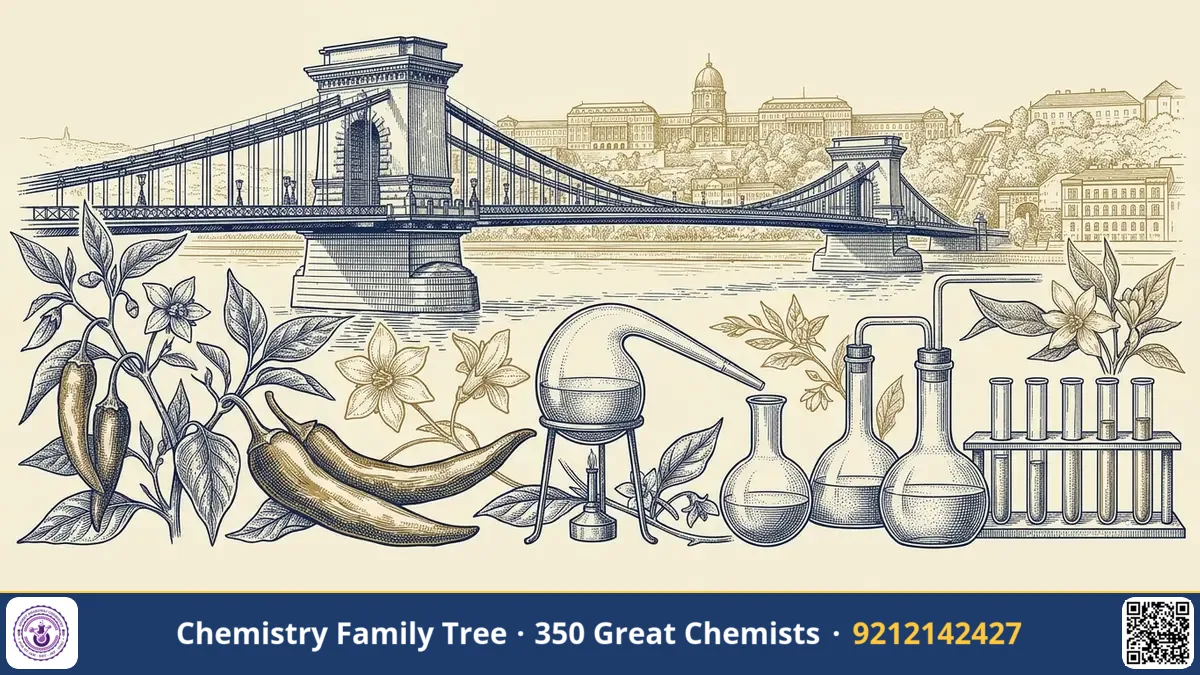
Albert Szent-Györgyi de Nagyrápolt (1893-1986) was a Hungarian biochemist who isolated vitamin C, clarified steps of cellular respiration and discovered actin and the mechanism of muscle contraction by ATP. He received the 1937 Nobel Prize in Physiology or Medicine. He was also a resistance figure during the Second World War and a lifelong seeker of the secrets of life. His legacy is a reminder that big discoveries can start with a simple pepper.
Early Life and Family
He was born on 16 September 1893 in Budapest, then part of the Austro-Hungarian Empire. His father, Nicholas, was a landowner, and his mother, Josephine, came from the Lenhossék family, in which several members were anatomy professors; his maternal uncle Mihály Lenhossék was a well-known anatomist at the University of Budapest. Science was part of his family culture. He was not a model student at first; he reportedly did badly at school until he found his interest in studying, and then he became a keen learner. His family had a tradition of public service, and the boy grew up among scientists and doctors.
Education and Mentors
He entered the Semmelweis Medical School in Budapest in 1911, and began research in his uncle's anatomy laboratory. When the First World War began, he served as a medical officer in the army and was affected deeply by the horrors of the war, which turned him against militarism for life. He completed his medical degree in 1917. He then worked in universities in Pozsony (Bratislava), Prague, Berlin, Leiden and Groningen, and in 1927 he moved to Cambridge in England. There he worked under Sir Frederick Gowland Hopkins and obtained a Cambridge Ph.D. in 1927. This is where he isolated hexuronic acid.
Career Timeline
| Year | Event |
|---|---|
| 1893 | Born in Budapest, Hungary |
| 1917 | Medical degree, Budapest |
| 1927 | Ph.D., Cambridge; worked with Hopkins |
| 1928 | Isolated hexuronic acid |
| 1930 | Professor of medical chemistry at Szeged, Hungary |
| 1932 | Identified hexuronic acid as vitamin C; extracted it from paprika |
| 1935-1937 | Work on C4-dicarboxylic acids and respiration |
| 1937 | Nobel Prize in Physiology or Medicine |
| 1940s | Discovered actin; showed ATP-induced contraction of actomyosin |
| 1944 | Escaped arrest by the Gestapo in Hungary; hid until 1945 |
| 1947 | Emigrated to the USA after the Communist takeover in Hungary |
| 1947-1971 | Directed the Institute for Muscle Research at the Marine Biological Laboratory, Woods Hole, Massachusetts |
| 1971 | Began cancer research at the National Foundation for Cancer Research |
| 1986 | Died on 22 October in Woods Hole, Massachusetts |
Major Scientific Contributions
- Vitamin C: Isolation of the vitamin from adrenal glands and paprika, proof that it cures scurvy.
- Biological oxidation: Catalytic role of the four-carbon dicarboxylic acids and the description of the fumarate-succinate pair, a stepping stone to the Krebs cycle.
- Muscle chemistry: Discovery of actin, actomyosin and ATP-induced contraction, which began the modern biochemistry of muscle.
- Flavonoids: Identification of citrin (vitamin P) from lemon peel, a flavonoid mixture; its vitamin status was later disputed.
- Cancer theory: Later, he proposed controversial ideas on electron transfer and the cell's regulation of growth; these were not widely accepted.
The core concepts are described in our discovery blog on Szent-Györgyi's vitamin C and actomyosin.
Awards, Honours and Nobel Prize
The 1937 Nobel Prize in Physiology or Medicine was given to Szent-Györgyi "for his discoveries in connection with the biological combustion processes, with special reference to vitamin C and the catalysis of fumaric acid". He later received the Albert Lasker Basic Medical Research Award in 1954, and many honorary degrees. He was a member of the US National Academy of Sciences. The Hungarian Academy of Sciences honoured him, and universities and a research institute in Szeged carry his name.
Personality, Struggles and Lesser-Known Facts
- Prize money for science: He gave part of his Nobel money to help Finland after the Soviet invasion of 1939-40, in solidarity with the Finns.
- Anti-Nazi activity: During the Second World War he secretly took part in resistance activity and helped to negotiate Hungary's exit from the war. The Gestapo tried to arrest him and he had to live in hiding in 1944-45.
- The paprika insight: Szeged is the home of Hungarian paprika, and he realised that this everyday spice could be a rich and cheap source of the vitamin, so he tested it in the laboratory.
- Move to America: After 1947 he had no money for a laboratory, and a Woods Hole group worked in a simple wooden building. His fame helped him collect support.
- Outspoken scientist: He criticised the system of research grants for rewarding safe projects rather than imaginative ones. In his late years he spoke openly about the dangers of war and nuclear weapons.
- Marriage: He married four times. His first marriage was to Kornélia Demény, and they had a daughter, Nelly.
Legacy and Influence on Modern Chemistry
Szent-Györgyi's isolation of vitamin C allowed the large-scale synthesis that ended scurvy as a public-health problem and made modern food preservation easier. His muscle work launched the field that led to the sliding filament model (Huxley and Hanson, 1954) and to the molecular motors that are studied today. His use of cheap local materials in a small university laboratory is a great example for researchers in places with limited resources, such as many Indian colleges. His dream of unifying physics and biology through electron behaviour led him to what he called "submolecular biology", opening discussion on quantum biochemistry.
Lessons for Students
- Look around you. A kitchen vegetable became his source for gram-scale vitamin C.
- Be curious across fields. He moved among anatomy, physiology, chemistry and physics.
- Use science for good. He helped to resist injustice and used prize money to help others.
- Dare to ask big questions, but test the answers with careful experiments.
Quick Facts Box
- Born: 16 September 1893, Budapest, Hungary
- Died: 22 October 1986, Woods Hole, Massachusetts, USA
- Nationality: Hungarian, later American citizen
- Field: Biochemistry
- Famous for: Vitamin C isolation, C4-acid catalysis, actin and actomyosin
- Nobel: 1937, Physiology or Medicine
FAQ
Did Szent-Györgyi win the Nobel Prize in Chemistry?
No. He won the 1937 Nobel Prize in Physiology or Medicine. Walter Haworth won the Chemistry prize that year for work on vitamin C structure and carbohydrates.
Where did he isolate vitamin C?
He first isolated hexuronic acid at Cambridge and then at Szeged, Hungary, from paprika.
What did he do in the Second World War?
He joined secret efforts to take Hungary out of the war, was hunted by the Gestapo and hid until the liberation.
Why is he important for muscle science?
He discovered actin and showed that ATP makes actomyosin contract, which is the basis of the biochemistry of muscle.
Published by ABC Chemistry — IIT-JAM | CSIR-NET | GATE Chemistry Coaching. Visit abcchemistry.com
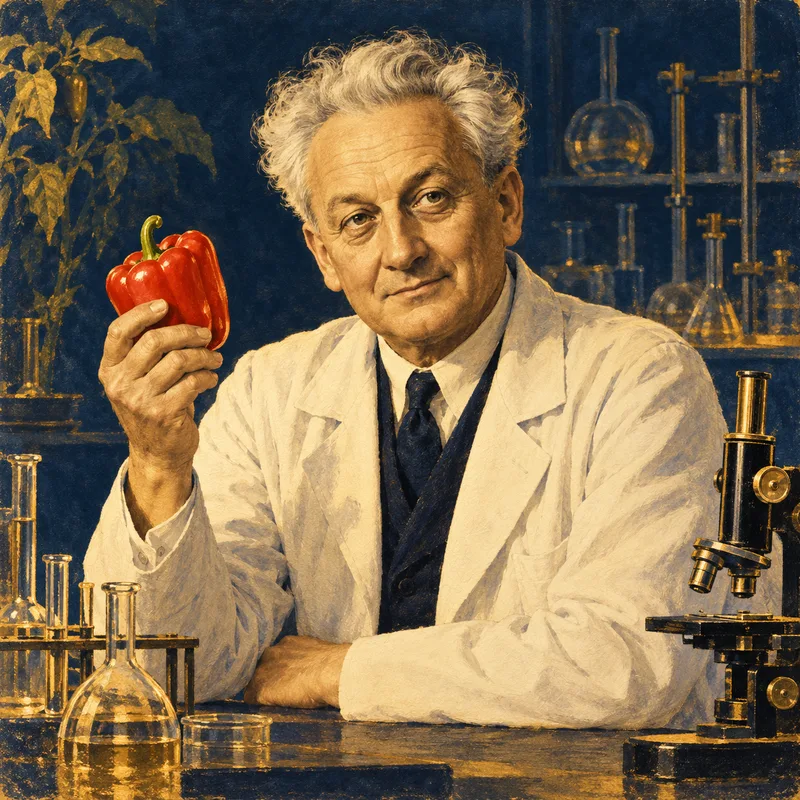
About the chemist
Albert Szent-Györgyi
1893-1986 · Hungary · Nobel Physiology/Medicine 1937
Isolated vitamin C; citric acid cycle