The discovery, explained · Chemist no. 319 of 350
Albert Szent-Györgyi: From Paprika to Vitamin C and Muscle Contraction
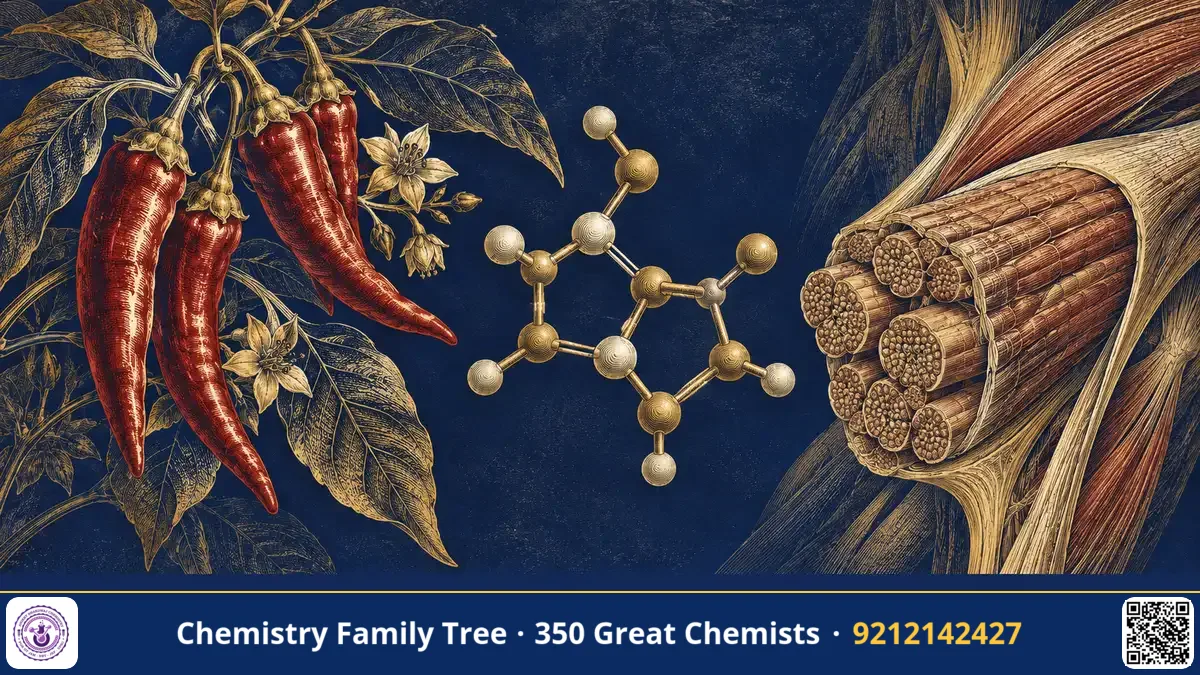
Why do sailors get scurvy? Why does a muscle shorten? Few scientists have made major discoveries on both questions, but Albert Szent-Györgyi (1893-1986) did. In the late 1920s he isolated a strong reducing sugar acid, which he named hexuronic acid; it was later shown to be vitamin C (L-ascorbic acid). In the 1930s he worked out key steps in cellular respiration using C4-dicarboxylic acids such as succinate, fumarate, malate and oxaloacetate, which helped Hans Krebs build his cycle. In the 1940s he discovered actin and showed how actomyosin contracts with ATP. He received the 1937 Nobel Prize in Physiology or Medicine for his discoveries on biological combustion, with special reference to vitamin C and the catalysis of fumaric acid.
The Scientific Problem Before the Discovery
Scurvy, a disease of bleeding gums, weak joints and slow wound healing, had killed thousands of sailors for centuries. James Lind had shown in 1747 that citrus fruit cured it, but the active substance was unknown. Scientists called it the "antiscorbutic factor", and many tried to isolate it without success. Gowland Hopkins had suggested that foods contain "accessory factors", and the word vitamin was coined in 1912 by Casimir Funk. Yet no one had purified the pure chemical of vitamin C.
On the other hand, in biochemistry, the mechanism of respiration was debated. Warburg believed that a respiratory enzyme activates oxygen; Wieland believed that cells remove hydrogen from substrates. The exact path of oxidation of carbohydrates was still unclear.
The Discovery / Experiment
Step 1: A strong reducing substance in adrenal glands
In Cambridge, in Gowland Hopkins's laboratory, Szent-Györgyi was studying why plants and animal tissue turn brown or oxidise. He extracted a strong reducing agent from the cortex of adrenal glands (cattle), orange juice and cabbage. He obtained crystals with the formula C6H8O6, which he called "hexuronic acid" because it was a six-carbon acid with sugar-like properties.
Step 2: A cheap source: paprika
Back in Szeged, Hungary, he found that the local red pepper (paprika) is very rich in the substance. In 1932 he extracted it by the kilogram from paprika. Together with Joseph Svirbely, he showed in animal feeding experiments (guinea pigs) that it cured scurvy. Almost at the same time, Charles Glen King in the US reported the same result. In 1933 Walter Haworth and Edmund Hirst determined the structure and synthesised it, and suggested the name ascorbic acid. Haworth received the 1937 Nobel Prize in Chemistry for this and carbohydrate chemistry, while Szent-Györgyi received the Medicine prize in the same year.
Step 3: The chemistry of ascorbic acid
L-ascorbic acid (C6H8O6) ⇌ dehydroascorbic acid (C6H6O6) + 2H+ + 2e-
The enediol group (C2-OH and C3-OH on a C=C double bond) in a five-membered lactone ring is easily oxidised. This explains its strong reducing power and its role as an antioxidant and as a cofactor for hydroxylation of proline in collagen.
Step 4: The C4-dicarboxylic acid catalysis
Using pigeon breast muscle, which respires quickly, Szent-Györgyi found that small amounts of succinate, fumarate, malate and oxaloacetate strongly increased oxygen uptake, far more than the added amount of acid could account for. The acids acted as catalysts of respiration. He suggested the sequence:
succinate ⇌ fumarate ⇌ malate ⇌ oxaloacetate
Malonate, an inhibitor of succinate dehydrogenase, stopped respiration, which supported the idea. Hans Krebs, building on these and other observations, completed the citric acid cycle in 1937.
Step 5: Muscle proteins
In the 1940s Szent-Györgyi moved to the University of Szeged then Budapest, working with Ilona Banga and F.B. Straub. They found that muscle protein myosin was actually a complex with a second protein which Straub purified as actin. Mixing actin and myosin gives actomyosin, and adding ATP made threads of actomyosin contract, as shown by Szent-Györgyi's glycerinated muscle fibres. This was the first demonstration that ATP is the direct energy source for the contraction of muscle proteins in vitro.
The Chemistry Behind It
- Vitamin C structure: a γ-lactone of a six-carbon sugar acid with an enediol. It is acidic (pKa about 4.2) because the C3-OH is stabilised by resonance.
- Role in collagen: ascorbate keeps the iron of prolyl hydroxylase in the Fe(II) state; without it, collagen is unstable, causing scurvy.
- Catalytic acids: The four-carbon acids are regenerated in the cycle, so a small amount helps in the oxidation of a large amount of acetyl units.
- Muscle contraction: Myosin head binds ATP, hydrolyses it (ATP → ADP + Pi), attaches to actin and makes a power stroke; Ca2+ controls the process through troponin.
Applications Today
- Nutrition and public health: Vitamin C is a key nutrient; Indian sources include amla (Indian gooseberry, one of the richest sources), guava, lemon and citrus.
- Food industry: Ascorbic acid (E300) is used as an antioxidant, flour improver and preservative.
- Industrial synthesis: The Reichstein process (from D-glucose via sorbitol and sorbose) produces vitamin C in tonnes.
- Analytical chemistry: Titration with DCPIP (2,6-dichlorophenolindophenol) or iodine measures vitamin C in juices, a standard practical.
- Muscle research: Understanding of cardiac and skeletal muscle disease and of drugs which act on myosin builds on his work.
Exam Corner
- Szent-Györgyi isolated hexuronic acid (vitamin C) and won the 1937 Nobel Prize in Physiology or Medicine.
- Vitamin C structure: L-ascorbic acid, C6H8O6, enediol lactone, strong reducing agent.
- Deficiency causes scurvy; vitamin C is needed for hydroxylation of proline and lysine in collagen.
- Malonate competitively inhibits succinate dehydrogenase.
- Actomyosin contracts in the presence of ATP and Mg2+.
Common Misconceptions
- "Haworth and Szent-Györgyi shared the Nobel Prize." No. They received separate prizes in 1937, Haworth in Chemistry, Szent-Györgyi in Physiology or Medicine.
- "Vitamin C prevents the common cold." Large clinical trials show at best a small effect on the duration of colds, not prevention.
- "Szent-Györgyi found the whole Krebs cycle." He found the role of C4 acids; Krebs completed the cycle, including citrate.
Quick Revision Box
- Hexuronic acid = L-ascorbic acid = vitamin C (C6H8O6).
- Source for bulk extraction: Hungarian paprika, 1932.
- Structure by Haworth and Hirst, 1933.
- Catalytic C4 acids: succinate, fumarate, malate, oxaloacetate.
- Actin + myosin = actomyosin; ATP causes contraction.
- Nobel 1937, Physiology or Medicine.
FAQ
Why is vitamin C called ascorbic acid?
The name means "anti-scurvy acid"; it comes from the Latin for scurvy, scorbutus, with the prefix "a" meaning without.
Why did Szent-Györgyi use paprika?
Paprika is a very rich and cheap source of vitamin C, allowing him to prepare gram-scale quantities for structure work and animal tests.
How is vitamin C measured in the laboratory?
By redox titration with iodine or the blue dye DCPIP, which is decolourised by ascorbic acid, or by HPLC.
What is actomyosin?
It is the complex of actin and myosin, which slides and contracts in muscle using ATP energy.
Published by ABC Chemistry — IIT-JAM | CSIR-NET | GATE Chemistry Coaching. Visit abcchemistry.com
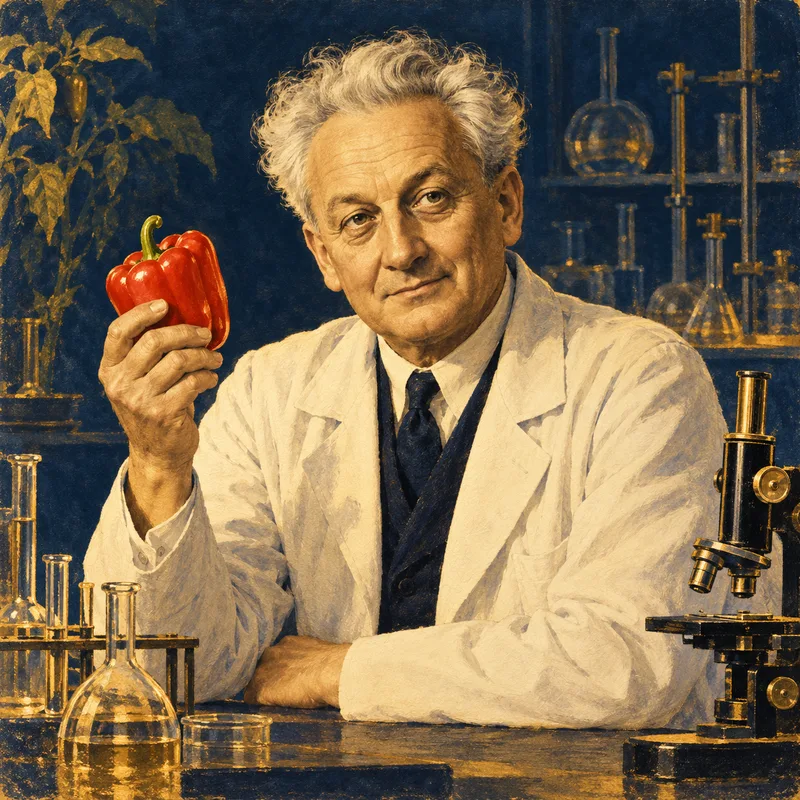
About the chemist
Albert Szent-Györgyi
1893-1986 · Hungary · Nobel Physiology/Medicine 1937
Isolated vitamin C; citric acid cycle