Biography · Chemist no. 311 of 350
Albrecht Kossel (1853–1927): The Chemist Who Found the Letters of Heredity
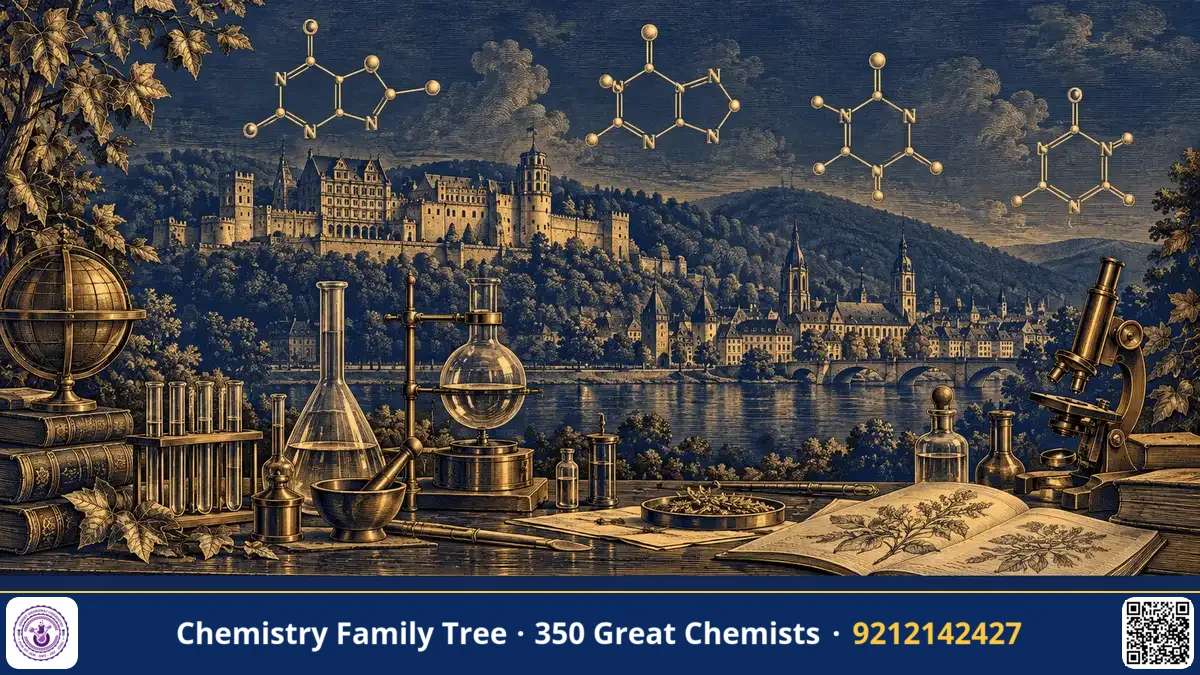
Ludwig Karl Martin Leonhard Albrecht Kossel was a German biochemist who spent his life taking apart the molecules inside the cell nucleus and identifying their pieces. He found the bases of the nucleic acids, discovered histones and helped to establish the amino acid composition of proteins. In 1910 he received the Nobel Prize in Physiology or Medicine. His legacy in one line: before anyone knew what DNA did, Kossel had already told us what it is made of.
Early Life and Family
Kossel was born on 16 September 1853 in Rostock, a port city on the Baltic Sea in northern Germany. His father, Albrecht Kossel Sr., was a merchant and a Prussian consul, and his mother was Clara Jeppe. The family was comfortable and educated. At school, he studied in Rostock and showed an early talent for natural science, although his parents hoped he would be trained in a profession with secure prospects, which led him towards medicine.
Education and Mentors
Kossel studied medicine at the University of Strasbourg from 1872, at a time when the city had just become part of the German Empire. In Strasbourg he met Felix Hoppe-Seyler, the great physiological chemist who had earlier shown that haemoglobin carries oxygen and who had supervised work on Miescher's nuclein. Kossel was drawn to chemistry and joined Hoppe-Seyler's laboratory, completing his medical degree in 1878. He then moved to Berlin, where he worked at the Physiological Institute of the University.
Career Timeline
| Year | Event |
|---|---|
| 1853 | Born in Rostock |
| 1872–1878 | Studies medicine at Strasbourg; works under Hoppe-Seyler |
| 1883 | Moves to the Physiological Institute in Berlin |
| 1884 | Isolates histones from nucleated red blood cells |
| 1885 | Isolates adenine |
| 1893–1894 | Identifies thymine and cytosine |
| 1895 | Appointed professor of physiology at Marburg |
| 1896 | Discovers histidine |
| 1901 | Becomes professor of physiology at Heidelberg |
| 1910 | Awarded the Nobel Prize in Physiology or Medicine |
| 1927 | Dies in Heidelberg on 5 July |
Major Scientific Contributions
1. The nucleobases. Kossel identified adenine, thymine and cytosine as components of nucleic acids and showed that guanine and uracil also arise from them. He recognised that the nucleic acids contain purines and pyrimidines, phosphoric acid and a carbohydrate. Later, Phoebus Levene, who had worked with Kossel, continued this line of research. More details are in our companion discovery article.
2. Histones and protamines. He identified histones as basic proteins associated with nucleic acids and studied protamines in fish sperm. These findings anticipated the modern understanding of chromatin.
3. Amino acids and protein structure. He discovered histidine and showed, with Hedin, that arginine is a protein component. He promoted the view that proteins are built from amino acids joined in chains, a concept that was developed further by Emil Fischer's peptide synthesis.
4. Teaching and the journal. From 1895, Kossel edited the Zeitschrift für physiologische Chemie, which had been founded by Hoppe-Seyler, and he led it for many years. This journal was a main forum for biochemistry.
Awards, Honours and Nobel Prize
In 1910, the Nobel Prize in Physiology or Medicine was awarded to Albrecht Kossel "in recognition of the contributions to our knowledge of cell chemistry made through his work on proteins, including the nucleic substances". This was a Nobel Prize in Medicine, and not in Chemistry, even though his discoveries are now regarded as basic chemistry and biochemistry. He was also recognised by academies and societies in Germany and abroad. Specific names and years of his other honours are not listed here since they cannot be fully verified.
Personality, Struggles and Lesser-Known Facts
- Son and scientist. His son, Walther Kossel (1888–1956), became a distinguished physicist and proposed an ionic theory of chemical bonding in 1916 that is often paired with G. N. Lewis' work in the history of the octet rule.
- Medical training, chemical mind. Kossel was trained as a physician but never practised; his career was devoted to laboratory research.
- Move from Berlin to Marburg and Heidelberg. He moved between universities to gain better research conditions, and at Heidelberg he led a leading physiology institute.
- International students. He trained students from several countries, among them the English biochemist Henry Drysdale Dakin, who worked with him in Heidelberg.
- Late writings. In his later years he summarised his lifelong work in books on the chemistry of the cell nucleus and on proteins.
Legacy and Influence on Modern Chemistry
When Watson and Crick built their model of DNA in 1953, they used the bases that Kossel and others had identified half a century earlier. Chargaff's rule, A = T and G = C, was based on chromatographic analysis of those same bases. Histones, once thought to be just packing material, are now known to be central to epigenetic regulation. For the Indian student, the base pairing rules, nucleotide structures and amino acid classification in the syllabus all go back to this early generation of biochemists.
Lessons for Students
- Persistence with simple tools. Kossel used crystallisation, precipitation and elemental analysis, and still found the building blocks of heredity.
- Break complex systems into parts. Hydrolysing the large molecule and identifying each fragment was a powerful strategy.
- Know the Nobel categories. Many biochemical discoveries received the Medicine Nobel, not the Chemistry Nobel.
- Science is a relay. Miescher, Kossel, Levene, Chargaff and Watson and Crick each added a piece.
Quick Facts Box
- Born: 16 September 1853, Rostock, Germany
- Died: 5 July 1927, Heidelberg, Germany
- Nationality: German
- Field: Biochemistry, physiological chemistry
- Famous for: Identifying nucleobases, histones, histidine
- Nobel: Physiology or Medicine, 1910
FAQ
Was Kossel's Nobel Prize in Chemistry?
No. It was in Physiology or Medicine, awarded in 1910.
Who was Kossel's teacher?
Felix Hoppe-Seyler, one of the founders of physiological chemistry, in Strasbourg.
Is Walther Kossel related to Albrecht Kossel?
Yes, Walther was his son, a physicist known for the Kossel theory of ionic bonding and for work on X-ray spectra.
Did Kossel know that DNA carries genes?
No. In his time the function of DNA was unknown. He studied its composition.
Published by ABC Chemistry — IIT-JAM | CSIR-NET | GATE Chemistry Coaching. Visit abcchemistry.com
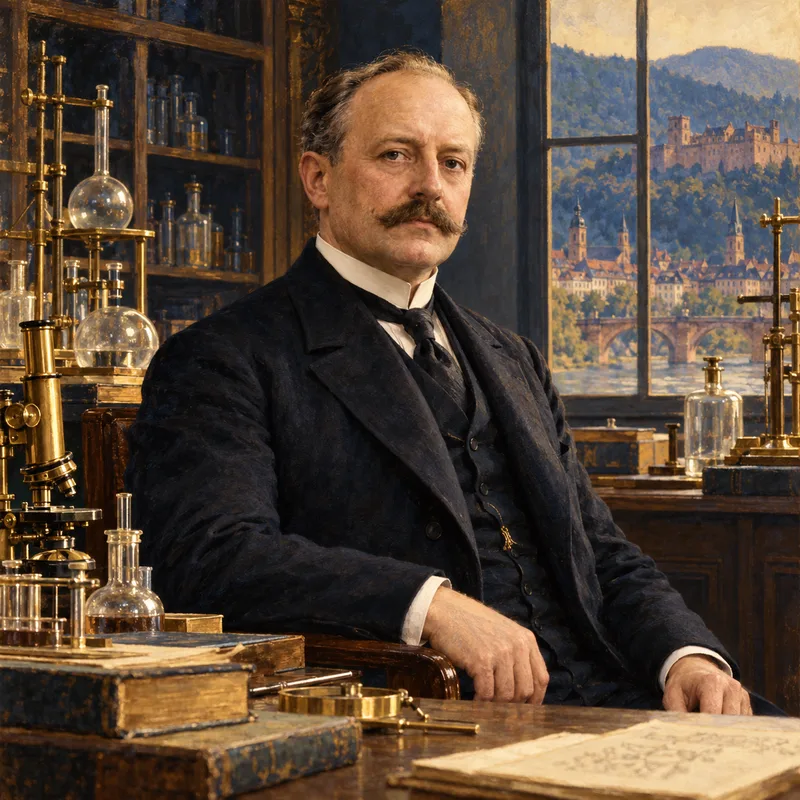
About the chemist
Albrecht Kossel
1853-1927 · Germany · Nobel Physiology/Medicine 1910
Nucleic acid chemistry; nucleobases