The discovery, explained · Chemist no. 311 of 350
Albrecht Kossel and the Chemistry of Nucleic Acids: Finding the Letters of Life
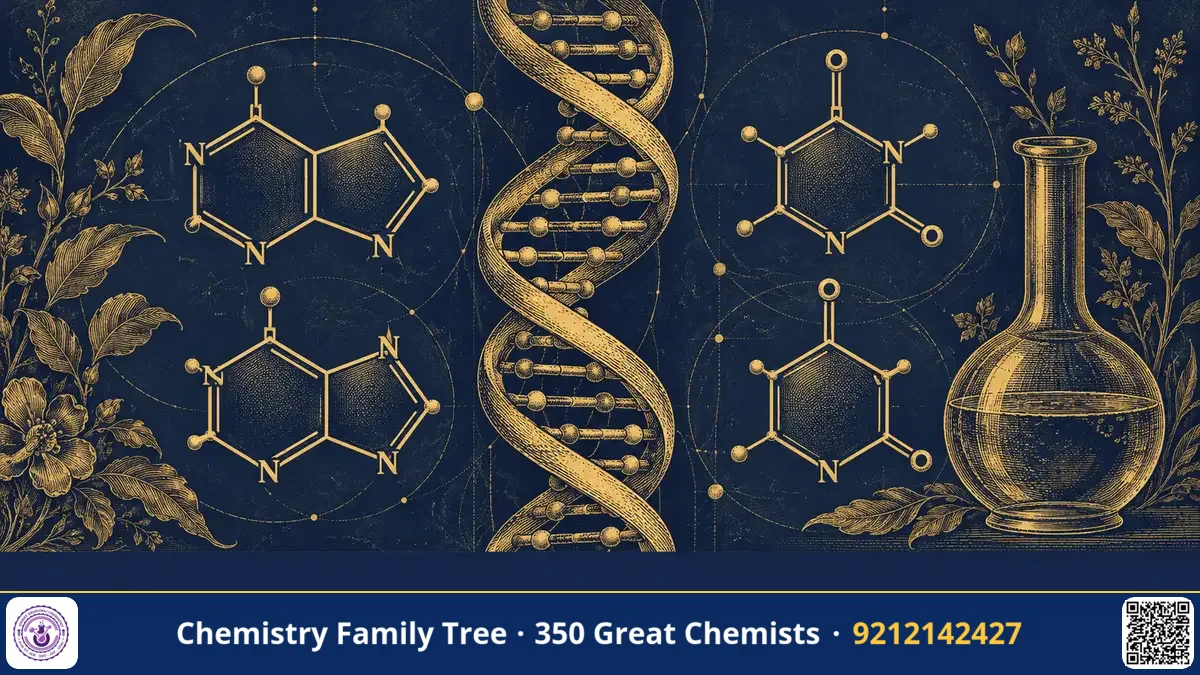
Today, every school student knows that DNA is written in a four-letter alphabet: A, T, G and C. But who found these letters? The answer is largely the German biochemist Albrecht Kossel. In the 1880s and 1890s he isolated and identified the nitrogen-containing bases of the nucleic acids: adenine, guanine, cytosine, thymine and uracil. He also discovered that histones are proteins rich in basic amino acids, and he contributed to the discovery of histidine and arginine as protein building blocks. For this work he was awarded the Nobel Prize in Physiology or Medicine in 1910 (not the Chemistry prize), "for his contributions to our knowledge of cell chemistry made through his work on proteins, including the nucleic substances".
The Scientific Problem Before the Discovery
In 1869, the Swiss physician Friedrich Miescher isolated from the nuclei of white blood cells (from pus-soaked bandages) a phosphorus-rich substance he called nuclein. It was clearly different from proteins, which contain little or no phosphorus. Over the next years, scientists learned that nuclein contained a protein part and a phosphorus-rich acidic part, which came to be called nucleic acid. But what was the chemical nature of this acid? The earlier work of Johann Friedrich Unger and others had shown that nuclein released substances such as guanine and hypoxanthine (a purine) on hydrolysis. Still, no one had a complete list of the building blocks, nor the techniques to identify them with certainty.
The problem was one of analytical chemistry in the nineteenth century: how to take apart a very complex natural substance, purify each fragment, and prove its composition and structure using only elemental analysis, crystallisation, solubility and precipitation with metal salts, without any chromatography or spectroscopy.
The Discovery: Step by Step
Kossel began working on nuclein in the laboratory of Felix Hoppe-Seyler, one of the founders of biochemistry. His approach was careful and systematic.
- Prepare nucleic material. He used sources such as yeast, pancreas, thymus gland and fish sperm, which are rich in nuclei.
- Hydrolyse. By heating the material with dilute acids (for example sulphuric acid), the large molecule breaks into small parts.
- Precipitate and purify. The bases were precipitated as insoluble salts, for example as silver or copper compounds, and then freed again and crystallised.
- Analyse. By elemental analysis (C, H, N) he worked out the molecular formula of each product, and by comparing properties he decided whether it was new.
The main results were:
| Base | Class | Formula | Reported by |
|---|---|---|---|
| Adenine | Purine | C₅H₅N₅ | Kossel, 1885 |
| Guanine | Purine | C₅H₅N₅O | Isolated earlier by Unger from guano; shown by Kossel to be a nucleic acid product |
| Thymine | Pyrimidine | C₅H₆N₂O₂ | Kossel and Neumann, 1893 |
| Cytosine | Pyrimidine | C₄H₅N₃O | Kossel and Albert Neumann, 1894 |
| Uracil | Pyrimidine | C₄H₄N₂O₂ | Isolated from yeast nucleic acid by Ascoli (1900) |
Kossel also realised that the two main kinds of nucleic acid then known differed in their bases: one (from the thymus) contained thymine, while the other (from yeast) contained uracil. In modern terms, these correspond to DNA (A, G, C, T) and RNA (A, G, C, U).
Histones, protamines and amino acids
Kossel also studied the proteins associated with nuclear material. In 1884 he isolated histones from goose red blood cells, and he studied protamines from fish sperm, which are strongly basic and rich in arginine. He established that arginine, histidine and lysine are the main basic amino acids, and he and his students showed that proteins are made up of amino acids. Hedin and Kossel are credited with isolating arginine from protein hydrolysates, and Kossel discovered histidine in 1896. He called arginine, lysine and histidine the "hexone bases".
The Chemistry Behind It
The five bases are heterocyclic aromatic compounds. Purines (adenine, guanine) have a fused six- and five-membered ring system with four nitrogen atoms. Pyrimidines (cytosine, thymine, uracil) have a single six-membered ring with two nitrogen atoms. All are planar and obey Hückel's rule (a purine ring system has 10 pi electrons, a pyrimidine 6), which is why they stack with each other in the helix.
Nucleobase + pentose sugar → nucleoside      (e.g., adenine + ribose → adenosine)
Nucleoside + phosphate      → nucleotide      (e.g., adenosine + phosphate → AMP)
Nucleotides --(phosphodiester bonds)--> polynucleotide (DNA or RNA)
Later work revealed that DNA has 2-deoxyribose and thymine, whereas RNA has ribose and uracil. In the double helix, bases pair by hydrogen bonds: A with T (two H-bonds) and G with C (three H-bonds). Because A and G are purines and T and C are pyrimidines, each pair has one large and one small ring, which keeps the helix width constant at about 2 nm.
Kossel's work on histones and basic proteins also anticipated the chemical basis of chromatin. Histones are rich in the positively charged amino acids lysine and arginine, and they bind to negatively charged DNA phosphate groups through ionic interactions to form nucleosomes. Chemical modifications of histone lysines, such as acetylation and methylation, control gene expression in epigenetics.
Applications Today
- Molecular biology and genetics: PCR, DNA sequencing and CRISPR all rely on base pairing.
- Medicine: Anticancer and antiviral drugs are base analogues, such as 5-fluorouracil, 6-mercaptopurine, acyclovir and zidovudine (AZT). Allopurinol, a purine analogue, treats gout.
- Diagnostics: DNA fingerprinting, genetic testing and RT-PCR tests for viruses.
- Vaccines: mRNA vaccines use modified uridine bases.
- Agriculture and forensic science in India: DNA profiling in crime investigation and crop improvement programmes.
Exam Corner: 5 Likely Points
- Purines: adenine and guanine; pyrimidines: cytosine, thymine and uracil. Mnemonic: "CUT the Py" (Cytosine, Uracil, Thymine are pyrimidines).
- DNA has A, T, G, C; RNA has A, U, G, C. Thymine is 5-methyluracil.
- A=T has two hydrogen bonds; G≡C has three, so GC-rich DNA has a higher melting temperature.
- Chargaff's rules: A = T and G = C in double-stranded DNA.
- Histones are basic proteins rich in lysine and arginine; protamines are rich in arginine.
Common Misconceptions
- "Kossel won the Chemistry Nobel." He won the Nobel Prize in Physiology or Medicine in 1910.
- "Kossel discovered DNA." DNA (nuclein) was first isolated by Miescher in 1869. Kossel identified its components.
- "Kossel found the structure of DNA." The double helix was proposed in 1953 by Watson and Crick, using X-ray data from Franklin and Wilkins.
Quick Revision Box
- Kossel identified adenine (1885), thymine (1893) and cytosine (1894); guanine (known earlier) was shown to come from nucleic acids, and uracil was isolated by Ascoli in 1900.
- Purines (A, G) have two rings; pyrimidines (C, T, U) have one ring.
- Nobel Prize in Physiology or Medicine, 1910.
- He discovered histones (1884) and histidine (1896).
- Miescher discovered nuclein (1869); Watson and Crick proposed the helix (1953).
- A–T: 2 H-bonds; G–C: 3 H-bonds.
FAQ
Why did Kossel win the Medicine Nobel and not the Chemistry Nobel?
His work was on the chemistry of cells and tissues, a field called physiological chemistry or biochemistry, and the Nobel Committee for Physiology or Medicine judged that it served medicine and biology.
What is the difference between a nucleoside and a nucleotide?
A nucleoside is a base joined to a sugar. A nucleotide is a nucleoside with one or more phosphate groups attached.
Why does RNA use uracil and DNA use thymine?
Thymine has an extra methyl group that makes DNA more stable and helps repair enzymes distinguish a damaged cytosine (which turns into uracil) from a normal base.
What are hexone bases?
This was Kossel's name for the three basic amino acids with six carbons: arginine, lysine and histidine.
Published by ABC Chemistry — IIT-JAM | CSIR-NET | GATE Chemistry Coaching. Visit abcchemistry.com
About the chemist
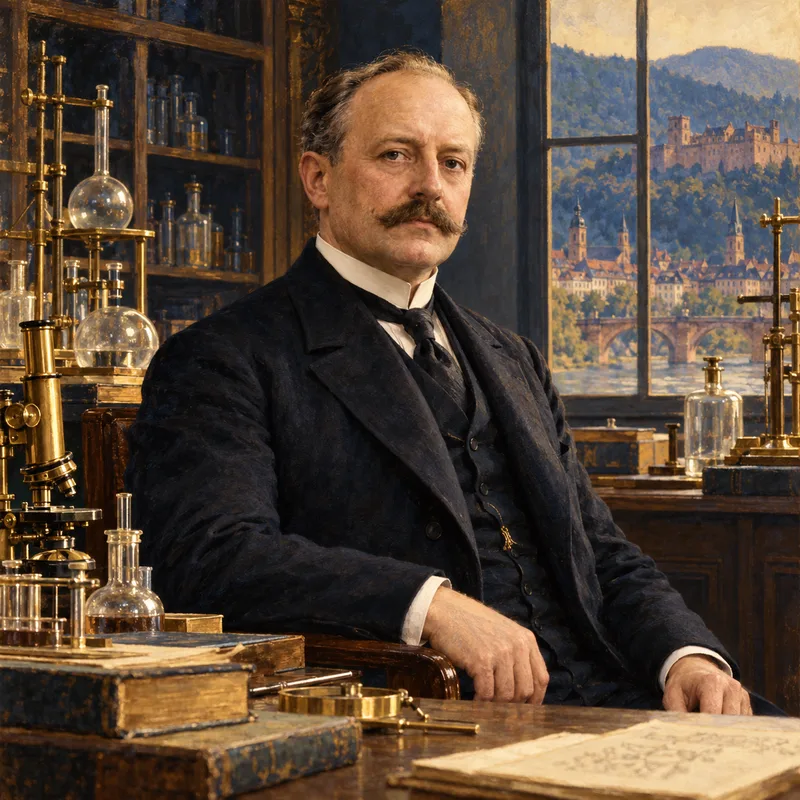
Albrecht Kossel
1853-1927 · Germany · Nobel Physiology/Medicine 1910
Nucleic acid chemistry; nucleobases