Biography · Chemist no. 348 of 350
Alessandro Volta: The Man Who Gave the World the Battery
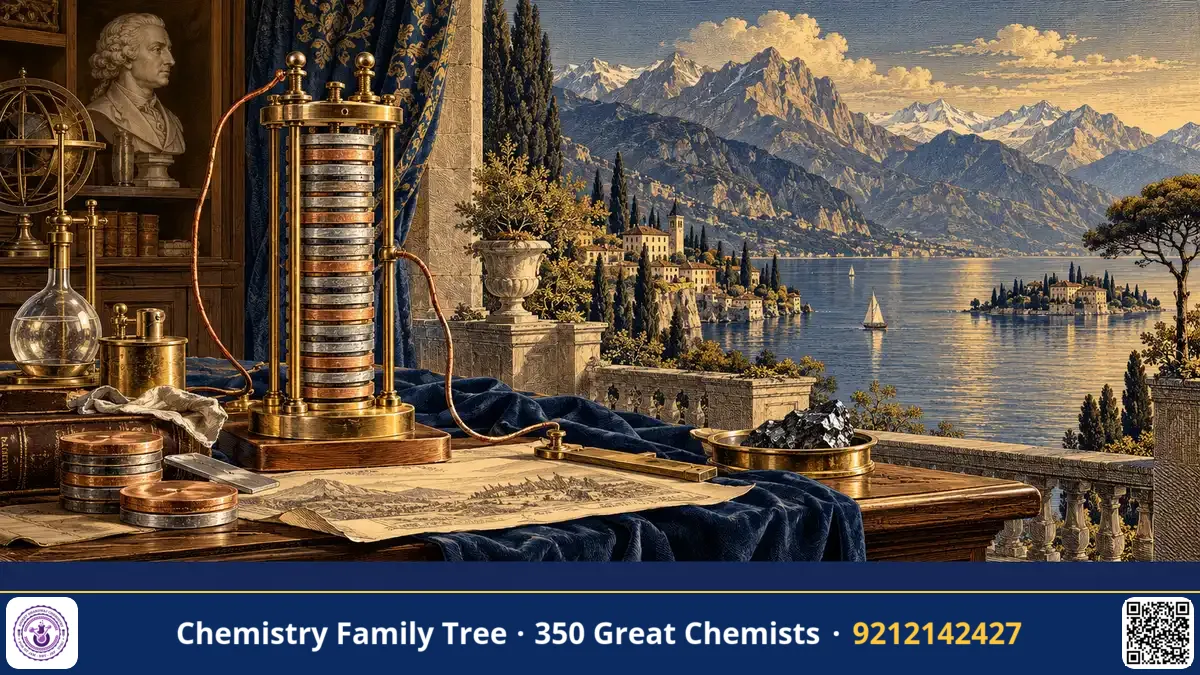
Count Alessandro Giuseppe Antonio Anastasio Volta (1745-1827) was an Italian physicist and chemist from Como in northern Italy. He invented the electric battery (the voltaic pile) in 1800, discovered methane gas in 1776, and made important improvements to electrical instruments. The unit of electric potential, the volt, bears his name. His one-line legacy: he turned electricity from a spark into a steady current, and so made modern electrochemistry and electrical technology possible. His life shows how curiosity, rivalry and careful experiment can open a new field of science.
Early Life and Family
Alessandro Volta was born on 18 February 1745 in Como, a town beside the lake of the same name in Lombardy, then part of the Austrian-ruled territories in northern Italy. His family was of noble background but not wealthy. His father, Filippo Volta, died when Alessandro was a young child, and relatives, some of them clergy, helped to look after the family. It is reported that he was late to speak as a child, and his family worried about him. He proved a quick learner, and by his teenage years he had become very interested in natural science and electricity. His family expected him to enter the church, but he preferred science.
Education and Mentors
Volta studied at local Jesuit schools in Como, where he learned languages, mathematics and physics. He was largely self-taught in electricity, reading widely and corresponding with leading scientists of the day, including Abbé Jean-Antoine Nollet in France and Giambattista Beccaria in Turin, a well-known student of electrical phenomena. His early letters on electrical experiments, written when he was in his early twenties, drew attention to his talent. In 1774 he was appointed a teacher of physics at the Royal School in Como, and in 1779 he became professor of experimental physics at the University of Pavia, a post he held for about 40 years.
Career Timeline
| Year | Event |
|---|---|
| 1745 | Born in Como, Lombardy |
| 1774 | Becomes teacher of physics at the Royal School, Como |
| 1775 | Invents the electrophorus, a device for generating electrostatic charge |
| 1776 | Discovers and isolates methane (marsh gas) from Lake Maggiore marshes |
| 1779 | Appointed professor of experimental physics at Pavia |
| 1791 | Galvani publishes his animal electricity work; Volta begins his critical studies |
| 1794 | Awarded the Copley Medal of the Royal Society |
| 1800 | Announces the voltaic pile |
| 1801 | Demonstrates the pile in Paris before Napoleon Bonaparte |
| 1810 | Made a count by Napoleon |
| 1827 | Dies in Como |
Major Scientific Contributions
- Voltaic pile: the first chemical battery, giving continuous current. Reaction at the zinc electrode:
Zn → Zn²⁺ + 2e⁻. - Methane discovery: collected "inflammable air" from marsh sediments and showed it burns with oxygen:
CH₄ + 2O₂ → CO₂ + 2H₂O. He also showed that it could be ignited by an electric spark in a closed vessel, which he used in his "electric pistol" experiment. - Electrophorus and condenser: instruments that produced and stored electrostatic charge, and helped to measure very small charges.
- Contact electricity: a ranking of metals by their tendency to become positive or negative on contact, the forerunner of the electrochemical series.
- Gas studies: work on the expansion of gases and on vapour pressure that was relevant to later gas laws.
The companion discovery article gives the electrochemistry of the pile in detail.
Awards, Honours and Nobel Prize
Volta lived long before the Nobel Prizes were established (1901), so he never received one. His honours include:
- The Copley Medal of the Royal Society of London (1794).
- Election as a foreign member of the Royal Society and membership in the French Institute.
- A gold medal and pension from Napoleon after his demonstration in Paris, and the title of count (1810), and appointment to the Senate of the Kingdom of Italy.
- The international adoption of the volt as the unit of potential difference (1881), long after his death.
Personality, Struggles and Lesser-Known Facts
- Friendly rival. His disagreement with Luigi Galvani about animal electricity was strong but respectful. Each was partly right: Galvani discovered bioelectricity, and Volta discovered the battery.
- A showman in the lecture hall. He enjoyed dramatic demonstrations. His electric pistol, which fired a cork using a spark in a methane-air mixture, was a classic one.
- Methane by wading in marshes. He collected the gas himself by stirring the mud of Lake Maggiore's shallows and capturing the bubbles.
- Letter to the Royal Society. His announcement of the pile was addressed to the president Sir Joseph Banks in 1800. The French edition and the English edition spread widely.
- Later years. He retired from teaching around 1819 and returned to the Como area, where he lived quietly. He did not make further major discoveries after the pile, though he was honoured by the state.
- Family life. He married Teresa Peregrini and had children.
Legacy and Influence on Modern Chemistry
The pile was the starting point of electrochemistry. Within months of its announcement, water was electrolysed. In 1807 Humphry Davy used a large battery to isolate potassium and sodium from their fused hydroxides, and later calcium, magnesium and barium. Michael Faraday's laws of electrolysis (1830s) built on the pile, and John Frederic Daniell's cell (1836) solved the problem of polarisation. Volta's metal-contact series led to the modern electrochemical series. Today's lithium-ion battery that powers phones and electric vehicles is a distant descendant. The Tempio Voltiano, a museum in Como, preserves his instruments. The volt, together with the ampere and the ohm, is a fundamental electrical unit used in every laboratory.
Lessons for Students
- Test a rival theory by experiment. The Galvani debate led Volta to the battery.
- Build your own apparatus. The pile was a simple construction, but changed science.
- Look at nature around you. Methane came from ordinary marsh bubbles.
- Be open to partial truth. Both Galvani and Volta contributed lasting ideas.
- Communicate clearly. A letter to the Royal Society carried his discovery across Europe.
Quick Facts Box
- Born: 18 February 1745, Como, Lombardy (now Italy)
- Died: 5 March 1827, Como, Lombardy
- Nationality: Italian
- Field: Physics and electrochemistry
- Famous for: Voltaic pile (1800), discovery of methane (1776)
- Nobel Prize: None (lived before the prize began); Copley Medal 1794
FAQ
Why is the unit of potential called the volt?
It was named in honour of Volta, and the name was adopted internationally in 1881.
Did Volta discover methane?
Yes. In 1776 he collected and studied methane from marsh gas near Lake Maggiore and showed that it was flammable.
Who was right, Galvani or Volta?
Volta was right that two metals produce an electric current, and Galvani was right that animal tissue produces and responds to electrical signals.
How did Volta's pile help chemistry?
It enabled electrolysis, which allowed Davy to discover several new elements and led to Faraday's laws.
Published by ABC Chemistry — IIT-JAM | CSIR-NET | GATE Chemistry Coaching. Visit abcchemistry.com
About the chemist
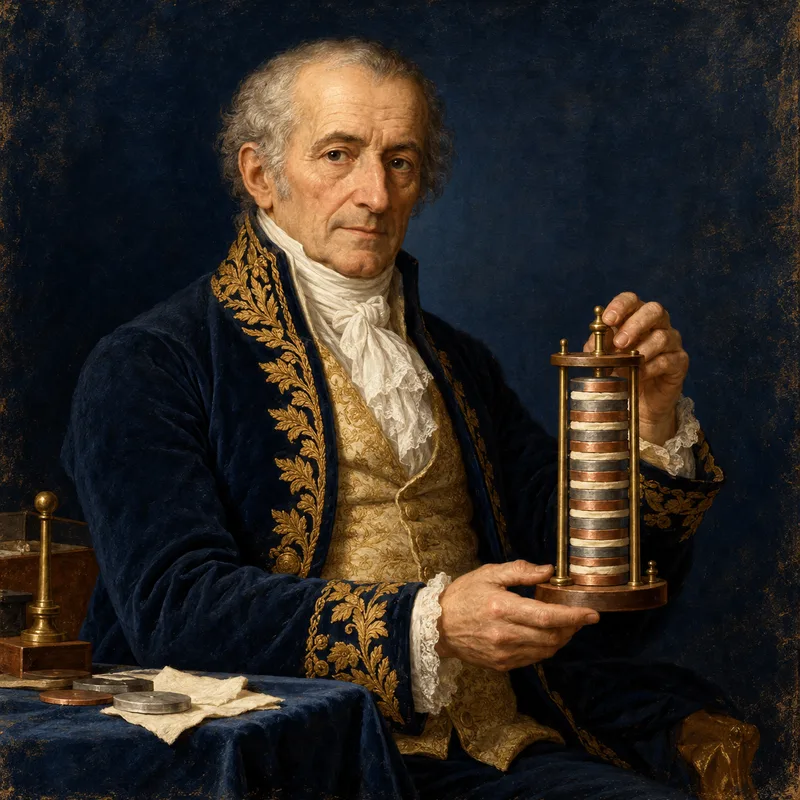
Alessandro Volta
1745-1827 · Italy
Voltaic pile; first electric battery