The discovery, explained · Chemist no. 348 of 350
Alessandro Volta and the Voltaic Pile: Birth of the Battery

Every mobile phone, torch, electric vehicle and laboratory pH meter depends on batteries, and every battery traces its ancestry to a stack of metal discs built by the Italian physicist Alessandro Volta in 1800. His voltaic pile was the first device to produce a steady, continuous electric current. Until then, scientists had only electrostatic machines and Leyden jars, which gave short bursts of charge. The pile opened the age of current electricity and gave birth to electrochemistry. Within weeks of its announcement, others used it to split water into hydrogen and oxygen; within a few years, Humphry Davy used much bigger piles to isolate sodium, potassium and other new elements. In his honour, the SI unit of potential difference is the volt. This article explains the pile and the chemistry that makes it work.
The Scientific Problem Before the Discovery
In the 1780s, Luigi Galvani in Bologna observed that the legs of a dissected frog twitched when touched with two different metals. Galvani concluded that the electricity came from the animal itself, which he called "animal electricity". Volta, professor of physics at Pavia, repeated the experiments but reached a different view: the electricity came from the contact between two different metals, with the moist animal tissue acting as a conductor. This scientific debate between the two men was one of the great controversies of the age.
To settle it, Volta needed to show that electricity could be generated without any animal tissue. He also needed a source that would last, so that electricity could be studied as a flow and not only as a spark.
The Discovery: Step by Step
- Contact experiments. Volta tested many pairs of metals and found that some combinations, for instance zinc and silver or copper, gave a much stronger effect than others. He ranked metals in what we now call the Volta series.
- Replacing the frog. He used a piece of cardboard or cloth soaked in salt water (brine) or dilute acid in place of the animal tissue.
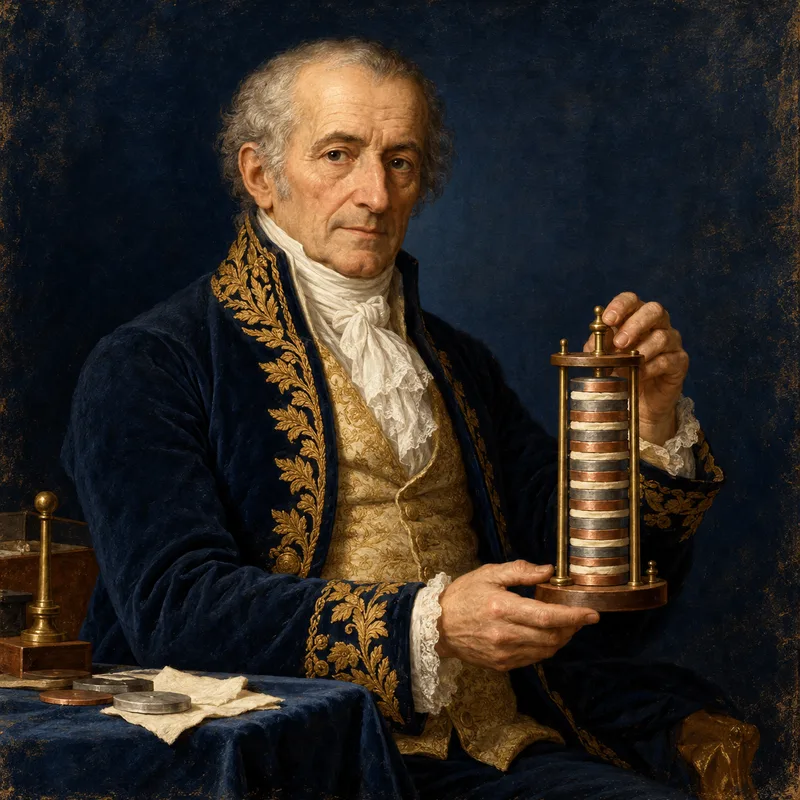
- Stacking the units. He placed a disc of zinc, then a disc of copper (or silver), then a moist cloth disc, and repeated this sequence many times to form a column. A pile of 20 or more units gave a clearly noticeable shock.
- Connecting the ends. When wires were joined to the top and bottom of the stack, a continuous current flowed, and he could feel it with his hands.
- Announcement. In a letter of March 1800 to Sir Joseph Banks, President of the Royal Society in London, Volta described the pile. It was published the same year in the Society's Philosophical Transactions.
The Chemistry Behind It
Volta himself believed that the electricity came merely from metal contact. We now know that the real cause is a chemical reaction: an oxidation-reduction (redox) reaction in which electrons are transferred. The pile is a set of galvanic cells connected in series.
Half-reactions
Take a zinc-copper pair with dilute acid as electrolyte (a version often used in schools):
Anode (oxidation):    Zn(s)  →  Zn²⁺(aq) + 2e⁻            E° = −0.76 V (for Zn²⁺/Zn reduction)
Cathode (reduction):  2H⁺(aq) + 2e⁻  →  H₂(g)  at the copper surface
Overall:              Zn + 2H⁺  →  Zn²⁺ + H₂
In salt water, oxygen dissolved in the water can also be reduced at the cathode. Zinc is a more reactive metal, with a more negative reduction potential than copper or silver, so it loses electrons readily. The electrons move through the external circuit from zinc to the copper.
Cell potential
For the Daniell-type Zn-Cu cell, the standard cell potential is E°cell = E°cathode − E°anode = 0.34 − (−0.76) = 1.10 V. A pile of n cells in series gives roughly n times the voltage of one cell, and this is why the tall pile gave a noticeable shock. For zinc and silver (E° Ag⁺/Ag = +0.80 V), the potential difference is larger, about 1.56 V per standard cell.
Nernst equation
E = E° − (0.0592 / n) log Q      (at 298 K)
ΔG° = − n F E°
Here F = 96,500 C mol⁻¹. A positive E° means a spontaneous reaction. Because the reactant concentrations change as the cell is used, the voltage of the pile slowly falls. Volta's pile also suffered from polarisation: hydrogen bubbles collected on the copper surface and increased internal resistance. Later cells (Daniell, Leclanché) solved this problem.
Electrolysis, the reverse process
In 1800, William Nicholson and Anthony Carlisle connected a voltaic pile to water and split it:
2H₂O(l) → 2H₂(g) + O₂(g)
This showed that electricity can drive chemical change, and that the volume of hydrogen is twice that of oxygen. Faraday later found the quantitative laws of electrolysis.
| Feature | Voltaic pile | Modern battery |
|---|---|---|
| Electrodes | Zinc and copper/silver | Many pairs, e.g. Li-ion, Zn-C, Pb-acid |
| Electrolyte | Brine-soaked cloth | Controlled salts, gels, liquids |
| Limitation | Polarisation, drying out | Reduced by design |
Applications Today
- Batteries: primary cells (dry cells, alkaline cells), secondary cells (lead-acid, lithium-ion) are all developments of the pile.
- Electrolysis industry: production of sodium hydroxide and chlorine, aluminium, and electroplating, all use direct current.
- Corrosion science: galvanic corrosion occurs when two different metals touch in a wet environment, just as in Volta's stack. Zinc coating (galvanising) protects iron.
- Analytical chemistry: pH meters, ion-selective electrodes and potentiometric titrations rely on electrode potentials.
- India: electric vehicles, solar storage and mobile devices rely on lithium-ion batteries, an area of active research.
Exam Corner
- Galvanic cell: spontaneous redox reaction produces electricity; anode = oxidation (negative), cathode = reduction (positive).
- E°cell = E°cathode − E°anode; ΔG° = −nFE°.
- Electrochemical series ranks standard reduction potentials; a metal with a lower value displaces a metal with a higher value from solution.
- Nernst equation: E = E° − (0.0592/n) log Q at 298 K.
- Cells in series add their EMFs; cells in parallel give the same EMF with greater current capacity.
Common Misconceptions
- "Volta was right that contact alone makes electricity." His contact idea was incomplete; the chemical reaction supplies the energy. Galvani was right that tissue can respond to electricity, though not about its origin.
- "Electrons flow through the electrolyte." Electrons move through the wire; ions carry the current inside the electrolyte.
- "Voltage depends on the size of the electrodes." The EMF depends on the materials and concentrations; size affects the current available.
Quick Revision Box
- Voltaic pile announced in 1800: stack of Zn and Cu/Ag discs with brine-soaked cloth.
- First source of steady electric current.
- Zn is oxidised at the anode: Zn → Zn²⁺ + 2e⁻.
- E°cell (Zn-Cu) = 1.10 V; ΔG° = −nFE°.
- Pile suffered polarisation due to H₂ on the cathode.
- The volt (V) is named after Volta.
FAQ
What was the voltaic pile made of?
Alternating discs of zinc and copper or silver separated by cloth or cardboard soaked in brine or acid.
Why does a tall pile give a higher voltage?
Each zinc-metal-electrolyte unit is a cell, and cells in series add up their voltages.
What was the Galvani-Volta controversy about?
Galvani thought the electricity was in the animal; Volta showed that it arises from dissimilar metals and a moist conductor.
What is polarisation in a cell?
It is the build-up of reaction products, such as hydrogen bubbles, on an electrode, which raises internal resistance and lowers current.
Published by ABC Chemistry — IIT-JAM | CSIR-NET | GATE Chemistry Coaching. Visit abcchemistry.com
About the chemist
Alessandro Volta
1745-1827 · Italy
Voltaic pile; first electric battery