Biography · Chemist no. 258 of 350
Alexander Mikhailovich Butlerov (1828-1886): Father of the Theory of Chemical Structure
Introduction
Alexander Mikhailovich Butlerov was a Russian chemist, professor and public figure who laid the foundation of structural organic chemistry. He created the term "chemical structure," predicted and made the first tertiary alcohol, and founded a school of chemists in Russia that included Markovnikov. His legacy in one line: he taught chemists that a molecule is an ordered arrangement of atoms, and that this arrangement can be discovered.
Early Life and Family
Butlerov was born on 15 September 1828 (new style) in the village of Butlerovka near Chistopol, in the Kazan province of the Russian Empire. His father, Mikhail Vasilyevich Butlerov, was a landowner and army officer. His mother died soon after his birth, and he was raised mainly in Kazan, where he went to private boarding schools and then a gymnasium. As a boy he was interested in nature and in chemical experiments, and it is said that a home experiment with gunpowder-like mixtures caused an explosion, for which he was punished at school. This anecdote is often told in Russian sources about his youth.
Education and Mentors
He entered Kazan University in 1844, first to study natural sciences and then chemistry. There he studied under Nikolay Zinin, famous for the reduction of nitrobenzene to aniline, and Karl Klaus, discoverer of ruthenium. Butlerov completed his studies in 1849, and in 1851 defended a master's thesis on the oxidation of organic compounds. In 1854 he defended a doctoral thesis on essential oils at Moscow University. His teachers made him aware of both the experimental and the theoretical sides of chemistry.
Career Timeline
| Year | Event |
|---|---|
| 1828 | Born near Chistopol, Kazan province |
| 1844 | Entered Kazan University |
| 1849 | Graduated; began teaching at Kazan |
| 1854 | Doctorate (Moscow University) |
| 1857-58 | Travelled in Europe; met Kekulé, Wurtz, Couper and others in Paris and elsewhere |
| 1860 | Became rector of Kazan University for a period |
| 1861 | Speyer talk: "On the chemical structure of matter" |
| 1864 | Prepared tert-butyl alcohol |
| 1865 | Published a textbook on organic chemistry |
| 1868 | Professor at St Petersburg University |
| 1874 | Elected full member of the St Petersburg Academy of Sciences |
| 1886 | Died on 17 August (5 Aug old style) in Butlerovka |
Major Scientific Contributions
- Theory of chemical structure (1861): The properties of a compound are determined by the order of linking of atoms. See our discovery blog for the full theory.
- Tert-butyl alcohol and isobutane: Prepared to confirm the prediction of isomers. This was the first synthesis of a tertiary alcohol.
- Formose reaction: Formaldehyde with lime water gives sugar-like products (1861).
- Polymerisation of isobutene: He studied the polymerisation of isobutene with acid catalysts, forming dimers, an early study of polymerisation of alkenes.
- Dynamic isomerism: He suggested that some isomers can change into each other, a forerunner of the concept of tautomerism.
- Textbook: His book Introduction to the Complete Study of Organic Chemistry (1864-66) was the first textbook built entirely on structural theory.
Awards, Honours and Nobel Prize
Butlerov was elected an ordinary academician of the St Petersburg Academy of Sciences in 1874. He was a leading member of the Russian Chemical Society. He was never given a Nobel Prize, as he died in 1886, fifteen years before the first prizes. The Butlerov Institute of Chemistry at Kazan Federal University is named after him.
Personality, Struggles and Lesser-Known Facts
- He was a gifted lecturer. Students at Kazan and St Petersburg remembered his clarity and his demonstrations.
- He was a passionate beekeeper. He wrote a practical book on bee-keeping and promoted beekeeping across Russia as a rural trade. This is well attested.
- He had a strong interest in spiritualism, which was criticised by colleagues such as Mendeleev. In the 1870s Butlerov defended the study of spiritualist phenomena, which damaged his reputation in some circles.
- Butlerov fought for the cause of women's education and took part in public lectures for women.
- He combined research with administration, serving as rector of Kazan University in the early 1860s.
Legacy and Influence on Modern Chemistry
Butlerov's students formed the "Butlerov school," including Vladimir Markovnikov (Markovnikov's rule), Alexander Zaitsev (Zaitsev's rule), Egor Wagner (Wagner oxidation of alkenes) and Alexander Popov (Popov's rule on oxidation of ketones). Through them his structural thinking shaped almost every named organic rule you meet in Class 12 and in GATE. Structural formulae, isomer counting, the use of NMR and IR to deduce structure and the logic of retrosynthesis all rest on his central claim that structure is knowable and determines properties. A bit of chemistry history ties it to India: the same approach underlies natural-product structure work done at CSIR labs.
Lessons for Students
- Use theory to predict. A theory that predicts new compounds proves its value.
- Do the experiment. Butlerov proved his idea by actually preparing tert-butyl alcohol.
- Teach what you learn. He wrote textbooks and trained a generation.
- Keep an open but critical mind. His later interest in spiritualism shows the cost of leaving rigour behind.
- Interests outside science help. He had beekeeping and public service.
Quick Facts Box
- Born: 15 September 1828, near Chistopol, Kazan province, Russian Empire
- Died: 17 August 1886, Butlerovka
- Nationality: Russian
- Field: Organic chemistry
- Famous for: Theory of chemical structure; tert-butyl alcohol; formose reaction
- Nobel Prize: None (died before 1901)
FAQ
Who was Butlerov's teacher?
Mainly Nikolay Zinin and Karl Klaus at Kazan University.
Which famous rule was discovered by Butlerov's student?
Markovnikov's rule on addition of HX to unsymmetrical alkenes, and Zaitsev's rule on elimination.
What was Butlerov's hobby?
Beekeeping. He wrote a book on it and promoted it in Russia.
Why is Butlerov important to organic chemistry?
He established that properties depend on structure and that structure can be determined by chemical methods.
Published by ABC Chemistry — IIT-JAM | CSIR-NET | GATE Chemistry Coaching. Visit abcchemistry.com
About the chemist
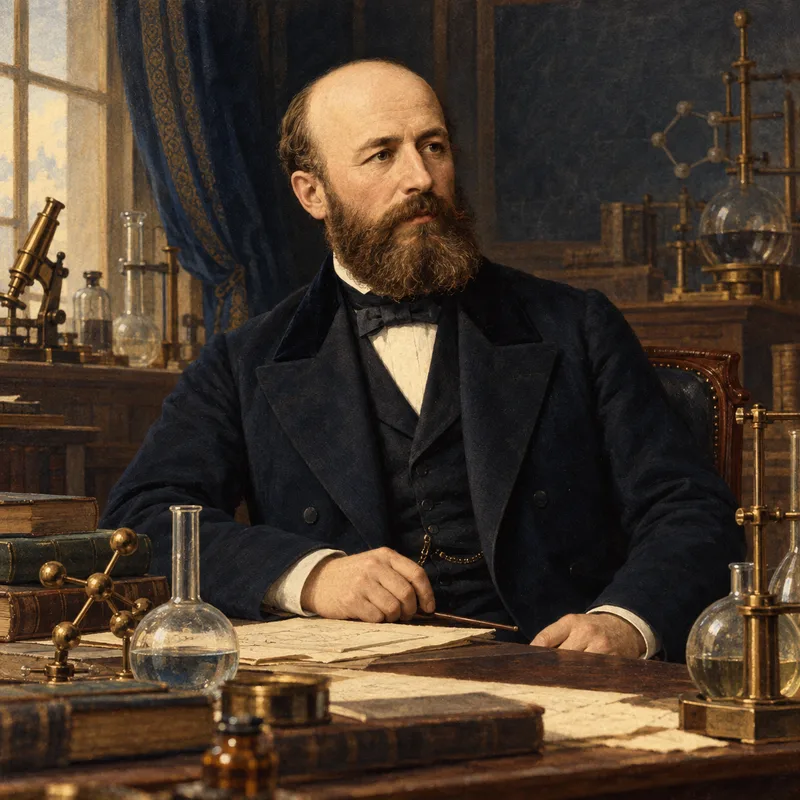
Alexander Butlerov
1828-1886 · Russia
Theory of chemical structure