The discovery, explained · Chemist no. 258 of 350
Alexander Butlerov and the Theory of Chemical Structure
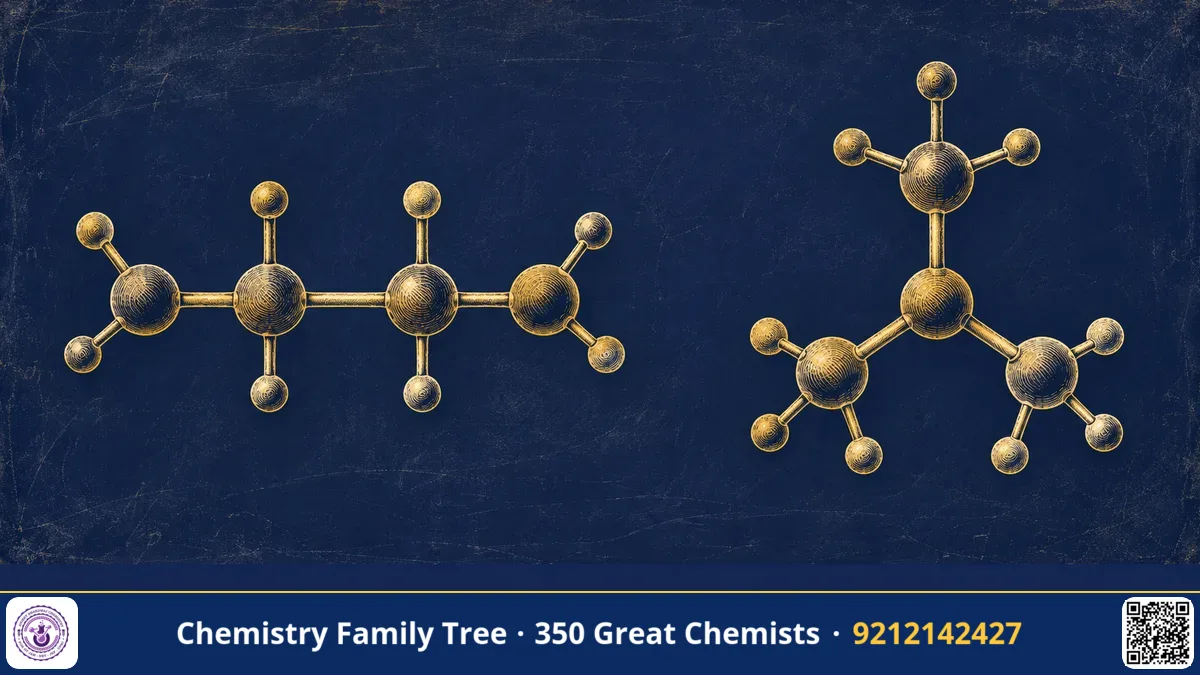
Why do two compounds with the same molecular formula, such as C₄H₁₀, have different boiling points and chemical behaviour? Today every Class 11 student knows the answer: their atoms are connected in different ways. This answer came largely from the Russian chemist Alexander Mikhailovich Butlerov. In 1861 he introduced the term "chemical structure" and claimed that the properties of a compound depend on the way its atoms are bonded, and that this arrangement can be found by experiments. He backed the theory by predicting isomers and making tertiary butyl alcohol, the first tertiary alcohol. This blog explains his ideas and why they matter for organic chemistry.
The Scientific Problem Before the Discovery
In the first half of the 19th century, organic chemistry was in confusion. Chemists used "type theory," which grouped compounds by how they could be derived from simple types such as water, ammonia and hydrogen, and the formulas written were often just ways to show reactions, not real structures. Many chemists, including Kolbe and Gerhardt, held that the real arrangement of atoms could not be known.
Meanwhile, two big ideas had arisen. In 1858 August Kekulé and Archibald Couper independently proposed that carbon is tetravalent and that carbon atoms can link to one another to form chains. But Kekulé thought formulas represent only the reactions of a compound. The problem was this: can we really know how atoms are arranged inside a molecule, and does this arrangement fix the properties?
The Discovery: Butlerov's Steps
Butlerov spoke at the congress of German scientists at Speyer in September 1861, in a talk titled "On the Chemical Structure of Matter". His central points were:
- Each atom has a fixed amount of "chemical force" (valence) and uses it in bonding.
- Atoms in a molecule are linked in a definite order, and this order is the chemical structure.
- The properties of a compound depend on its structure, including the nature of its atoms, their number and their order of linking.
- Structure can be found from the chemical reactions of the compound (especially synthesis and decomposition). Each compound therefore has one rational formula.
He tested his theory by prediction. If butane, C₄H₁₀, can have a straight chain, then another arrangement with a branched chain should exist. He also predicted the number of isomers of butyl alcohol, C₄H₉OH. Four isomers of butanol are possible, and at that time only three were known. In 1864 he prepared the fourth, tert-butyl alcohol, by reacting acetyl chloride with dimethylzinc and then water, a clear success of the theory.
CH3COCl + 2 Zn(CH3)2 → (CH3)3C–O–ZnCH3 + ZnCH3Cl   (approx. scheme)
(CH3)3C–OZnCH3 + H2O → (CH3)3C–OH + Zn(OH)CH3
He also synthesised isobutane (2-methylpropane) in the 1860s, and he showed that the compound with branching had properties different from n-butane.
| Compound | Structure | Boiling point (approx.) |
|---|---|---|
| n-Butane | CH₃CH₂CH₂CH₃ | −0.5 °C |
| Isobutane | (CH₃)₃CH | −11.7 °C |
| n-Butanol | CH₃CH₂CH₂CH₂OH | 117 °C |
| tert-Butanol | (CH₃)₃COH | 82 °C |
In 1861 Butlerov also observed that formaldehyde (methanal) in the presence of lime water condenses to give a sugar-like mixture. This is now known as the formose reaction:
n HCHO --Ca(OH)2--> sugars (mixture of C2–C6 carbohydrates)
It was the first synthesis of a sugar-like substance from a simple compound, and it is of great interest in studies on the origin of life.
The Chemistry Behind It
The theory of structure gives us the base of modern organic chemistry.
- Isomerism: Compounds with the same molecular formula but different structure are structural isomers. Butlerov explained them as differences in the order of bonding. For C₄H₁₀ there are 2 isomers; for C₅H₁₂, 3; and for C₆H₁₄, 5.
- Tautomerism: Butlerov was among the first to suggest dynamic isomerism, where isomers transform quickly into each other, an idea related to keto-enol tautomerism.
- Classification of alcohols: Primary, secondary and tertiary alcohols are defined by the carbon attached to OH. Tertiary alcohols resist oxidation, and react fastest in the Lucas test:
(CH3)3C–OH + HCl --ZnCl2--> (CH3)3C–Cl + H2O (turbidity immediately)
- Predictive power: A good theory should predict, not just explain. Butlerov's theory predicted unseen isomers, and it was confirmed.
Applications Today
- Drug design: Every drug is designed on the principle that structure determines function, such as isomers with distinct activity (ibuprofen, thalidomide).
- Petrochemicals: Branched isomers like isooctane (2,2,4-trimethylpentane) give high octane rating in petrol. The octane scale takes isooctane as 100.
- Solvents and chemicals: tert-Butanol and MTBE (from isobutene) are used as solvents and fuel additives.
- Spectroscopy: NMR, IR and mass spectrometry, used in Indian labs, are methods to find structure, exactly what Butlerov said was possible.
- Origin-of-life research: The formose reaction is studied as a way sugars may have formed on early Earth.
Exam Corner
- Butlerov introduced "chemical structure" in 1861 (Speyer congress).
- He synthesised tert-butyl alcohol, the first tertiary alcohol.
- Formose reaction: formaldehyde with Ca(OH)₂ gives sugars.
- Number of structural isomers: C₄H₁₀ = 2, C₅H₁₂ = 3, C₆H₁₄ = 5.
- Tertiary alcohols react immediately in the Lucas test and do not oxidise easily.
Common Misconceptions
- "Kekulé alone created structure theory." Kekulé, Couper and Butlerov all contributed. Butlerov used the term "chemical structure" and insisted it could be known.
- "Isomers have the same properties." They have the same formula but different physical and chemical properties.
- "The formose reaction gives a single sugar." It gives a complex mixture.
Quick Revision Box
- 1861: Butlerov states the theory of chemical structure.
- Properties depend on the order of linking of atoms.
- Predicted and made tert-butyl alcohol (1864).
- Formose reaction: HCHO to sugars with lime water.
- Explained isomerism and hinted at tautomerism.
- Foundation of the Russian school of organic chemistry.
FAQ
What is Butlerov's theory of chemical structure?
It says that the properties of a molecule depend on how its atoms are linked, and that this structure can be found from chemical reactions.
What did Butlerov synthesise?
He synthesised tert-butyl alcohol (1864), isobutane and the sugar-like mixture of the formose reaction (1861), among others.
Why is tert-butyl alcohol important in this story?
Its existence was predicted by the structure theory, and its preparation confirmed the theory.
Is the formose reaction in the syllabus?
It appears occasionally in organic chemistry and origin-of-life topics; know that it converts formaldehyde into sugars under basic conditions.
Published by ABC Chemistry — IIT-JAM | CSIR-NET | GATE Chemistry Coaching. Visit abcchemistry.com
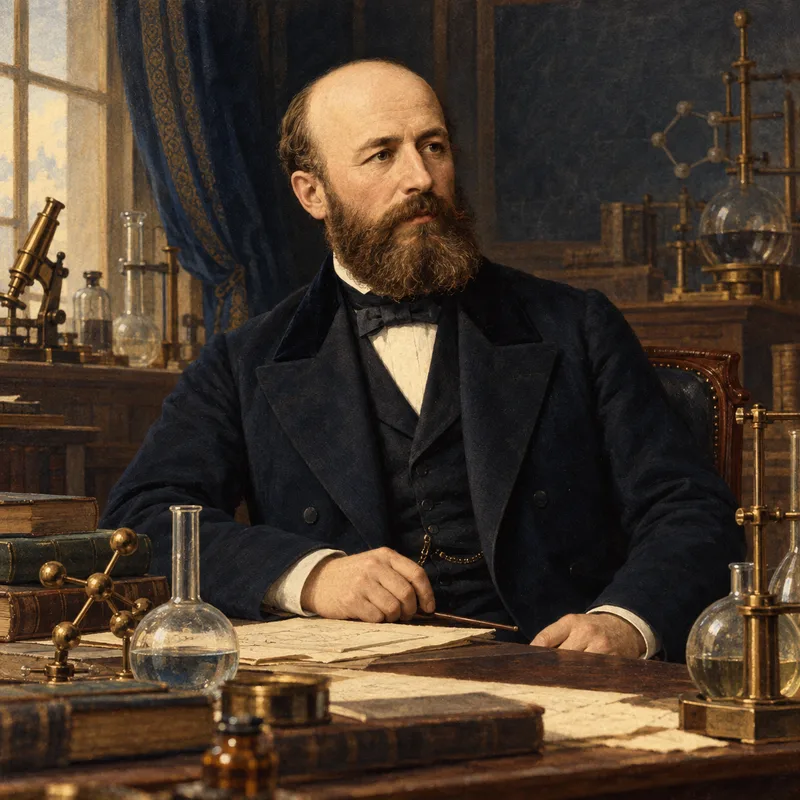
About the chemist
Alexander Butlerov
1828-1886 · Russia
Theory of chemical structure