Biography · Chemist no. 341 of 350
Alexander Parkes: The Victorian Inventor of the First Plastic
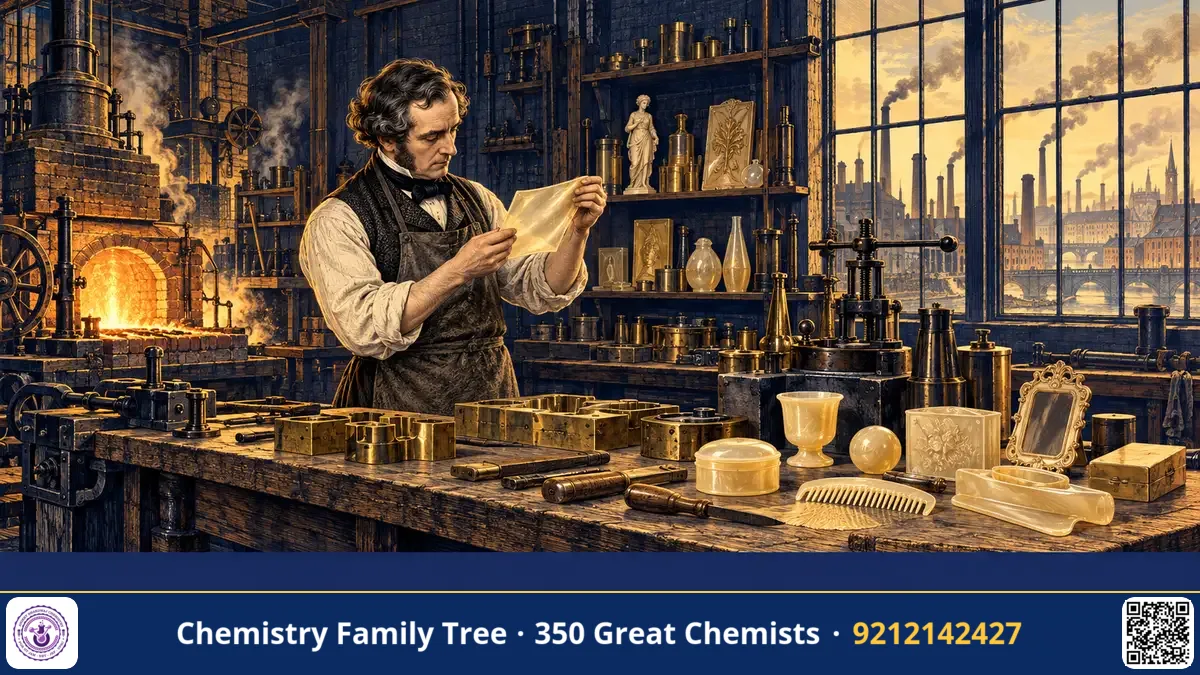
Alexander Parkes (1813-1890) was an English metallurgist, chemist and inventor from Birmingham. He is remembered as the creator of Parkesine, the first man-made plastic, which he displayed in 1862. His other major invention, the Parkes process for removing silver from lead, was important in metal refining. His one-line legacy: a practical workshop chemist who showed that natural polymers could be chemically remade into new materials. Although he did not become rich, he opened the road that led to celluloid, photographic film and modern plastics. His life is a useful case study in invention, business risk and persistence.
Early Life and Family
Alexander Parkes was born in Birmingham on 31 December 1813. Birmingham was then one of Britain's great manufacturing centres, famous for brass, buttons, jewellery, guns and metalware, and people called it the workshop of the world. His father was a brass-lock maker, so metals and workshop skills were part of his surroundings from childhood. As a boy he was apprenticed in the Birmingham metal trades, learning practical processes rather than theory. This hands-on background is typical of Victorian inventors, many of whom were trained in works and not in universities.
Education and Mentors
Parkes did not have a formal university education in chemistry. He learned through apprenticeship in the Birmingham metal trades and later worked with the Elkington firm, famous for electroplating. There he was exposed to metallurgy and the chemical processes behind coating and refining metals. The Elkington company was led by George and Henry Elkington, who pioneered electro-deposition of silver and gold. He learned from this environment how chemistry could be industrialised and how patents and manufacturing worked. He held patents for various processes before turning to his own ventures.
Career Timeline
| Year | Event |
|---|---|
| 1813 | Born in Birmingham, England |
| 1830s to 1840s | Works at Elkington's in Birmingham on electroplating and metal processes |
| 1850 | Patents the Parkes process for desilvering lead with zinc |
| 1850s | Develops and patents methods for making a moulding material from nitrated cellulose |
| 1862 | Displays Parkesine at the London International Exhibition and is awarded a bronze medal |
| 1866 | Parkesine Company founded; it ends within a few years |
| 1890 | Dies at Sydenham, London |
Major Scientific Contributions
- Parkesine (cellulose nitrate plastic): chemically modified cellulose, softened with oils and solvents, which could be moulded and hardened. This is the first man-made plastic and is the ancestor of celluloid.
- The Parkes process: liquid zinc added to molten lead dissolves silver; the silver-zinc alloy forms a crust that is skimmed off. This is a classic example of liquid-liquid extraction in metallurgy.
- Electroplating work: during his years in the electroplating industry he worked on processes for coating metals.
- Rubber treatment: he also patented methods connected with the treatment of rubber, a field of great interest after Goodyear's vulcanisation.
For the chemistry, recall the nitration of cellulose with a mixed acid, which produces cellulose nitrate by replacing –OH groups with –ONO₂ groups. The discovery article gives equations and exam hints.
Awards, Honours and Nobel Prize
Parkes lived long before the Nobel Prizes began in 1901 and received none. His recognition included:
- A bronze medal at the 1862 International Exhibition in London for Parkesine.
- Patents in metallurgy, rubber and plastic materials, which were his main form of recognition.
- Historical recognition as a pioneer of the plastics industry. Museums in Britain preserve early Parkesine objects.
Personality, Struggles and Lesser-Known Facts
- A man of many trades. Parkes worked on metals, rubber and plastics. He moved easily between these because he thought about processes, not just about single materials.
- The business failed. His Parkesine Company, set up in 1866, struggled because the product was expensive and not consistent in quality. Cost-cutting in manufacture led to warping and cracking in articles. The company wound up in the late 1860s.
- Others took the idea further. The Hyatt brothers in the United States developed celluloid using camphor as plasticiser, and celluloid became a commercial success. Daniel Spill, who had worked with Parkes, also continued with similar materials.
- A modest end. Parkes spent his later years in London without great wealth, despite having been first with the idea. His story is a reminder that being first does not guarantee commercial success.
- Applied thinking. Many of his inventions began as solutions to industrial problems, such as saving costly silver or making a cheaper alternative to ivory and horn.
Legacy and Influence on Modern Chemistry
The plastics industry today produces hundreds of millions of tonnes per year, and its origin is traced back to the cellulose-based materials of Parkes, Spill and Hyatt. Cellulose nitrate became celluloid, which was used for photographic and cinema film, though its flammability caused serious fires and led to safer cellulose acetate film. Concepts such as plasticisation, semi-synthetic polymers and the control of the degree of substitution on a polymer chain remain central to polymer science. In metallurgy, the Parkes process is a textbook example of using different solubilities in two immiscible molten metals to separate a valuable trace element. In India, his name appears in discussions of the history of plastics in school and college texts.
Lessons for Students
- Practical skill matters. Parkes learned in workshops, yet his ideas shaped chemistry.
- Chemistry can imitate nature. Scarce ivory and horn inspired the search for substitutes; many modern innovations also begin with a resource problem.
- Quality control is part of science. A great idea fails if the product is unreliable.
- Do not give up after failure. His company ended, but the knowledge was passed on and succeeded in other hands.
- Know the history for exams. Questions often ask who made the first plastic or what is the first synthetic polymer.
Quick Facts Box
- Born: 31 December 1813, Birmingham, England
- Died: 29 June 1890, Sydenham, London
- Nationality: British (English)
- Field: Metallurgy, industrial and polymer chemistry
- Famous for: Parkesine, the first man-made plastic (1862), and the Parkes process for silver
- Nobel Prize: None (the prizes began in 1901, so none was awarded to him)
FAQ
Is Parkesine the first plastic?
It is generally called the first man-made plastic, although it is semi-synthetic because it is made from natural cellulose.
What is the Parkes process?
It is a method in which zinc is added to molten lead so that silver dissolves in the zinc layer, which is then skimmed off.
Why did Parkesine fail commercially?
The product was costly, and poor quality control in manufacturing led to cracking and warping, so the company closed within a few years.
How is Parkes connected to celluloid?
Celluloid, a cellulose nitrate plastic plasticised with camphor, was developed by the Hyatt brothers and is a direct successor to Parkesine.
Published by ABC Chemistry — IIT-JAM | CSIR-NET | GATE Chemistry Coaching. Visit abcchemistry.com
About the chemist
Alexander Parkes
1813-1890 · United Kingdom
Parkesine, first plastic