The discovery, explained · Chemist no. 341 of 350
Alexander Parkes and Parkesine: The First Man-Made Plastic
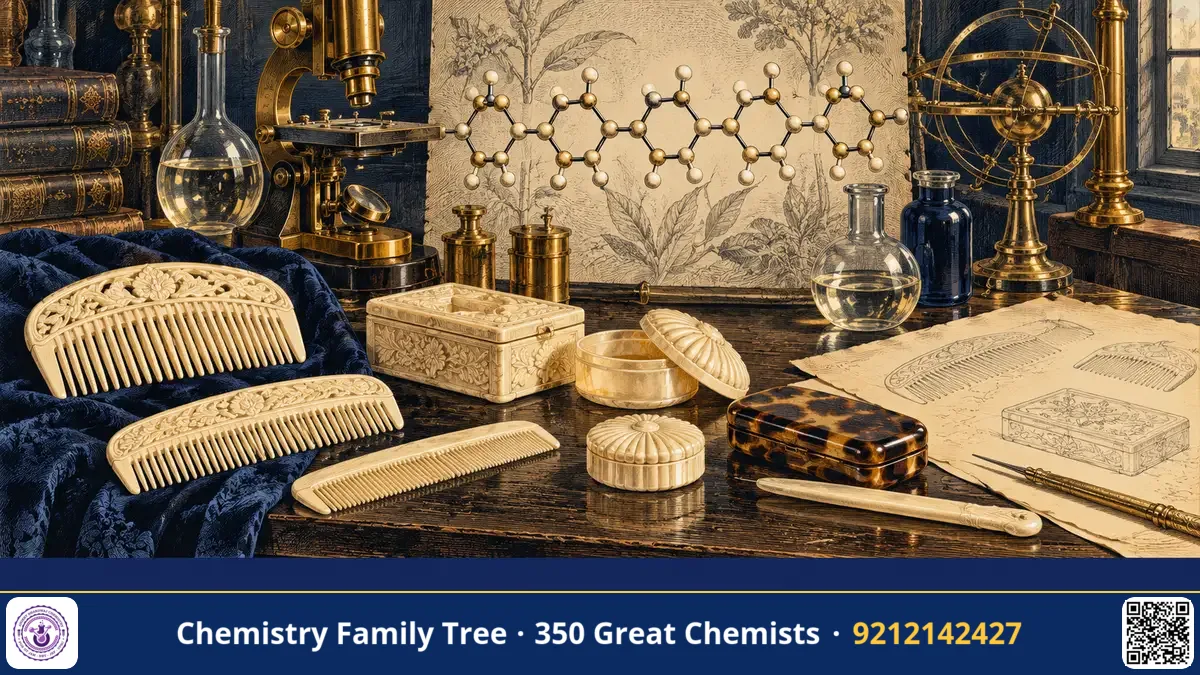
Look around your room. Almost everything, from pens to switch covers, may be plastic. The first step on that long road was taken in Victorian Britain by Alexander Parkes, who showed in 1862 at the London International Exhibition a hard, shapeable material he called Parkesine. It was made from cellulose, the main substance of plant cell walls, chemically modified with nitric acid and then softened with oils and solvents. Parkesine is often described as the first man-made plastic. Although the business failed, the chemistry behind it, cellulose nitrate, gave rise to celluloid, photographic film and later cellulose-based polymers. Parkes also made a major contribution to metallurgy through the Parkes process for removing silver from lead. This article explains both discoveries in simple terms.
The Scientific Problem Before the Discovery
In the mid-1800s, industry relied on natural materials for moulded objects: ivory, tortoiseshell, horn, wood, rubber and shellac. Ivory and tortoiseshell were expensive and limited in supply, and demand for combs, billiard balls, buttons and handles kept growing. Natural rubber was useful but went sticky in heat and brittle in cold until Goodyear's vulcanisation (1839) improved it.
Meanwhile chemists had found that cellulose, when treated with strong acids, formed explosive or flammable compounds. In 1846 Christian Schönbein had discovered guncotton, a highly nitrated cellulose. Collodion, a solution of less-nitrated cellulose in ether and alcohol, was used in medicine and in early photography. The problem was how to turn nitrated cellulose into a safe, shapeable solid rather than an explosive or a thin film.
The Discovery: Step by Step
- Starting material. Parkes used cellulose from cotton or other plant fibre.
- Nitration. Cellulose was treated with a mixture of concentrated nitric acid and sulphuric acid. This replaced some of the –OH groups with nitrate ester groups, –ONO₂, giving cellulose nitrate (nitrocellulose). The degree of nitration was kept low, much lower than for guncotton.
- Plasticising. The product was dissolved or softened with solvents and mixed with oils, such as castor oil, and other substances. These added molecules sit between polymer chains and make the mass flexible.
- Shaping. The soft mass could be rolled, pressed or moulded, and when the solvent evaporated it hardened into a tough, horn-like solid that could be coloured, carved or painted.
- Public display. At the 1862 London International Exhibition, Parkes showed a range of objects made from Parkesine and won a bronze medal for the material.
Cellulose  +  n HNO₃  --(H₂SO₄)-->  Cellulose nitrate  +  n H₂O
[C₆H₇O₂(OH)₃]ₓ                       [C₆H₇O₂(OH)₃₋ₙ(ONO₂)ₙ]ₓ
The Chemistry Behind It
Nitration of cellulose
Cellulose is a polysaccharide made of β-D-glucose units joined by β-1,4-glycosidic links. Every glucose unit has three free hydroxyl groups (at C2, C3 and C6). With the nitrating mixture, these are converted into nitrate esters. Sulphuric acid acts as a catalyst and dehydrating agent: it helps produce the nitronium ion NO₂⁺ and removes the water formed.
HNO₃ + 2H₂SO₄  ⇌  NO₂⁺ + H₃O⁺ + 2HSO₄⁻
Cell–OH + HNO₃  →  Cell–ONO₂ + H₂O
The nitrogen content depends on the extent of nitration. Low-nitrogen products are used for plastics and lacquers; high-nitrogen guncotton (about 13 percent N) is explosive.
Role of the plasticiser
Cellulose nitrate on its own is stiff and hard to shape because strong hydrogen bonds and dipole interactions hold chains tightly. A plasticiser, a small molecule that dissolves in the polymer, increases the spacing between chains, weakens interactions and lowers the glass transition temperature. This is a standard concept in polymer science: plasticisers add flexibility. The famous later example is camphor in celluloid, developed by the Hyatt brothers in the United States in the 1860s and 1870s.
Is Parkesine a polymer?
Yes, but it is a chemically modified natural polymer (a semi-synthetic polymer). The backbone is natural cellulose, but its functional groups were changed by chemical reaction. A fully synthetic plastic, Bakelite, was made later by Leo Baekeland in 1907 from phenol and formaldehyde.
The Other Big Idea: The Parkes Process
In 1850 Parkes patented a method to extract silver from lead ore products. Lead obtained from galena often contains traces of silver. Parkes added molten zinc to molten lead. Zinc dissolves silver far better than lead does, and it is almost immiscible with lead. On cooling, a silver-rich zinc crust floats to the top and can be skimmed off. The zinc is then removed by distillation, leaving silver. The idea is based on distribution (partition) of a solute between two immiscible liquid phases. Variants were used in industry for many decades.
Applications Today
- Cellulose nitrate descendants: nitrocellulose lacquers for wood and nail polish, table-tennis balls (celluloid), and some inks.
- Cellulose derivatives: cellulose acetate for spectacle frames, film base and filters; rayon from regenerated cellulose; carboxymethyl cellulose in food and pharmaceuticals.
- Plasticisers: phthalates and other plasticisers are used to soften PVC, a modern development of Parkes's idea.
- Metallurgy: desilvering of lead by zinc and related partition methods are still part of the history and practice of base-metal refining.
Exam Corner
- Parkesine was the first man-made plastic, a cellulose nitrate plastic, shown in 1862.
- Nitration uses a mixture of conc. HNO₃ and conc. H₂SO₄, which generates the nitronium ion, NO₂⁺.
- Cellulose is a polymer of β-D-glucose with 1,4-glycosidic links; starch is a polymer of α-D-glucose.
- Plasticisers reduce intermolecular forces and lower the glass transition temperature, Tg.
- Parkes process: zinc dissolves silver from molten lead; the Zn-Ag crust is separated.
Common Misconceptions
- "Bakelite was the first plastic." Bakelite was the first fully synthetic plastic, but semi-synthetic Parkesine came about 45 years earlier.
- "Nitrocellulose is always explosive." Only highly nitrated forms are explosive; the lightly nitrated forms are used in plastics and lacquers, though they remain flammable.
- "Parkesine was a commercial success." The company failed, partly due to cost and quality problems. The idea succeeded later in the form of celluloid.
Quick Revision Box
- Parkesine: cellulose nitrate plus plasticiser, shown at the 1862 London exhibition.
- Nitrating mixture: conc. HNO₃ + conc. H₂SO₄ gives NO₂⁺.
- It is a semi-synthetic polymer, not fully synthetic.
- Plasticiser spaces out the chains and adds flexibility.
- Parkes process (1850): zinc removes silver from molten lead.
- Successor material: celluloid (cellulose nitrate plus camphor).
FAQ
What is Parkesine made of?
It is made of cellulose nitrate mixed with plasticisers such as oils and solvents.
Why is cellulose nitrate flammable?
The nitrate ester groups act as built-in oxidising agents, so the material can burn rapidly even without much air.
What is the difference between guncotton and Parkesine?
Guncotton is highly nitrated cellulose and explosive; Parkesine used a lower degree of nitration with plasticisers and was meant for shaping into objects.
Is the Parkes process in the syllabus?
It is useful as an example of metallurgy by liquid-liquid extraction (partition of silver into zinc), which can appear in the extraction of metals unit.
Published by ABC Chemistry — IIT-JAM | CSIR-NET | GATE Chemistry Coaching. Visit abcchemistry.com
About the chemist
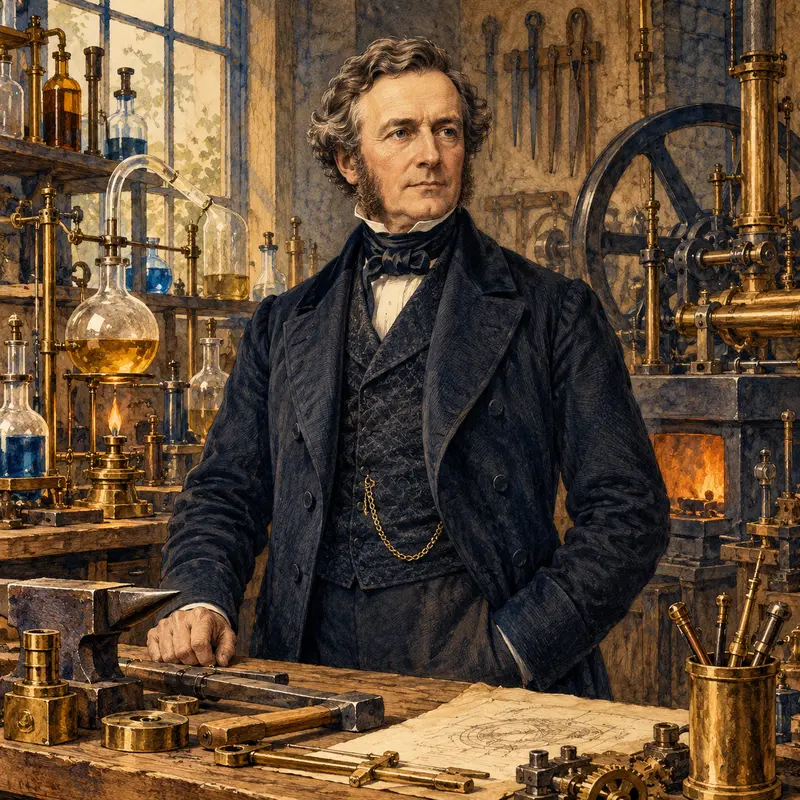
Alexander Parkes
1813-1890 · United Kingdom
Parkesine, first plastic