The discovery, explained · Chemist no. 133 of 350
Alexander Todd and Nucleotides: Building the Chemistry of ATP and DNA
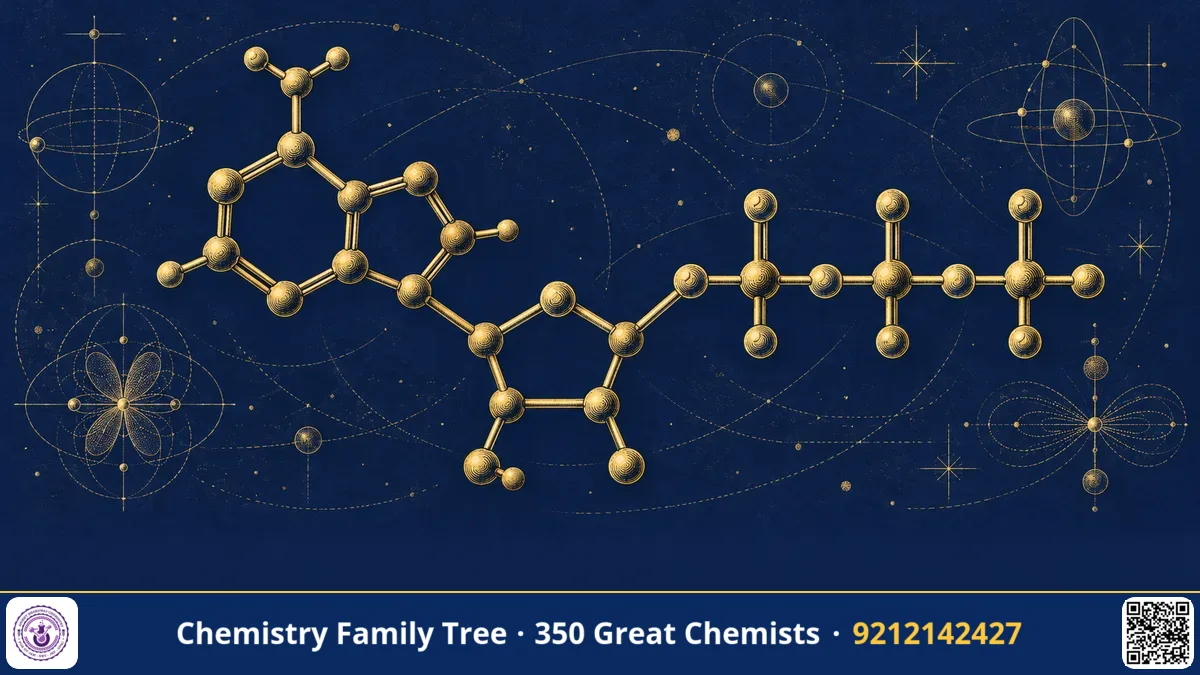
Every cell in your body runs on ATP, and every gene is written in a chain of nucleotides. Before the 1940s, the chemical structure of these molecules was only partly known. The Scottish organic chemist Alexander Robertus Todd, working in Edinburgh, Manchester and Cambridge, determined the structure of nucleosides and nucleotides, proved how they are linked together, and synthesised adenosine triphosphate (ATP), adenosine diphosphate (ADP) and the coenzymes FAD and others. His work prepared the ground for the double helix of Watson and Crick, and in 1957 he received the Nobel Prize in Chemistry "for his work on nucleotides and nucleotide co-enzymes".
The Scientific Problem Before the Discovery
By the 1920s Phoebus Levene and others had shown that nucleic acids consist of nucleotides, each made of a nitrogenous base, a five-carbon sugar and phosphate. Levene suggested that a nucleic acid was a short, repeating tetranucleotide, which turned out to be wrong. Important questions were still open:
- How is the sugar joined to the base: through which nitrogen, and in which ring form (furanose or pyranose)?
- Where is the phosphate attached on the sugar?
- How are nucleotides linked together in the chain?
- Could ATP, the energy currency of the cell, be made in the laboratory to prove its structure?
The chemical tools to answer such questions were limited, and phosphate esters are delicate molecules that easily hydrolyse.
The Discovery: Step by Step
- Structure of nucleosides. Todd and his coworkers (notably Basil Lythgoe and D. M. Brown) used chemical degradation, synthesis and comparison with natural products. They showed that in adenosine and the other nucleosides the sugar is attached as a five-membered ring (ribofuranose) in a β-glycosidic linkage to N-9 of purines or to N-1 of pyrimidines.
- Position of phosphate. Through the chemical synthesis of nucleotides such as adenosine-5′-phosphate, they showed that the monomer nucleotides from nucleic acid hydrolysis carried phosphate at the 3′ or 5′ position of the sugar.
- Phosphorylation methods. Todd introduced mild phosphorylating reagents, especially dibenzyl phosphorochloridate, (BnO)₂P(O)Cl, which attaches a protected phosphate to an alcohol, after which the benzyl groups are removed by hydrogenolysis. The related Atherton-Todd reaction converts dialkyl phosphites to phosphoramidates with CCl₄ and an amine.
- Synthesis of ATP (1948). Todd's group prepared adenosine-5′-triphosphate chemically, and showed that the synthetic compound was identical to natural ATP. They also synthesised ADP and later the coenzymes FAD (flavin adenine dinucleotide) and NAD⁺-related compounds.
- The internucleotide link. In the early 1950s Todd and Brown proved that in DNA and RNA the nucleotides are linked by 3′-5′ phosphodiester bonds, which made it clear that nucleic acids are long, unbranched polymer chains.
The Chemistry Behind It
A nucleoside is base + sugar; a nucleotide is nucleoside + phosphate. For example:
Adenine + ribose → adenosine (nucleoside)
Adenosine + H₃PO₄ → adenosine-5′-monophosphate, AMP (nucleotide)
AMP + 2 phosphate → ATP
ATP contains two phosphoanhydride bonds, which release energy upon hydrolysis:
ATP + H₂O → ADP + Pi ΔG°′ ≈ −30.5 kJ/mol
The reason for the large negative free energy is the relief of electrostatic repulsion between the negatively charged phosphate groups, resonance stabilisation of the products and better solvation. This makes ATP a universal carrier of chemical energy.
In DNA, the sugar is 2′-deoxyribose; in RNA it is ribose. The 3′-OH group of one nucleotide is joined to the 5′-phosphate of the next, forming a phosphodiester linkage:
…sugar(3′)–O–P(=O)(O⁻)–O–(5′)sugar…
The RNA 2′-OH group makes RNA less stable than DNA because it can attack the neighbouring phosphorus, a point that follows directly from Todd-type studies of nucleotide hydrolysis. Todd also studied the vitamin B12 (cobalamin) fragments, which gave important chemical evidence for the structure later confirmed by Dorothy Hodgkin using X-ray crystallography, and he took part in the synthesis of vitamin B1 (thiamine) and studied vitamin E and the active constituents of cannabis.
Applications Today
- Oligonucleotide synthesis. Modern DNA synthesisers use phosphoramidite chemistry, a descendant of Todd's phosphorylation ideas, to build primers for PCR and gene sequencing.
- Antiviral drugs. Nucleoside analogues such as acyclovir, AZT and remdesivir work by imitating natural nucleosides; their design depends on knowing nucleoside structure.
- Cancer chemotherapy. Drugs like 5-fluorouracil and cytarabine are based on nucleobase and nucleoside chemistry.
- Biochemistry teaching. The ATP/ADP cycle, NAD⁺, FAD and coenzyme A are central to metabolism chapters in Class 12, B.Sc. and NEET-oriented courses.
- Vaccines. mRNA vaccines rely on synthetic nucleotide chemistry.
Exam Corner
- Nucleoside = base + pentose sugar (β-N-glycosidic bond); nucleotide = nucleoside + phosphate ester.
- Nucleotides in DNA and RNA are joined by 3′-5′ phosphodiester bonds.
- Purines bond to sugar through N-9; pyrimidines through N-1.
- ATP has two high-energy phosphoanhydride bonds; hydrolysis ΔG°′ about −30.5 kJ/mol.
- Todd won the 1957 Nobel Prize in Chemistry for work on nucleotides and nucleotide coenzymes.
Common Misconceptions
- "The energy of ATP is stored in the P–O bond itself." The energy released comes from the overall stability change of products compared to ATP, not from bond breaking alone.
- "Todd discovered the double helix." No. Watson and Crick did, but Todd's work on linkages was essential background.
- "Todd won a Nobel Prize in Medicine." It was in Chemistry.
Quick Revision Box
- Nucleoside: base + sugar. Nucleotide: base + sugar + phosphate.
- Todd proved the 3′-5′ phosphodiester linkage in nucleic acids.
- He synthesised ATP, ADP and coenzymes such as FAD.
- Reagent: dibenzyl phosphorochloridate; Atherton-Todd reaction.
- RNA is less stable than DNA because of the 2′-OH group.
- Nobel Prize in Chemistry 1957.
FAQ
What did Alexander Todd prove about nucleic acids?
That nucleotides are linked through 3′-5′ phosphodiester bonds, making nucleic acids long chain polymers.
Which Nobel Prize did he receive?
The 1957 Nobel Prize in Chemistry, for work on nucleotides and nucleotide coenzymes.
Did he make ATP in the laboratory?
Yes. His group synthesised ATP in 1948 and showed that it matched the natural compound.
Why is ATP called the energy currency?
Because its hydrolysis to ADP and phosphate releases usable free energy that drives many cellular reactions.
Published by ABC Chemistry — IIT-JAM | CSIR-NET | GATE Chemistry Coaching. Visit abcchemistry.com
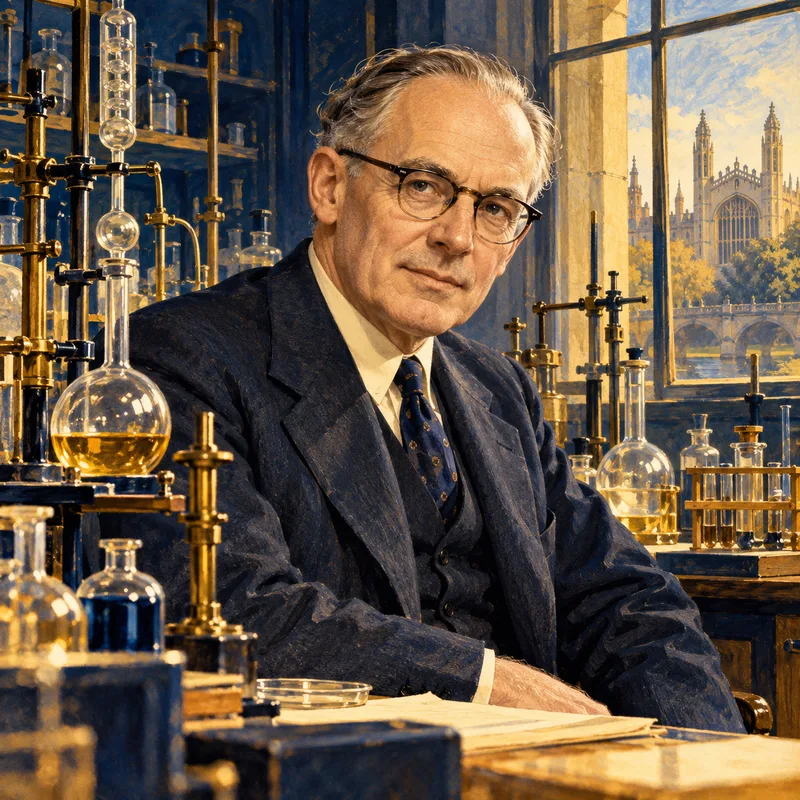
About the chemist
Alexander Todd
1907-1997 · United Kingdom · Nobel Chemistry 1957
Nucleotides and nucleotide coenzymes