Biography · Chemist no. 250 of 350
Alexander William Williamson (1824-1904): The Chemist Who Taught Britain Modern Chemistry
Introduction
Alexander William Williamson was an English chemist who spent most of his career at University College London. He is known for the Williamson ether synthesis and for the idea that chemical reactions in solution are in dynamic equilibrium. He was also a great teacher and an organiser of British chemistry. His legacy in one line: he made ether chemistry clear, and he brought the new continental chemistry to Britain.
Early Life and Family
Williamson was born on 1 May 1824 in Wandsworth, London. His father, Alexander Williamson was a clerk at the East India House. As a child he lost the use of his left arm after an illness, and his eyesight was also poor, so that he had to work with one eye very close to his work. Even with these difficulties, he became a skilled experimenter.
Education and Mentors
Williamson was educated in Britain and on the Continent, and then went to the University of Heidelberg, where he first intended to study medicine, as his family wished. At Heidelberg he met the chemist Leopold Gmelin, who encouraged him to take up chemistry. He then moved to Giessen in 1844 to work with Justus von Liebig, and took his doctorate there in 1845. In Paris from 1846 to 1849 he attended the lectures of Auguste Comte on mathematics and positivist philosophy, and he came in contact with Laurent and Gerhardt. These influences gave him a strong view that chemistry should be based on clear theory.
Career Timeline
| Year | Event |
|---|---|
| 1824 | Born in Wandsworth, London |
| 1844-1845 | Works at Giessen under Liebig; doctorate |
| 1846-1849 | Studies in Paris; attends Comte's lectures |
| 1849 | Appointed professor of analytical and practical chemistry at University College London |
| 1850 | Publishes the ether synthesis |
| 1855 | Becomes Fellow of the Royal Society; succeeds Thomas Graham as professor of chemistry at UCL |
| 1862 | Receives a Royal Medal of the Royal Society |
| 1863-1865 | President of the Chemical Society (and again 1869-1871) |
| 1873 | President of the British Association for the Advancement of Science |
| 1887 | Retires from UCL |
| 1904 | Dies at Hindhead, Surrey, on 6 May |
Major Scientific Contributions
- Ether synthesis (1850): Reaction of an alkoxide with an alkyl halide to give R-O-R', which proved the structure of ethers and supported the water-type view.
- Etherification process: A clear explanation of how a small amount of sulfuric acid can convert a large amount of alcohol to ether through ethyl hydrogen sulfate.
- Dynamic equilibrium: The idea that atoms continually exchange between molecules in a liquid, even when the system looks at rest. This anticipated modern ideas of chemical kinetics and the idea of molecules in constant motion.
- Type theory: He extended Gerhardt's types by showing that polybasic acids and compounds could be understood as built up from more than one water molecule, giving the idea of "condensed types".
- Chemical teaching: He ran a practical laboratory course at UCL, which was among the first in Britain open to ordinary students for training in chemical analysis.
C2H5OK + CH3I -> C2H5-O-CH3 + KI       (mixed ether, 1850)
C2H5OH + H2SO4 <=> C2H5OSO3H + H2O ; C2H5OSO3H + C2H5OH -> (C2H5)2O + H2SO4
Awards, Honours and Nobel Prize
Williamson became a Fellow of the Royal Society in 1855 and received a Royal Medal in 1862. He served twice as president of the Chemical Society, and in 1873 as president of the British Association. He gave the Faraday Lecture of the Chemical Society in 1869. He was alive in 1901, when the first Nobel Prizes were given, but he was not a recipient.
Personality, Struggles and Lesser-Known Facts
- With a paralysed left arm and weak eyesight, he still carried out difficult experiments, and students were struck by how skilfully he handled apparatus with one hand.
- He was known as a friendly man and a generous host to visiting chemists from abroad,.
- He married Emma Catherine Key in 1855.
- He was a strong supporter of atomic theory, and in his 1869 address to the Chemical Society he discussed the case for atoms in a lecture that was widely read.
Legacy and Influence on Modern Chemistry
The Williamson ether synthesis is a standard named reaction. Its SN2 nature was understood after the work of Hughes and Ingold in the 1930s. His idea of dynamic equilibrium influenced later thinking by Clausius on the exchange of ions in electrolytes and the development of kinetic ideas. At UCL he trained a generation of British chemists and contributed to the shift from the old, unsystematic chemistry of the early century to a modern, theory-based science.
Lessons for Students
- A good experiment can settle a long argument. The single mixed ether answered a question many people had debated.
- Physical limitations are not barriers to scientific skill. Williamson worked with one useful arm and poor sight.
- Think about what happens inside a liquid. His idea of continuous exchange showed that equilibrium is dynamic.
- Study theory and practice together. He learned from Liebig's laboratory and Comte's lectures.
Quick Facts Box
- Born: 1 May 1824, Wandsworth, London
- Died: 6 May 1904, Hindhead, Surrey
- Nationality: English (British)
- Field: Organic chemistry
- Famous for: Williamson ether synthesis; dynamic equilibrium
- Nobel Prize: None
FAQ
What is Williamson known for?
For the Williamson ether synthesis of 1850 and for the concept of dynamic equilibrium in chemical reactions.
Where did Williamson work?
At University College London, first as professor of practical chemistry from 1849 and then as professor of chemistry from 1855 until his retirement.
Did Williamson have a physical disability?
Yes. He lost the use of one arm in childhood and had poor eyesight, but he became an expert experimenter.
Did he receive a Nobel Prize?
No. He received a Royal Medal in 1862 and was president of the Chemical Society and the British Association.
Published by ABC Chemistry — IIT-JAM | CSIR-NET | GATE Chemistry Coaching. Visit abcchemistry.com
About the chemist
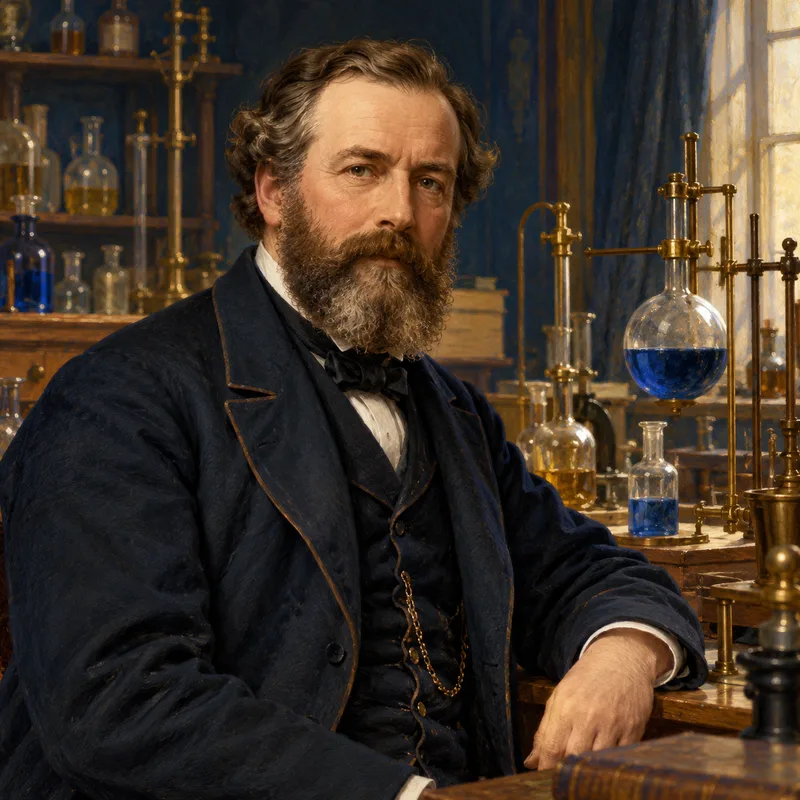
Alexander Williamson
1824-1904 · United Kingdom
Williamson ether synthesis