The discovery, explained · Chemist no. 250 of 350
The Williamson Ether Synthesis: How One Reaction Settled the Structure of Ether
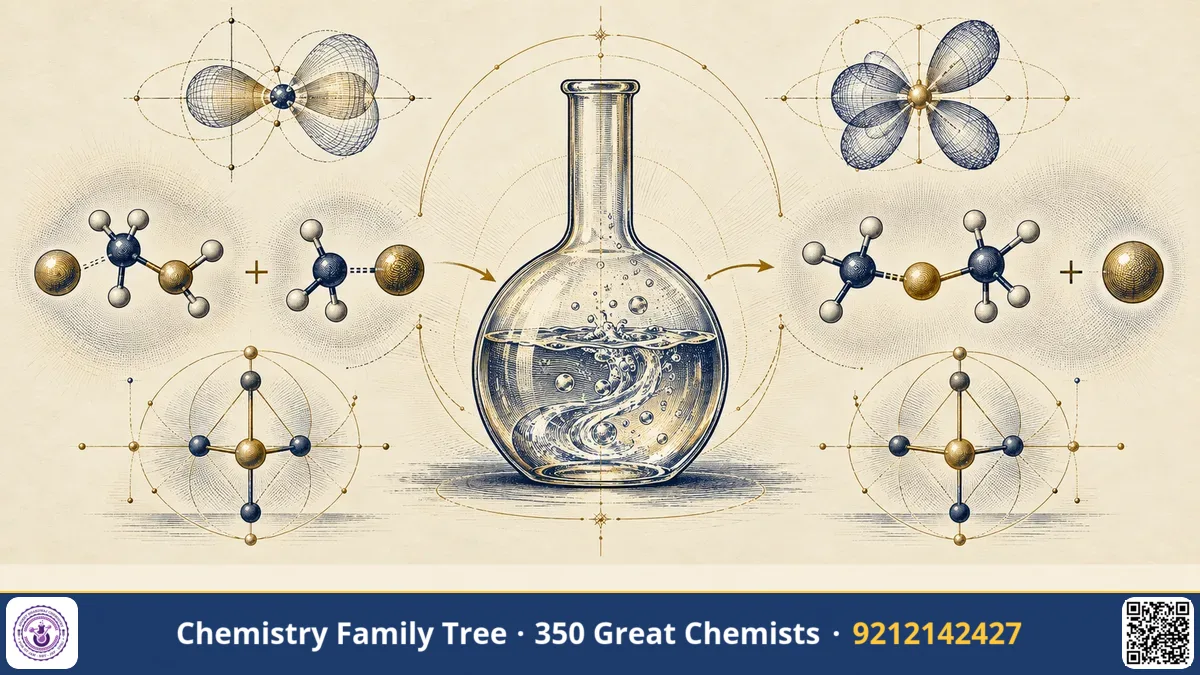
Every student who has studied alcohols and ethers meets the Williamson ether synthesis: an alkoxide ion reacts with an alkyl halide to make an ether. The reaction was described in 1850 by Alexander William Williamson (1824-1904), an English chemist working at University College London. It is still the most common laboratory method for making ethers, but its importance in history was larger. It proved that ether is formed of two alkyl groups joined through oxygen, supported the new water type of Gerhardt and Laurent, and led Williamson to a new idea about chemical equilibrium: that molecules in a solution are constantly exchanging their parts. This post explains the problem, the experiments, the mechanism and the exam points.
The Scientific Problem Before the Discovery
Diethyl ether had been made since the sixteenth century by heating ethanol with sulfuric acid. By 1850, chemists argued over what was happening. Liebig had suggested that sulfuric acid took water away from alcohol: the dehydrating agent view. Others, like Mitscherlich, thought that sulfuric acid acted by "contact" (catalysis) in a way that was not understood. There was also confusion over formulas. With the old atomic weights, ethanol was written as C4H6O2 and ether as C4H5O. The relation between alcohol and ether was not clear. Was ether just alcohol minus water, or something different? Was ether a compound of an "ethyl" radical with oxygen?
There was also the practical puzzle of the continuous process: a small amount of sulfuric acid could convert a large amount of alcohol into ether without being used up. How could it work?
The Discovery / Experiment
The Williamson synthesis (1850)
- Williamson dissolved potassium in absolute alcohol, giving potassium ethoxide, a compound in which the hydrogen of the OH group has been replaced by potassium.
- To this he added ethyl iodide and warmed the mixture.
- Potassium iodide formed as a precipitate, and ordinary diethyl ether was found in the liquid.
2 C2H5OH + 2 K -> 2 C2H5OK + H2
C2H5OK + C2H5I -> C2H5-O-C2H5 + KI
The key experiment was the use of a different alkyl iodide. When Williamson treated potassium ethoxide with methyl iodide, he got a new compound, ethyl methyl ether, with a different boiling point from ordinary ether. When he mixed the two groups the other way (potassium methoxide and ethyl iodide) he obtained the same compound.
C2H5OK + CH3I -> C2H5-O-CH3 + KI
CH3OK + C2H5I -> CH3-O-C2H5 + KI      (same product)
If ether were formed by simply taking water from two alcohols, the product from an ethyl and methyl source should be a mixture. The result of a single mixed ether proved that ether has the structure R-O-R', with the oxygen joining two alkyl groups. Ordinary ether is R-O-R with both groups the same. In the language of his time, ether and alcohol belong to the water type: alcohol is water with one hydrogen replaced by ethyl, and ether is water with both hydrogens replaced.
Water type: H-O-H C2H5-O-H (alcohol) C2H5-O-C2H5 (ether)
Explaining the sulfuric acid process
Williamson then explained the continuous etherification: the acid reacts with alcohol to give ethyl hydrogen sulfate, and this reacts with a second molecule of alcohol to give ether and regenerate the acid. The cycle repeats.
C2H5OH + H2SO4 -> C2H5OSO3H + H2O
C2H5OSO3H + C2H5OH -> C2H5OC2H5 + H2SO4      (about 140 C)
Williamson also drew the conclusion that in a liquid like this, the molecules are not at rest. Atoms are constantly exchanging between molecules, so that even in a mixture at equilibrium, reactions are going on in both directions. This idea of dynamic equilibrium was an important step towards chemical kinetics and equilibrium theory.
The Chemistry Behind It
The Williamson synthesis is a bimolecular nucleophilic substitution (SN2). The alkoxide ion is a strong nucleophile. It attacks the carbon bearing the halogen from the back side, while the halide leaves, in a single step with inversion of configuration at carbon.
RO(-) + R'-X  ->  [RO---R'---X](-) transition state  ->  RO-R' + X(-)
Rate = k [RO-][R'X]
Choice of reagents: The alkyl halide should be primary (or methyl). Secondary halides give a mixture of substitution and elimination, and tertiary halides give almost only alkenes by E2, since the alkoxide is also a strong base.
(CH3)3C-Br + CH3O(-)  ->  (CH3)2C=CH2 + CH3OH + Br(-)   (elimination, not the ether)
To make tert-butyl methyl ether (MTBE): use (CH3)3C-O(-) + CH3I
So, to make an unsymmetrical ether, put the bulkier group on the alkoxide and use the less hindered primary halide. Aryl ethers are made from sodium phenoxide with an alkyl halide, for example anisole from phenoxide and methyl iodide, because aryl halides do not undergo SN2.
C6H5ONa + CH3I -> C6H5OCH3 + NaI (anisole)
Intramolecular version: A halohydrin with base forms an epoxide (3-membered ring) or oxolane (tetrahydrofuran from 4-chlorobutanol). Wurtz's ethylene oxide synthesis is an example of this type.
ClCH2CH2OH + NaOH -> (CH2CH2)O + NaCl + H2O
Polar aprotic solvents (DMF, DMSO) speed up the SN2 reaction because they leave the alkoxide anion unsolvated and more reactive. The use of sodium hydride to form the alkoxide from the alcohol is now common, as is phase-transfer catalysis in industry.
Applications Today
- Pharma and fine chemicals: Making aryl alkyl ethers in drug molecules, for example in the synthesis of some beta-blockers and antifungals.
- Protecting groups: Benzyl and methyl ethers protect alcohols (benzyl bromide with the alkoxide).
- Crown ethers and polymers: Williamson coupling builds crown ethers and polyethers, which bind metal ions.
- Sugars and cellulose derivatives: Carboxymethyl cellulose (CMC), used in food, detergents and paper, is made by a Williamson-type reaction of cellulose alkoxide with chloroacetate.
- Fuels: MTBE and ETBE (made by acid-catalysed addition of alcohol to isobutene, not by Williamson itself) are ethers used as octane boosters in some countries.
Exam Corner
- Williamson synthesis: R-ONa + R'-X gives R-O-R' + NaX; SN2 with inversion; works best with primary alkyl halides.
- Tertiary alkyl halides give alkenes (E2); to make tert-butyl ethers, use the tert-butoxide and a primary halide.
- Sulfuric acid method: ethanol at 140 C gives diethyl ether; at 170 C gives ethene.
- Aryl ethers: phenoxide + alkyl halide; aryl halides do not react by SN2 under these conditions.
- Mixed ether proved the structure R-O-R' and the water type.
Common Misconceptions
- "Any alkyl halide can be used." Tertiary halides give alkenes, so the choice of which partner carries the alkoxide matters.
- "Sulfuric acid is consumed in ether formation." It is regenerated, which is why a small amount is enough in the continuous process.
- "The reaction is SN1." It is SN2, with a strong nucleophile and primary substrates.
Quick Revision Box
- Alexander Williamson (1824-1904), English chemist at UCL.
- 1850: ether synthesis from alkoxide and alkyl halide.
- Mixed ether (ethyl methyl ether) proved R-O-R' structure.
- SN2, best with methyl or primary halides; tertiary gives alkene.
- Also explained continuous etherification and dynamic equilibrium.
- Ethanol + H2SO4: 140 C ether, 170 C ethene.
FAQ
What is the Williamson ether synthesis?
It is the reaction of a metal alkoxide with a primary alkyl halide to form an ether by an SN2 mechanism.
Why did Williamson use a mixed ether?
To show that ether has two alkyl groups joined by oxygen. A single mixed product, ethyl methyl ether, came from either combination of reagents.
Why are tertiary halides not used?
The alkoxide is a strong base and removes a beta hydrogen from the crowded tertiary halide, giving an alkene by E2.
What is dynamic equilibrium in Williamson's view?
It means that atoms and groups are continually being exchanged between molecules in a mixture, so reactions go on in both directions even at equilibrium.
Published by ABC Chemistry — IIT-JAM | CSIR-NET | GATE Chemistry Coaching. Visit abcchemistry.com
About the chemist
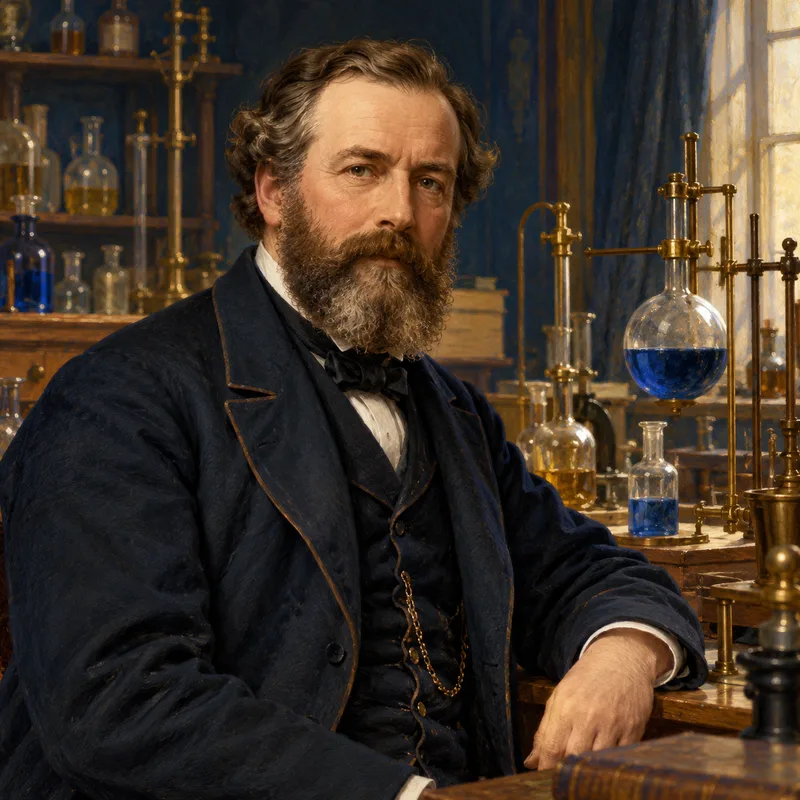
Alexander Williamson
1824-1904 · United Kingdom
Williamson ether synthesis