Biography · Chemist no. 224 of 350
Alexei Ekimov: The Soviet Physicist Who First Saw Quantum Dots in Coloured Glass
Alexei Ivanovich Ekimov, born in 1945 in the Soviet Union, is a physicist who made the first observation of the quantum size effect in semiconductor nanocrystals. He did it in the early 1980s while studying coloured glass at the Vavilov State Optical Institute in Leningrad. In 2023 he shared the Nobel Prize in Chemistry with Louis Brus and Moungi Bawendi. His legacy in one line: he found quantum dots hiding inside glass, long before anyone used that name.
Early Life and Family
Ekimov was born on 22 February 1945 in the Soviet Union, in the final months of World War II. He grew up in the Soviet period, which gave strong emphasis to physics and engineering education. Detailed information about his family is not widely available, so this post sticks to documented facts about his scientific training and career.
Education and Mentors
Ekimov studied physics at Leningrad State University (now Saint Petersburg State University), graduating in 1967. He then pursued a doctorate and built his research career at the Vavilov State Optical Institute in Leningrad. A strong influence on his work was the theoretical physicist Alexander Efros, who developed the theory of quantum confinement in semiconductor nanocrystals and worked with him. Ekimov's research in optics of semiconductors and the physics of excitons gave him the tools to recognise the significance of the colour changes in glass.
Career Timeline
| Year | Event |
|---|---|
| 1945 | Born in the Soviet Union |
| 1967 | Graduates in physics from Leningrad State University |
| 1970s | Researcher at the Vavilov State Optical Institute, Leningrad |
| 1980-1981 | With A. A. Onushchenko, reports quantum size effect in CuCl nanocrystals in glass |
| 1982 | Theory of confinement in semiconductor spheres published by Al. L. Efros and A. L. Efros |
| 1980s-1990s | Studies CdS and CdSe nanocrystals in glass, including optical nonlinearities |
| 1990s | Begins international collaborations; later moves to the United States |
| 2023 | Nobel Prize in Chemistry (shared) |
Major Scientific Contributions
First observation of the quantum size effect (1980-81). By heating glass doped with CuCl, Ekimov grew nanocrystals of different sizes and showed that the smaller ones absorbed light at higher energy. See our discovery post for the details.
Nanocrystals in glass with known sizes. He characterised crystal size with X-ray methods and correlated it with optical spectra, giving a quantitative test of theory.
Study of CdS and CdSe. Ekimov moved to II-VI semiconductor nanocrystals in glass, which show strong confinement and spectra across the visible range. His group studied how excited electrons and holes behave in these dots, including their relaxation and optical nonlinearities.
Spectroscopy of electron states. He and co-workers used optical methods to reveal the discrete electronic states of nanocrystals, effectively showing that dots behave as "artificial atoms".
Later work. After moving to the United States in the 1990s, he worked at Nanocrystals Technology, a company in New York, applying nanocrystal science to practical devices. This was a transition from a state research institute to the private sector.
Awards, Honours and Nobel Prize
Ekimov received the Nobel Prize in Chemistry 2023 with Louis Brus and Moungi Bawendi "for the discovery and synthesis of quantum dots". Other honours are not listed because they could not be verified with certainty. Ekimov is one of very few Nobel chemistry laureates whose major work was done in a Soviet institute.
Personality, Struggles and Lesser-Known Facts
- Working behind the Iron Curtain. His 1981 paper was published in Russian and was difficult to access for Western scientists. It took years before it was widely cited.
- A physicist honoured in chemistry. The Nobel committee recognised quantum dots as a chemistry topic because the work concerns materials and their synthesis. Ekimov trained as a physicist.
- Glass as a laboratory. He turned an industrial product, coloured glass, into a precise research tool. It was a practical choice because glass kept crystals separated and stable.
- Prize news. The 2023 chemistry prize was widely reported before the official announcement because of an early press release, and Ekimov's name was one of the three.
- Theory partner. His collaborator Alexander Efros developed the theoretical framework of quantum confinement; the partnership between theory and experiment was central.
Legacy and Influence on Modern Chemistry
Ekimov's observation proved that material properties can be tuned by size. It started the field of semiconductor nanocrystals. Today quantum dots are in televisions, bioimaging reagents, lasers and solar cell research. The idea of "tuning by size" now extends to nanoplatelets, nanorods, perovskite nanocrystals, and even to quantum information devices. In India, nanoscience is a major research area, and Ekimov's story is a common example in lectures about nanoparticles.
His career also illustrates that the full credit for a discovery may take decades. Ekimov, Brus and Bawendi completed three steps: observation, explanation and controlled synthesis. Only together did they give us usable quantum dots.
Lessons for Students
- Observe small details. A shift in glass colour led to a Nobel Prize.
- Combine craft and theory. Glass making and quantum mechanics worked together.
- Publish and communicate. Language and access barriers delayed recognition; share work widely.
- Be patient. Credit came more than forty years later.
- Work in teams. Experiment partnered with theory in his case.
Quick Facts Box
- Born: 22 February 1945, Soviet Union
- Died: Living
- Nationality: Russian-born; later worked in the United States
- Field: Solid-state physics, nanocrystal optics
- Famous for: First observation of the quantum size effect in nanocrystals (CuCl in glass), 1981
- Nobel: Chemistry 2023, shared with Brus and Bawendi
FAQ
Where did Ekimov do his discovery?
At the Vavilov State Optical Institute in Leningrad, in the Soviet Union.
What material did he study first?
Copper(I) chloride (CuCl) nanocrystals in silicate glass.
What is the difference between Ekimov and Brus?
Ekimov grew nanocrystals inside solid glass; Brus studied nanocrystals in liquid solution. Both observed size-dependent optical properties.
Is he a chemist?
He is a physicist by training, but the Nobel Prize in Chemistry recognised his contribution to materials and nanochemistry.
Published by ABC Chemistry — IIT-JAM | CSIR-NET | GATE Chemistry Coaching. Visit abcchemistry.com
About the chemist
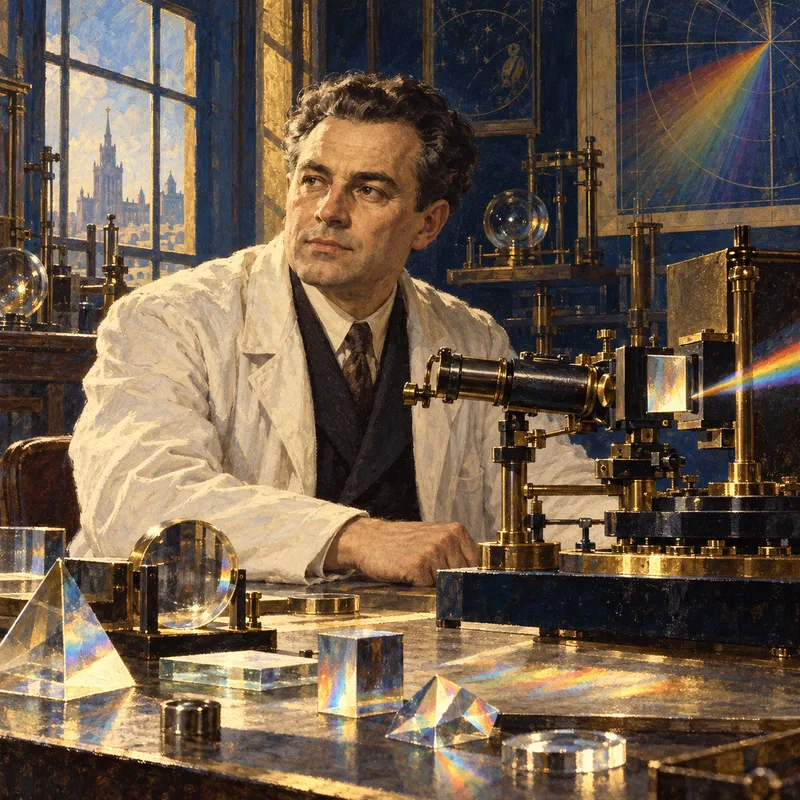
Alexei Ekimov
1945- · Russia · Nobel Chemistry 2023
Discovery of quantum dots in glass