The discovery, explained · Chemist no. 224 of 350
Quantum Dots in Glass: How Alexei Ekimov First Saw the Quantum Size Effect
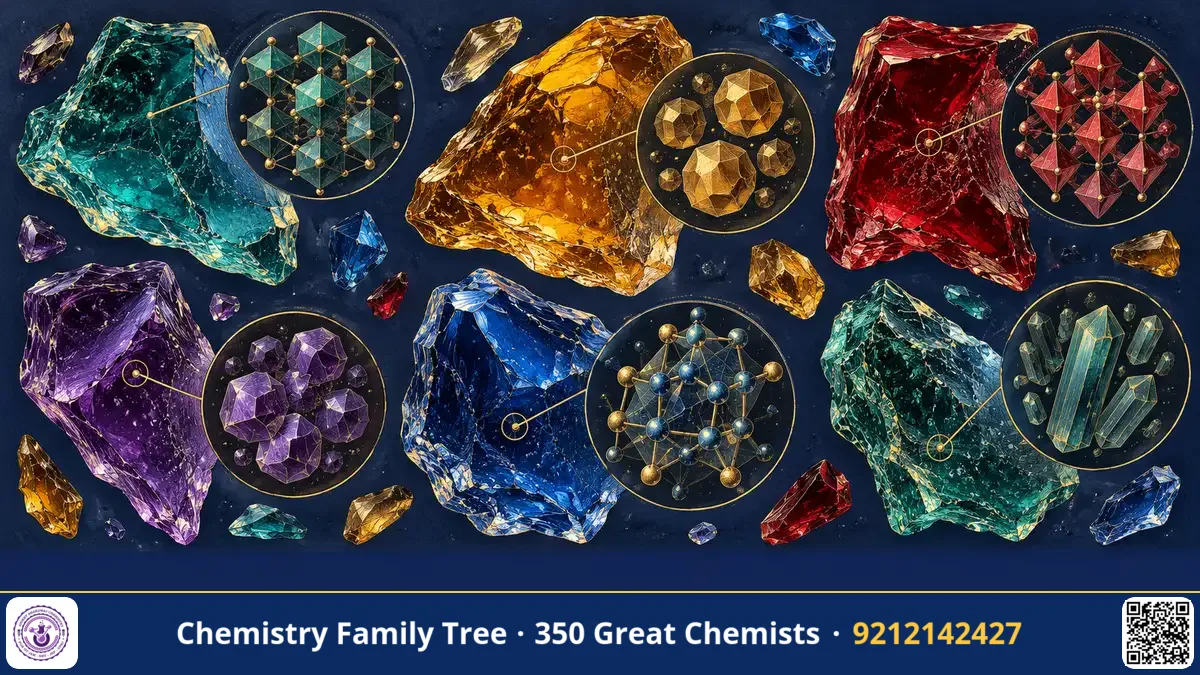
Coloured glass has been made for thousands of years. Medieval cathedral windows glow red with gold colloids and yellow with silver. But in the late 1970s, Alexei Ekimov, a physicist working at the Vavilov State Optical Institute in Leningrad (now Saint Petersburg), asked a modern question: why does the colour of some glass filters change when the glass is heated for different times? The answer was that tiny semiconductor crystals grow inside the glass, and their size decides which colours of light they absorb. In 1981 Ekimov and his colleague Alexei Onushchenko published what is now recognised as the first observation of the quantum size effect in semiconductor nanocrystals, that is, of quantum dots. In 2023 Ekimov shared the Nobel Prize in Chemistry with Louis Brus and Moungi Bawendi.
This post explains the experiment, the chemistry of growing crystals inside glass, and the science behind the colours.
The Scientific Problem Before the Discovery
Colour glass filters were used in optics and industry. Many of them were made by adding semiconductor compounds, such as cadmium sulfide selenide (CdS-CdSe) or copper halides, to a molten glass. The glass is cooled and often reheated ("annealed" or heat treated) to develop the colour. The resulting colour had practical value, but its origin was only partly understood. Glass makers knew empirically that longer or hotter heat treatments changed the shade.
At the same time, theoretical physicists such as Alexander Efros had predicted that when a semiconductor crystal is smaller than the natural size of an electron-hole pair, its energy levels should shift. This was the quantum size effect. But no one had cleanly shown it in a sample with known crystal size. Without both a clear theory and a clean experiment, the idea remained speculative.
The Discovery / Experiment
Ekimov's approach was practical and careful. He used silicate glass containing copper and chlorine and treated it in a controlled way to make copper(I) chloride (CuCl) nanocrystals. The steps were:
- Prepare a glass melt containing the elements of the semiconductor (Cu and Cl) dissolved in the silicate network.
- Cool it to form a clear, supersaturated glass.
- Heat the glass at a chosen temperature for a chosen time. Ions diffuse through the glass and nucleate and grow nanocrystals of CuCl.
- Use X-ray diffraction and small-angle X-ray scattering to determine the size and crystal structure of the nanocrystals. Samples ranged from only a few nanometres in radius to much larger crystals.
- Record the optical absorption spectra at low temperatures for samples with different crystal sizes.
What Ekimov and Onushchenko saw was striking. In large crystals the sharp absorption peak from the exciton (the electron-hole pair) was at the same energy as in bulk CuCl. But as the crystals became smaller, the absorption peak moved to higher energy (a blue shift). The smaller the crystals, the larger the shift. The effect was systematic, matched theoretical predictions by Efros and Efros, and showed that the shift was due to the confinement of the exciton in a tiny box and not to a chemical change.
Glass with Cu+ and Cl- → heat → CuCl nanocrystals (size grows with time/temperature)
Smaller crystal → larger band gap → absorption at shorter wavelength
The paper was published in the Soviet journal JETP Letters in 1981 (the work was reported in 1980 as well). It was in Russian and appeared during the Cold War, so it took years to become known outside the Soviet Union. When Louis Brus reported similar behaviour in colloidal solution a few years later, he had no knowledge of Ekimov's work.
The Chemistry Behind It
Nucleation and growth in glass. The glass is a viscous liquid that is cooled so that the semiconductor components are trapped in a supersaturated state. On heating, ions can diffuse, and crystals form by nucleation and then grow. Larger crystals grow at the cost of smaller ones at long times (Ostwald ripening, or Lifshitz-Slyozov coarsening). The glass matrix prevents the crystals from clumping and protects them from air and moisture.
Quantum confinement. If the radius R of the crystal is smaller than the exciton Bohr radius, the exciton is squeezed. The confinement energy of the carriers rises approximately as 1/R². Therefore, the exciton energy increases when the crystal is smaller. The relationship (in simplified form):
E(R) ≈ E(bulk exciton) + ħ²π² / (2μR²) μ = reduced mass of the electron-hole pair
For CuCl the exciton Bohr radius is very small (about 0.7 nm), so strong confinement needs very tiny crystals. Ekimov observed the weak-confinement regime, where the exciton as a whole is confined as a particle with a translational mass, which gives a blue shift that depends on size as 1/R².
| Regime | Condition | What is confined |
|---|---|---|
| Weak confinement | R slightly larger than the exciton Bohr radius | Centre of mass motion of exciton |
| Strong confinement | R smaller than the exciton Bohr radius | Electron and hole separately |
Ekimov later used CdSe and CdS nanocrystals in glass, where strong confinement could be reached and the optical properties shifted across the visible range.
Applications Today
- Optical filters. Glass doped with semiconductor nanocrystals gives sharp-cut colour filters used in photography, laboratories and industry.
- Nonlinear optics. Nanocrystals in glass have large optical nonlinearities and were studied for optical switching and fast photonic devices.
- Display and lighting technology. The principle of size-tuned colour led to quantum dot colour conversion layers.
- Research tool. Glass-embedded dots were an early test bed for studying electrons in confined systems, a stepping stone to modern quantum technology.
- Education. The story shows an ancient craft, glassmaking, meeting modern quantum physics. Students can study the same effect by looking at vials of CdSe dots under UV light.
Exam Corner
- Quantum size effect: band gap increases as the nanocrystal radius decreases below the exciton Bohr radius.
- Ekimov (1981, CuCl in glass) was the first to observe quantum confinement in semiconductor nanocrystals.
- Exciton Bohr radius: a_B = 4πε0 ε ħ² / (μ e²).
- Ostwald ripening: larger particles grow at the expense of smaller ones.
- 2023 Nobel Prize in Chemistry: Ekimov, Brus, Bawendi.
Common Misconceptions
- "Quantum dots were invented in 2000s." They were first observed in 1980-81.
- "Glass colour is only due to pigments." In these glasses, colour is determined by nanocrystal size, not just by composition.
- "Ekimov was a chemist by training." He is a physicist; chemistry's Nobel recognises the material and its synthesis.
Quick Revision Box
- Early 1980s: Ekimov and Onushchenko at the Vavilov State Optical Institute.
- System: CuCl nanocrystals grown in silicate glass by heat treatment.
- Observation: smaller crystals absorb at higher energy (blue shift).
- Explanation: quantum size effect (confinement of the exciton).
- Published in Russian in 1981, before Brus's solution work.
- Nobel Prize in Chemistry 2023 (shared).
FAQ
Why did the Western world not know about Ekimov's work?
It was published in Soviet journals in Russian during the Cold War, and so it received less attention abroad until later translations and reviews.
How are crystals made in glass?
By heating glass containing dissolved semiconductor elements, which diffuse and crystallise inside the glass matrix.
What is a blue shift?
It is a shift of absorption or emission to higher energy, shorter wavelength.
Is a quantum dot always a crystal?
Typically it is a semiconductor nanocrystal, but similar quantum effects are observed in other nanoscale systems, such as carbon dots.
Published by ABC Chemistry — IIT-JAM | CSIR-NET | GATE Chemistry Coaching. Visit abcchemistry.com
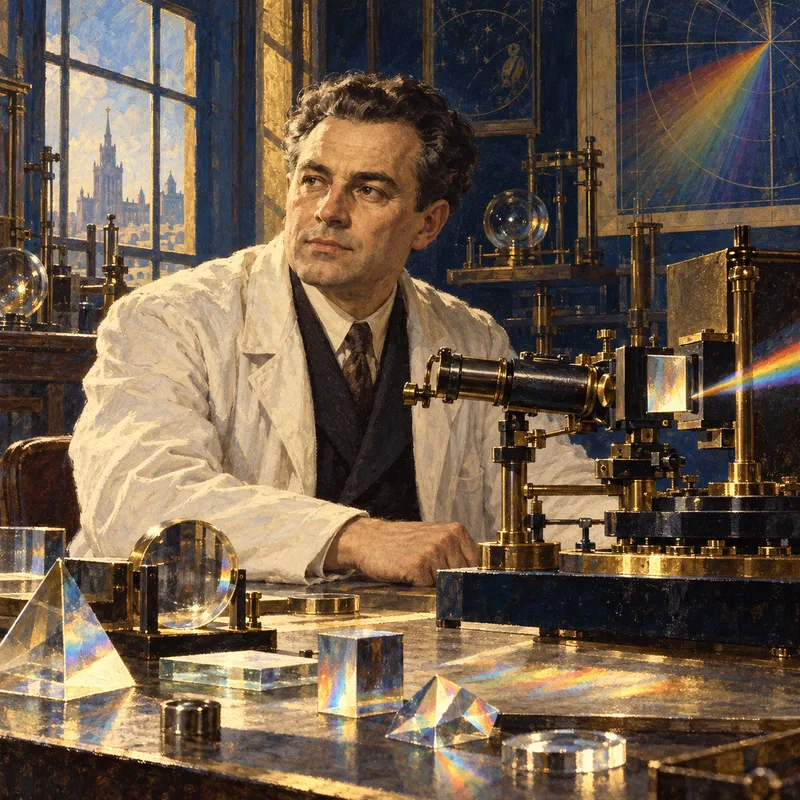
About the chemist
Alexei Ekimov
1945- · Russia · Nobel Chemistry 2023
Discovery of quantum dots in glass